Table of Contents
ToggleHow to Treat Your Spouse According to the Quran
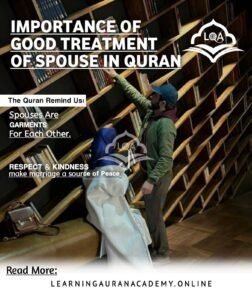
Marriage in Islam is more than a legal relationship between a husband and wife. The Quran presents marriage as a relationship in which spouses can find tranquility, affection, mercy, and companionship. The good treatment of spouse in Quran is rooted in these values, encouraging both husband and wife to treat one another with kindness, respect, and compassion.
Allah describes marriage as one of His signs and explains that He placed affection and mercy between spouses. (Quran 30:21)
The Quran also gives practical guidance about how spouses should treat one another, especially through kindness, fairness, responsibility, patience, and reconciliation. These teachings are further explained through the Sunnah of Prophet Muhammad ﷺ, whose conduct with his family provides a practical example of good character within marriage.
So, what does the Quran say about treating your spouse?
The central principle is simple: marriage should be built upon kindness, mercy, dignity, responsibility, and obedience to Allah—not cruelty, selfishness, humiliation, or injustice.
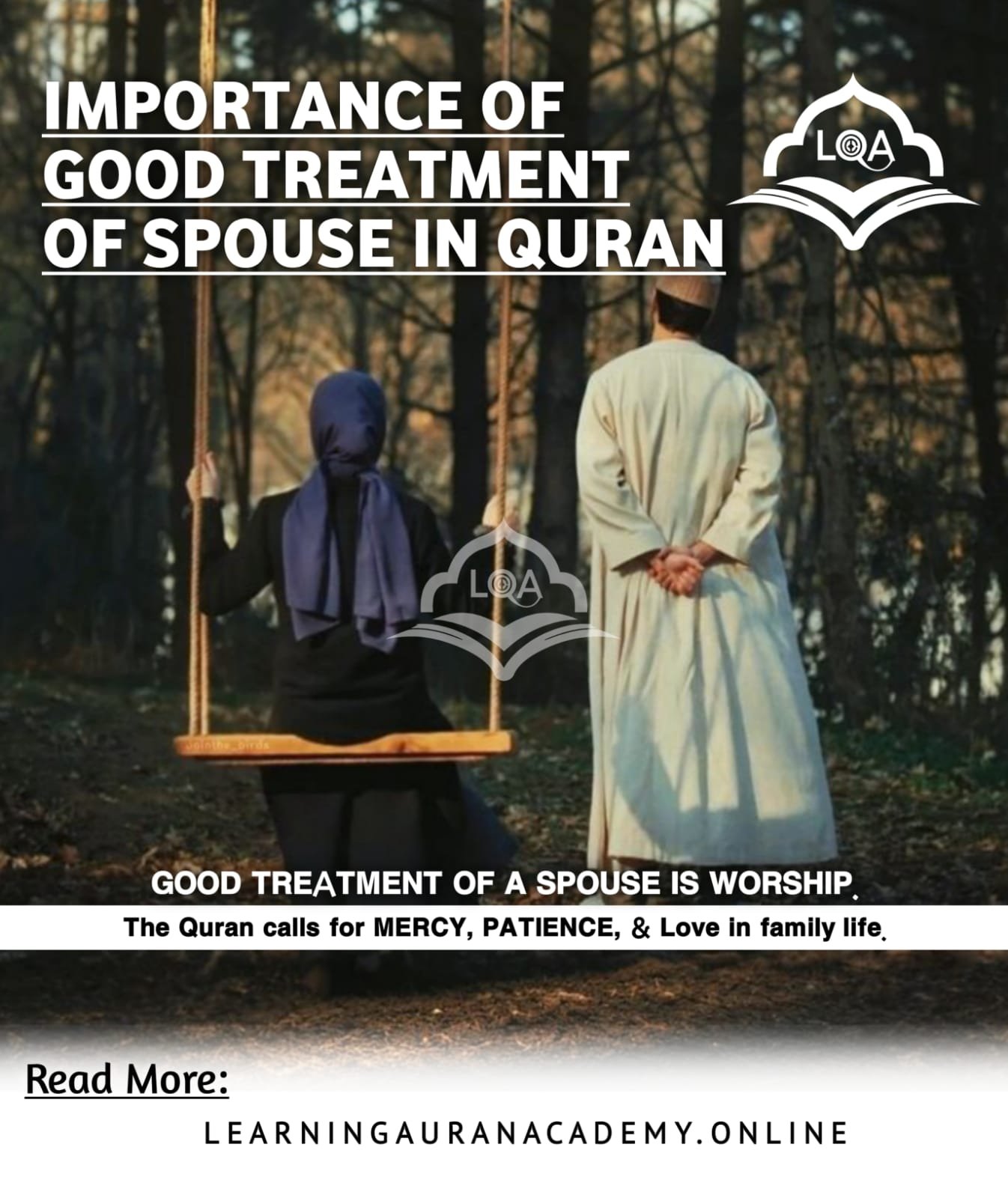
What Does the Quran Say About Good Treatment of Your Spouse in Islam?
One of the clearest Quranic commands concerning the treatment of a wife appears in Surah An-Nisa:
“And live with them in kindness.”
Quran 4:19
This verse directly addresses husbands and establishes an important principle: a wife should be treated with ma’ruf—what is recognized as fair, decent, honorable, and kind.
Good treatment is therefore not merely about providing material needs. It includes the way a husband speaks to his wife, respects her dignity, deals with disagreements, recognizes her efforts, and behaves toward her during difficult moments.
The Quranic approach also teaches that marriage cannot be reduced to personal demands. Both spouses have responsibilities before Allah, and their behavior toward one another is part of their moral and religious accountability.
The Prophet Muhammad ﷺ reinforced this principle when he said:
“The most complete of the believers in faith is the one with the best character among them. And the best of you are those who are best to their women.”
This shows that good character inside the home is not separate from faith. The way a person treats his family is an important reflection of his character.
Quran 30:21: Love, Mercy, and Tranquility in Marriage
One of the most important Quranic verses about marriage is Surah Ar-Rum 30:21.
Allah says that He created spouses so that people may find tranquility in them and that He placed affection and mercy between them.
Three important concepts appear in this verse:
1. Tranquility
Marriage is described as a source of comfort and tranquility. A healthy marriage should provide emotional security and companionship rather than constant fear, humiliation, or hostility.
This does not mean that a Muslim marriage will never experience disagreement. Every human relationship can have difficulties. Rather, it means that the overall relationship should be directed toward peace, stability, and mutual care.
2. Affection
Allah mentions mawaddah, commonly translated as affection or love.
Affection should be visible in everyday behavior. It can appear through kind words, appreciation, thoughtful actions, spending meaningful time together, and showing consideration for one’s spouse.
3. Mercy
Allah also mentions rahmah, or mercy.
Mercy becomes especially important when spouses make mistakes, become tired, face financial difficulties, experience illness, or disagree about something.
Love can sometimes be affected by circumstances, but mercy encourages a person to continue treating the other with dignity even during difficult periods.
How Should a Husband Treat His Wife According to Islam?
The Quran specifically commands husbands to live with their wives in kindness. This principle should influence both major responsibilities and everyday behavior.
A husband should strive to:
- Speak to his wife respectfully.
- Provide her lawful rights and financial maintenance according to Islamic principles.
- Protect her dignity.
- Avoid humiliating or insulting her.
- Appreciate her efforts.
- Be patient when difficulties arise.
- Consult and communicate rather than making every issue a source of conflict.
- Avoid ظلم, oppression, and deliberate harm.
- Treat disagreements with fairness.
- Remember that he is accountable to Allah for how he treats his family.
The Prophet ﷺ connected good character with good treatment of women. This means that religious character should not appear only in the mosque or in public. It should also be visible inside the home.
A person may speak politely to strangers, but true character is also tested by how he behaves with the people closest to him.
How Should a Wife Treat Her Husband in Islam?
Islamic marriage also involves responsibilities on the part of the wife. A wife should strive to treat her husband with respect, honesty, cooperation in what is lawful, and consideration.
She should:
- Speak respectfully.
- Protect the privacy and dignity of the marriage.
- Cooperate in lawful matters.
- Appreciate her husband’s legitimate efforts.
- Avoid unnecessary humiliation or insults.
- Communicate problems honestly.
- Help create a peaceful home environment.
- Support righteousness and good deeds.
- Deal with disagreements without deliberately causing harm.
These responsibilities should not be understood as permission for either spouse to demand obedience in matters that are sinful or unjust. Both husband and wife remain servants of Allah, and obedience to Allah takes priority.
The purpose of discussing marital responsibilities is therefore not to create a competition over who has more rights. It is to help each spouse understand what Allah expects from them.
Husband and Wife Have Responsibilities Toward One Another
The Sunnah describes family responsibility in terms of accountability.
The Prophet ﷺ said:
“All of you are guardians and responsible for your wards and the things under your care.”
He then explained that a man is responsible for his family and that a woman is responsible for her husband’s household.
Sahih al-Bukhari 893
This hadith provides an important principle: responsibility comes with accountability.
Marriage should therefore not be understood simply as:
“What can my spouse do for me?”
A better question is:
“What does Allah expect me to do for my spouse?”
This change in perspective can transform the way couples approach marriage.
Instead of constantly counting mistakes, each spouse can focus on fulfilling their own responsibilities sincerely.
What Are the Main Principles of Good Treatment Between Spouses?
The Quranic and Prophetic teachings about marriage can be summarized through several important principles.
Kindness
Kindness should be present in speech, behavior, financial dealings, and conflict.
A spouse should not use harsh words simply because an argument has started.
Mercy
Marriage requires overlooking some mistakes and responding with compassion when the other person is struggling.
Respect
Respect means recognizing the dignity of your spouse even when you disagree.
Disagreement does not give either spouse permission to insult, expose private matters, or deliberately humiliate the other.
Justice
A spouse should not allow anger, favoritism, or personal resentment to make them unjust.
Patience
Marriage requires patience because two people have different personalities, habits, expectations, and emotional needs.
Responsibility
Both spouses should take their responsibilities seriously rather than expecting the other person to carry everything.
Privacy
Marital problems should not automatically become public conversations. Sensitive matters should be handled wisely and with concern for the dignity of both spouses.
What Does the Quran Say About Serious Marital Conflict?
The Quran recognizes that serious disagreements can occur between husband and wife. It does not simply pretend that every marriage will always be peaceful.
Instead, the Quran provides a framework for reconciliation.
Allah says in Surah An-Nisa 4:35 that when serious dissension is feared between husband and wife, an arbitrator can be appointed from his family and another from hers. If both sides genuinely seek reconciliation, Allah can bring about reconciliation between them.
This verse shows that Islam provides a structured approach to serious marital conflict.
The goal should not be to “win” an argument.
The goal should be islah—reconciliation and correction of the relationship.
When problems become serious, couples should consider:
- Calmly identifying the actual problem.
- Avoiding insults and personal attacks.
- Giving each spouse an opportunity to explain their concerns.
- Seeking sincere reconciliation.
- Taking advice from trustworthy and qualified people when necessary.
- In serious cases, involving appropriate family representatives or qualified scholars according to Islamic guidance.
- Taking safety concerns seriously if there is abuse, violence, or genuine danger.
Islamic guidance should never be used as an excuse to justify abuse or deliberate harm.
How Did Prophet Muhammad ﷺ Treat His Wives?
The Prophet Muhammad ﷺ provides the most important practical example of Islamic character.
His guidance teaches Muslims that good character is not limited to public behavior. It should also appear in family life.
The Prophet ﷺ encouraged good treatment of women and connected excellence in faith with good character. He also demonstrated affection, consideration, patience, and kindness toward his family.
Studying the Sunnah is therefore essential for anyone who wants to understand how Quranic principles can be applied practically within marriage.
The Quran provides foundational guidance, while the Sunnah shows Muslims how prophetic character can be lived in everyday relationships.

What Should Husband and Wife Avoid in Marriage?
Good treatment is not only about knowing what to do. Couples should also understand what can damage a marriage.
Avoid constant criticism
Repeatedly focusing on your spouse’s mistakes can create resentment and emotional distance.
Avoid humiliation
Arguments should never become an excuse to destroy the other person’s dignity.
Avoid exposing private matters
Personal marital problems should be handled responsibly rather than turned into public entertainment or gossip.
Avoid uncontrolled anger
Anger can make people say things they later regret. A disagreement should not become a justification for harmful behavior.
Avoid keeping score
Marriage should not become a competition in which each spouse keeps a list of the other’s mistakes.
Avoid neglecting spiritual life
A marriage becomes stronger when both spouses encourage one another toward prayer, Quran, dua, good character, and obedience to Allah.
How Can Couples Practice Quranic Marriage Principles Every Day?
Islamic marriage principles become meaningful when they are practiced through everyday actions.
Here are some practical habits couples can develop:
Speak kindly
Choose respectful words even when discussing a difficult subject.
Express appreciation
Do not assume that your spouse already knows that you appreciate them. Say it.
Listen before responding
Sometimes a spouse needs to be heard before a solution can be discussed.
Make time for one another
A strong marriage requires attention. Constantly being busy can gradually create emotional distance.
Pray for one another
Make dua for your spouse, your children, and your household.
Study the Quran together
Even a small amount of regular Quran learning can strengthen the spiritual environment of a home.
Forgive reasonable mistakes
Not every mistake needs to become a permanent part of the marriage’s history.
Discuss problems privately
Sensitive disagreements should generally be handled with wisdom and discretion.
Encourage righteousness
Husband and wife should help one another become better Muslims rather than pulling each other away from obedience to Allah.
How Does a Good Marriage Affect Children?
The relationship between parents can have a powerful influence on the environment in which children grow.
The Quran commands believers to protect themselves and their families from the Fire. (Quran 66:6)
Although this verse is broader than marriage alone, it establishes an important principle of family responsibility and spiritual upbringing.
Children learn not only from what parents tell them but also from what they observe.
When children regularly see:
- respectful communication,
- patience,
- prayer,
- forgiveness,
- honesty,
- cooperation,
- and good manners,
they receive practical examples of Islamic character.
For this reason, treating one’s spouse well can contribute to creating a healthier Islamic environment for the entire family.
Marriage in Islam Is a Responsibility Before Allah
One of the most important changes a Muslim can make is to stop viewing marriage only through the question of personal rights.
A husband may ask:
“What are my wife’s responsibilities?”
A wife may ask:
“What are my husband’s responsibilities?”
These questions can be useful, but an even more important question is:
“What responsibilities has Allah given me?”
This mindset encourages personal accountability.
Instead of waiting for your spouse to become perfect, work on fulfilling your own responsibilities with sincerity.
Instead of asking only whether your spouse deserves kindness, remember that you are responsible before Allah for your own behavior.
This is where Islamic marriage becomes more than a social relationship. It becomes part of a Muslim’s worship and character.
Key Quran Verses About Marriage and Spouses
Several Quranic passages are especially useful when studying marriage and the treatment of spouses:
Quran 4:19
This verse directly instructs husbands to live with their wives in kindness.
Quran 30:21
This verse describes marriage through tranquility, affection, and mercy.
Quran 4:35
This verse provides guidance regarding reconciliation when serious conflict develops between husband and wife.
Quran 66:6
This verse teaches believers about responsibility toward their families and their spiritual protection.
These verses should be studied with their surrounding context and with reliable Tafsir rather than being treated as isolated quotations.
Key Takeaways
Good treatment of a spouse in Islam is built upon several core principles:
- Marriage should be approached with kindness and mercy.
- Quran 4:19 directly commands husbands to live with their wives in kindness.
- Quran 30:21 describes marriage through tranquility, affection, and mercy.
- Both husband and wife have responsibilities within the marriage.
- Good character should be visible inside the home.
- Serious marital conflict should be approached with a sincere desire for reconciliation.
- The Sunnah of Prophet Muhammad ﷺ provides practical guidance for family life.
- Neither spouse should use Islamic teachings as an excuse for ظلم, humiliation, or deliberate harm.
- Parents should create a home environment where children can observe Islamic character.
- Each spouse should focus first on fulfilling their own responsibilities before demanding perfection from the other.