Table of Contents
ToggleWhat We Learn from the Quran: Guidance for Life and Faith!
What we learn from the Quran is guidance for every aspect of life. We learn many important things from the Quran, and it is difficult to mention all of them.
However, the most important lesson we learn from the Quran is Tawheed, the belief in the oneness of Allah.
The Quran teaches us to worship only one God and to have complete faith in Him. This belief strengthens our relationship with Allah and guides our actions, character, and way of living according to His commands.
Another important lesson we learn from the Quran is to maintain good relationships with our brothers and relatives.
The Quran strongly emphasizes silah-rahmi and encourages kindness, love, and care for others. It also places great importance on personal character, teaching us honesty, patience, humility, and good manners.
Furthermore, we learn from the Quran strong moral and ethical values. In simple words, it teaches us how to make our worldly life better and how to serve humanity. By following these teachings, we can improve our lives and achieve success in both this world and the Hereafter.
What We Learn from the Quran is that all praise belongs to Allah alone
When I first started reflecting on the Quran, the lesson of al-Fatihah struck me deeply, especially the opening ayah that begins with In the Name of Allah—Most Compassionate, Most Merciful.
It reminds us that the only one who is truly capable of receiving all praise is Allah, and that human nature often makes us pride ourselves when we succeed, showing the world how famous, rich, successful, or beautiful we are.
But this ayah clearly teaches that Allah is the only one to be praised, and whatever we get is a blessing from the Almighty.
When I started applying this in my own life, I noticed how quickly gratitude replaced arrogance, and how every achievement felt like a reminder that I was capable of achieving great things only through His favors.
This realization helped me understand what we truly learned from the Quran: that when we achieve something great in life, we should not become proud of ourselves, but instead remain thankful for the blessing of Allah.
The moment we recognize that success is not solely our doing, our attitude changes—we stay humble, and we continue to say thanks for every opportunity and every achievement, knowing that the favors we receive are a sign of His mercy and guidance.
Keep your blessings hidden
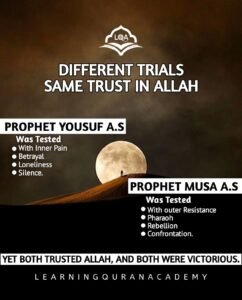
In the same spirit of alhamdulillah and recognizing Allah as the Lord, Surah Yusuf gives us a powerful reminder about keeping your blessings private:
when Hazrat Yaqub (AS) told Hazrat Yusuf (A.S), “my dear son”, not to relate his vision to his brothers, it was not just a story—it was a guide for our age of social media where anyone in any corner of the world can see our whole life, from good grades to promotion, marriage, or any good thing we achieve.
The ayah (Yusuf 12:5) warns that if we share our news too openly, others may devise a plot out of jealousy, because Satan, the sworn enemy of humankind, can use envy to cause harm,
so we learn to wait, stay cautious, and keep our achievements private to protect ourselves from enemies who are secretly jealous and may try to harm us, just like the good dream of stars, sun, and moon prostrating was meant to be cherished, not broadcasted.
Allah's plans are incredible you won't understand
فَانْطَلَقَا حَتَّىٰ إِذَا رَكِبَا فِي الْفُلْكِ خَرَقَهَا ۖ قَالَ أَخَرَقْتَهَا لِتُغْرِقَ أَهْلَهَا ۖ لَقَدْ جِئْتَ شَيْئًا إِمْرًا
“So they set out, until when they embarked on the ship, he (Khidr) tore it open. Moses said, ‘Have you torn it open to drown its people? You have certainly done a grave thing.’”
In Surah Kahf, Allah teaches a lesson through the story of Hazrat Mosa (AS), who accompanied a man on a journey, only to see him build a hole in the boat—a moment that tested patience and made Hazrat Mosa protested.
When they were parting ways, the man explained the reasons behind the incident, revealing that he had damaged the ship because a tyrant king had grabbed ships, so he defaulted the ship to keep away from that threat.
This story reminds us that we never know Allah’s plan behind different incidents; sometimes things hurt us and we question why they happened, but the lesson is to stay patient, trust, and believe that Allah has planned something great for us—even if we don’t understand it in the moment.
Nothing Is Impossible For Your Lord
كَذَٰلِكَ يَقُولُ رَبُّكَ هَٰذَا ضِدٌّ مُّبِينٌ
“Thus does your Lord make clear the truth by His words to His servant [O Muhammad].”
In Surah Maryam, a beautiful surah full of lessons, Allah reminds us about Toheed and His unlimited ability, showing that what seems impossible to us is effortless for Him; I remember feeling stuck in a situation where I kept asking dua and a sudden thought popped into my mind—how can I ever get this thing?
but Surah Maryam teaches that nothing is impossible for Allah Almighty, as illustrated by Hazrat Zakariyyah (AS) who prayed for offspring despite being old, and his wife being old too, yet with complete belief his answered prayers proved that Allah can do anything, so we learn to keep firm belief and ask Him whatever we wish without doubt.
Privacy in our Home
يَا أَيُّهَا الَّذِينَ آمَنُوا لَا تَدْخُلُوا بُيُوتًا غَيْرَ بُيُوتِكُمْ حَتَّىٰ تَسْتَأْنِسُوا وَتُسَلِّمُوا عَلَىٰ أَهْلِهَا ۚ ذَٰلِكُمْ خَيْرٌ لَّكُمْ لَعَلَّكُمْ تَذَكَّرُونَ
“O you who have believed, do not enter houses other than your own until you have asked permission and greeted their inhabitants. That is best for you; perhaps you will be reminded.”
In Surah Noor, this ayah teaches believers a simple but powerful rule about privacy: never enter a house other than your own without asked permission, and always greet the occupants first,
because Allah has mentioned that this is the best for you and helps you stay mindful; I have seen how this guidance protects relationships when we go to someone’s house, we should first send Salam,
showing respect and ensuring we don’t violate the privacy of others’ homes, because entering without consent can cause discomfort, misunderstandings, and even harm, while this practice builds trust and sincerity in our interactions.
Choose Your Friends Wisely
قَالَ يَا لَيْتَنِي اتَّخَذْتُ مَعَ الرَّسُولِ سَبِيلًا
“He will say, ‘Oh, I wish I had taken with the Messenger a way.’”
In Surah Furqan, Allah referred to a powerful warning in Furqan 25:28, where the ayah begins with “Woe” and the regretful phrase “wish I had never taken”
a close friend, reminding us that our friends have a strong effect on us because we spend time with them and their habits, attitudes, and manners gradually influence our personality; from personal experience,
I’ve seen how a single toxic friendship can change the way you think, act, and even speak, so this ayah warns us to avoid bad company and instead choose good Saleh company,
otherwise we may unknowingly adopt habits that lead to regret one day, proving that friendship is not just emotional but a spiritual decision.
Wrong Doers Can’t Escape From Allah
أَمْ حَسِبَ الَّذِينَۡ أَسَـٰوٓا أَن يَتَّخِذُوا۟ عِندَنَآ أَن يَفْلِتُوا۟ ۚ سَيَحْلِبُهُمُ ٱللَّهُ ۖ وَمَا هُم مِّنْهُۥ بِمُعْجِزِينَ
“Or do those who do evil think that they can outrun Us? Evil is what they judge.”
In Surah Ankaboot, Allah delivers a profound message through Ankaboot 29:4, where the ayah questions whether evildoers think they can escape Us, calling it a wrong judgment and reminding us that the people of Quraish,
as enemies of Islam, tortured those who accepted Islam, yet still thought they could avoid Allah’s grip; from my own observation, people often believe they can hide their sins,
but this warning makes it clear that nobody can get away, and it also comforts the oppressed, showing that those who wronged others can’t run from Allah and will face the punishment they deserve, reinforcing the idea that justice is inevitable.
Always Speak With Justice
وَإِذَا قُلْتُمْ فَاعْدِلُوا وَلَوْ كَانَ ذَا قُرْبَىٰ
“And when you speak, be just, even if it concerns a near relative.”
In Surah Al-Inaam, Allah gives a clear practical lesson in Al-Inaam 6:152, warning against the common practice of lying in our society, whether it’s telling your boss you have an emergency to skip work,
or getting caught in a situation and trying to transform it in your favor; this particular ayah reminds us that Allah has commanded us to be truthful and speak truth,
even if it involves near ones or loved ones, because we are not allowed to lie for family whether mothers trying to save children from punishment or friends lying for each other—so the lesson we learn is to uphold justice and honesty even when it’s difficult.
The Power of Small Acts
فَمَن يَعْمَلْ مِثْقَالَ ذَرَّةٍ خَيْرًا يَرَهُۥ
وَمَن يَعْمَلْ مِثْقَالَ ذَرَّةٍ شَرًّا يَرَهُۥ
“So whoever does an atom’s weight of good will see it,
And whoever does an atom’s weight of evil will see it.”
In Surah Az-Zalzalah, Allah teaches through Az-Zalzalah 99:7-8 that even an atom’s weight of good or evil will see it, which completely changed my understanding of how small deeds can make a big impact;
we often think a little effect doesn’t matter, but the Quran teaches that little actions truly matter,
because even removing a stone from the road or helping an old lady carry heavy weight will not go in vain and you will be rewarded for every tiny thing in your life,
while doing bad thinking it has no consequences is mistaken, as everything is noted and we will face consequences for our deeds.
Don’t Spreading False Rumors
يَا أَيُّهَا الَّذِينَ آمَنُوا اجْتَنِبُوا كَثِيرًا مِّنَ الظَّنِّ ۖ إِنَّ بَعْضَ الظَّنِّ إِثْمٌ ۖ وَلَا تَجَسَّسُوا وَلَا يَغْتَب بَعْضُكُمْ بَعْضًا ۚ وَاتَّقُوا اللَّهَ ۚ إِنَّ اللَّهَ تَوَّابٌ رَّحِيمٌ
“O you who have believed, avoid much suspicion. Indeed, some suspicion is sin. And do not spy or backbite one another. And fear Allah; indeed, Allah is Accepting of repentance, Most Merciful.”
In Surah Hujurat, Allah warns believers in Hujurat 49:12 to avoid many suspicions, because some suspicions are sinful, and not to spy or backbite one another, comparing it to the disgusting act of wanting to eat flesh of a dead brother,
which we naturally despise, and reminding us to fear Allah, for He is the Accepter of Repentance, Most Merciful; living in an era of modern technology,
where news spreads at a fast rate and a notification from any corner of the world can deceive us,
I’ve seen how easily people spread false news, so this ayah teaches us to be careful, avoid rumors, and stay away from false news, because committing such sins harms both individuals and communities.
Allah gives rizq
وَلَا تَقْتُلُوا أَوْلَادَكُمْ خَشْيَةَ إِمْلَاقٍ ۖ نَّحْنُ نَرْزُقُكُمْ وَإِيَّاهُمْ ۚ إِنَّ قَتْلَهُمْ كَانَ خِطْئًا كَبِيرًا
“And do not kill your children for fear of poverty. We provide for you and for them. Indeed, their killing is ever a great sin.”
In Surah Al-Isra, Allah gives a strong warning in Al-Isra 17:31 against the extreme fear of poverty, saying “kill children” is forbidden even if people fear poverty,
because Allah will provide for them and for you, and killing them is a heinous sin; in today’s world, many youth feel stressed about their future job as poverty is increasing,
and they become anxious about how they will get a job and provide for family, but this ayah reminds us that the fear of rizq is a haunting thought that Allah Himself addresses,
showing that He is the provider of all humanity, it is His duty to give rizq, and He is al-Razzaq, so we should not be stressed about money and instead leave it to Allah.
What is the Quran?
The Quran is not just another book; it is a living collection of words that carry truth and guidance for every human being, and Muslims believe these words were revealed directly by God in the Arabic language to the last prophets and messengers, especially Muhammad ﷺ (peace be upon him).
It presents itself through various names and descriptions, such as Quran and Kitab—meaning Recital and Writ which explain the two main ways this scripture is experienced: either recited aloud or written down, and both can be encountered on the website.
Another powerful title is Kalam Allah (Divine Speech), emphasizing that the Quran is a direct communication from the Creator, the Master of every living being, and holds the highest level of authority for believers, further clarified and supported by the teachings of the Prophet ﷺ.
It also serves as Dhikr and Huda—Remembrance and Guidance—helping us connect with God, keep Him in our hearts and on our tongues, and act as a guide for our personal lives and for the community and society.
The Quran is the final revealed message, which complements and completes the earlier scriptures, just as the Prophet Muhammad ﷺ continued the same essential message as prophets before him, including Adam, Noah, Moses, Abraham, and Jesus (peace be upon them all).
It clarifies what humanity needs to know until the Day of Judgment, and it remains preserved from loss or distortion, unlike previous scriptures which were affected in various ways.
The Quran is described as a blessed Book, as in Sad 38:29, where it is said that it was revealed to you, O Prophet, so that people may contemplate verses and the people of reason may be mindful—a message beautifully explained by Dr. Mustafa Khattab in The Clear Quran.
I’ve personally found that approaching the Quran with an open heart, to read and listen, and to deeply contemplate its verses, makes it a source of constant renewal.
When we sincerely seek knowledge contained within and use the resources on the site, the Quran becomes more than a text—it becomes a guide that can truly enrich life’s journey, and I genuinely pray that its message continues to be a blessing in our lives.
How do we know the Quran is authentic?
The Quran does not demand blind belief; instead, it invites all human beings to study, reflect, and follow evidence, and there are broad aspects that help Muslims become convinced of its truth and accuracy as the revealed Word of God.
On the historical side, material evidence and living evidence show that the Quran was transmitted both orally and in writing from the time of Prophet Muhammad ﷺ, who announced at the age forty (around 610 CE) that he was receiving revelation from an angel sent by the One God.
The content of this message, combined with the Prophet’s impeccable character, integrity, and credibility, formed a believing community in Arabia, which then carried the Quran to all parts of the world.
On the teachings side, the Quran created a revolution in the lives of the Arabs when it was first revealed, and it continues to bring positive change to individuals and communities who follow its teachings,
with the practical example and explanations of the Prophet ﷺ acting as the strongest proof that it comes from the Creator, who knows best for His creation.
The Quran also presents miracles by declaring itself inimitable, and the eloquent Arabs who initially opposed its message were unable to meet the challenge, demonstrating the literary miracle—an eloquence beyond human ability.
This is just one dimension of what makes the Quran unique and miraculous, and as human knowledge expands, more dimensions continue to be discovered, strengthening our confidence in its authenticity.
Can the Quran be translated?
The global Muslim population is vast and diverse, with the richness of the Islamic faith reflected in its adaptability across cultural contexts, different ethnicities, cultures, and languages,
as Islam has spread to every continent and now includes an estimated 2 billion Muslims worldwide, with the majority living in Asia, especially Indonesia (the highest number), followed by Pakistan, India, and Bangladesh, and with significant populations in Africa, the Middle East, Europe, and North America.
Because of this diversity, the Quran has been translated into over 100 languages, but each translation is essentially an interpretation of the original Arabic text,
which is the word of God, sacred, and unchangeable; translations can only convey meaning accurately to the best of the translator’s ability, and interpretations may differ especially in certain passages,
which is why many of us learn to read the Arabic to feel the true rhythm and depth of the message.
Never Read the Quran Where Should I Start?
When I first approached the Quran, I remember feeling overwhelmed by the idea of where to begin, but what truly helped me was keeping an open mind and a willingness to learn, setting aside any preconceived notions or biases,
and adopting a positive attitude with the desire to understand the message rather than just finishing a book; the recommendation I often give is to start with the first chapter, Surah Al-Fatiha, because it is the Opening, known as Umm al-Kitab or Mother of the Book,
and its significance is immense with its seven verses that are most widely recited in Islamic faith, repeated in the five daily prayers, and anchored by Bismillahir-Rahmanir-Rahim (In the name of God, Most Merciful, Most Compassionate)
which reminds us to seek God’s blessings before beginning any task; it is beautifully divided into two parts—an introduction that acknowledges God’s Greatness, Power, Mercy,
and a heartfelt supplication asking for guidance, help, protection, and not to go astray, making it the foundation for Muslim prayer, memorized by children and new Muslims around the world,
and yet the Quran itself does not require a strict order, since it was revealed over 23 years, and each verse and surah is self-contained, offering guidance, wisdom,
and practical or comforting messages that can be read regardless of order, whether you follow the compiled order, a chronological or thematic approach, or read based on your interests, needs, or circumstances.
moral integrity synonym
When I reflect on the Quran as a compass for one’s life, I’m reminded that it not only guides our faith but also shapes our character by clearly stating what it prohibits falsehood, haughtiness, and oppression
and constantly reminds us that every person should be truthful, fair, and kind, as emphasized in the verses like “Surely, Allah enjoins you to be just and do good” (Surah An-Nahl 16:90),
which teaches us that our relations with people—whether at the individual level or the social level—must be built on integrity, a lesson I’ve seen transform workplaces and communities when we apply it in real life.
The Importance of Education
The quest for wisdom and knowledge is a core teaching of the Quran, and it deeply influenced my own journey when I realized that learning is not just for success but for understanding life’s purpose;
the Quran encourages followers to ponder over nature, humanity, and the universe, beginning with the powerful command “Read, in the name of your Lord who created you and other things” (Surah Al-Alaq 96:1),
which shows that acquiring education is a way of learning about Allah’s creation, actualizing oneself, and contributing to the development of the community.
Angry People Are Not Muslims
The aspect of forgiveness is deeply strong in Islam, and I’ve learned from personal experience that when anger takes over,
it blocks the heart from seeing compassion; the followers of Islam are encouraged to forget harm and treat it as an act of God’s mercy, because Allah Himself tells us “let them forgive and overlook. Is it not Allah who would wish to forgive you?” (Surah An-Nur 24:22),
a lesson that aligns with the Ahaadiyath teaching us to keep practicing forgiveness so we can recall Godlike attributes in our interactions, and in doing so, we truly reflect the spirit of Islam rather than the rage that distances us from it.
Conclusion
The Quran is not just a book of rules, but a complete guide for life. It teaches us Tawheed, the oneness of Allah, and reminds us that every blessing is from Allah, so we should stay humble and thankful.
Through stories like Surah Yusuf and Surah Kahf, we learn to trust Allah’s plan, keep our blessings private, and avoid jealousy and harm.
The Quran also emphasizes justice, knowledge, forgiveness, good company, and honesty, and warns that wrongdoers cannot escape Allah.
Overall, the Quran shows that nothing is impossible for Allah, and by following its teachings we can live a balanced and meaningful life.