Table of Contents
ToggleIslamic Finance Investment Course: Complete Online Course for Beginners
Quick Answer: Islamic Finance Investment means investing money according to Shariah principles, avoiding interest (riba), excessive uncertainty (gharar), gambling, and prohibited businesses. It focuses on ethical investments, risk sharing, real economic activity, and lawful profits. Common options include Sukuk, Shariah-compliant stocks, Islamic funds, and halal business ventures, helping Muslims grow wealth while following Islamic financial principles.
Understanding how to earn, save, invest, and manage money according to Islamic principles is an important part of a Muslim’s financial life. Modern banking, investments, online businesses, stocks, insurance, loans, and digital financial products can create many questions about what is halal, what is haram, and how Shariah principles apply to today’s financial world.
Our Islamic Finance Investment Course is designed to help students understand Islamic financial principles from the basics and gradually explore important areas of modern Islamic finance and investment. The course covers concepts such as Riba, Gharar, Maysir, halal income, Islamic banking, business transactions, Shariah-compliant investments, stocks, Sukuk, Mudarabah, Musharakah, Takaful, Zakat, and Islamic wealth management.
The course is suitable for beginners who want to build a strong foundation without needing an advanced background in finance.

Meet Your Islamic Finance Investment Instructor
A specialized subject such as Islamic finance requires instruction from someone with relevant academic and practical expertise. This course is taught by Muhammad Anas Usmani, an Islamic Finance professional with specialized academic and teaching experience.
Instructor: Muhammad Anas Usmani
- Islamic Finance Qualification: Master’s in Islamic Finance
- Teaching Experience: 10 years
- Professional Training: Provides Islamic Finance training at colleges and universities
- Specialization: Islamic Finance, Islamic Banking, Halal Investment, and Islamic Financial Principles
With this specialized background, students can study Islamic financial concepts through a structured curriculum rather than relying only on general Islamic education or unverified investment information.
The instructor’s specialization is particularly relevant to topics such as Islamic banking, halal investment, Shariah-compliant financial structures, stock screening, and modern financial transactions.
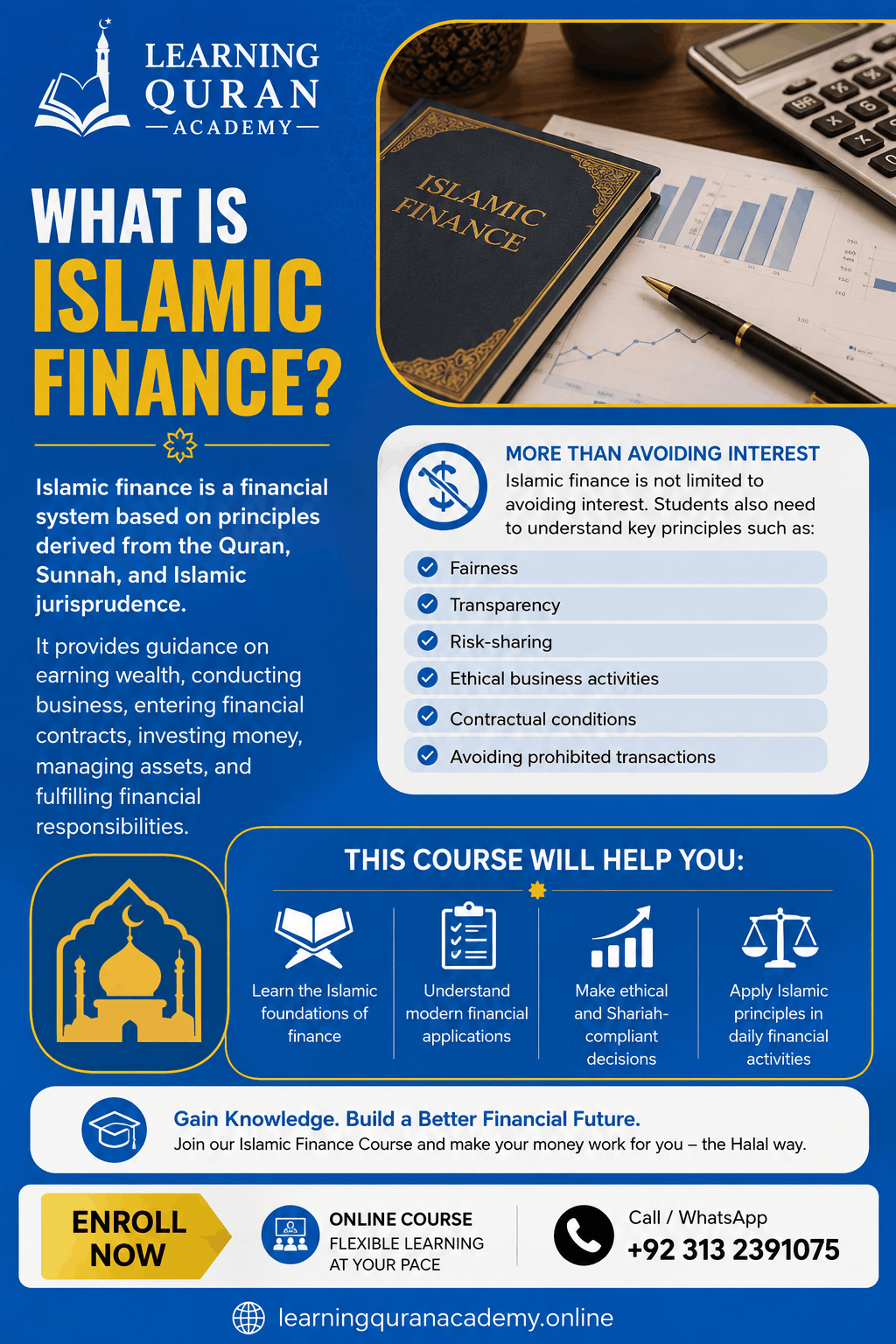
What Is Islamic Finance?
Islamic finance is a financial system based on principles derived from the Quran, Sunnah, and Islamic jurisprudence. It provides guidance on earning wealth, conducting business, entering financial contracts, investing money, managing assets, and fulfilling financial responsibilities.
Islamic finance is not limited to avoiding interest. Students also need to understand concepts such as fairness, transparency, risk-sharing, ethical business activities, contractual conditions, and avoiding prohibited transactions.
In this course, students will learn both the Islamic foundations of finance and their application to modern financial situations.
What Will You Learn in Our Islamic Finance Investment Course?
Our Islamic Finance Investment Course follows a structured curriculum designed to take students from basic concepts to more advanced areas of Islamic financial management.
Module 1: Introduction to Islamic Finance
Students begin by understanding the foundations of Islamic finance.
Topics include:
Meaning and scope of Islamic finance
Quranic principles related to wealth and trade
Financial guidance from the Sunnah
Difference between Islamic and conventional finance
Basic principles of Shariah-compliant financial transactions
Ethical responsibility in earning and managing wealth
This module creates the foundation needed to understand the rest of the course.
Module 2: Understanding Riba and Interest
Riba is one of the most important subjects in Islamic finance.
Students will learn:
What is Riba?
Types and basic concepts of Riba
Quranic prohibition of Riba
Difference between interest and legitimate business profit
Interest-bearing loans
Credit cards and interest-based charges
Common modern examples of Riba
How to identify potential interest-based transactions
The purpose is to help students understand the principles rather than simply memorize definitions.
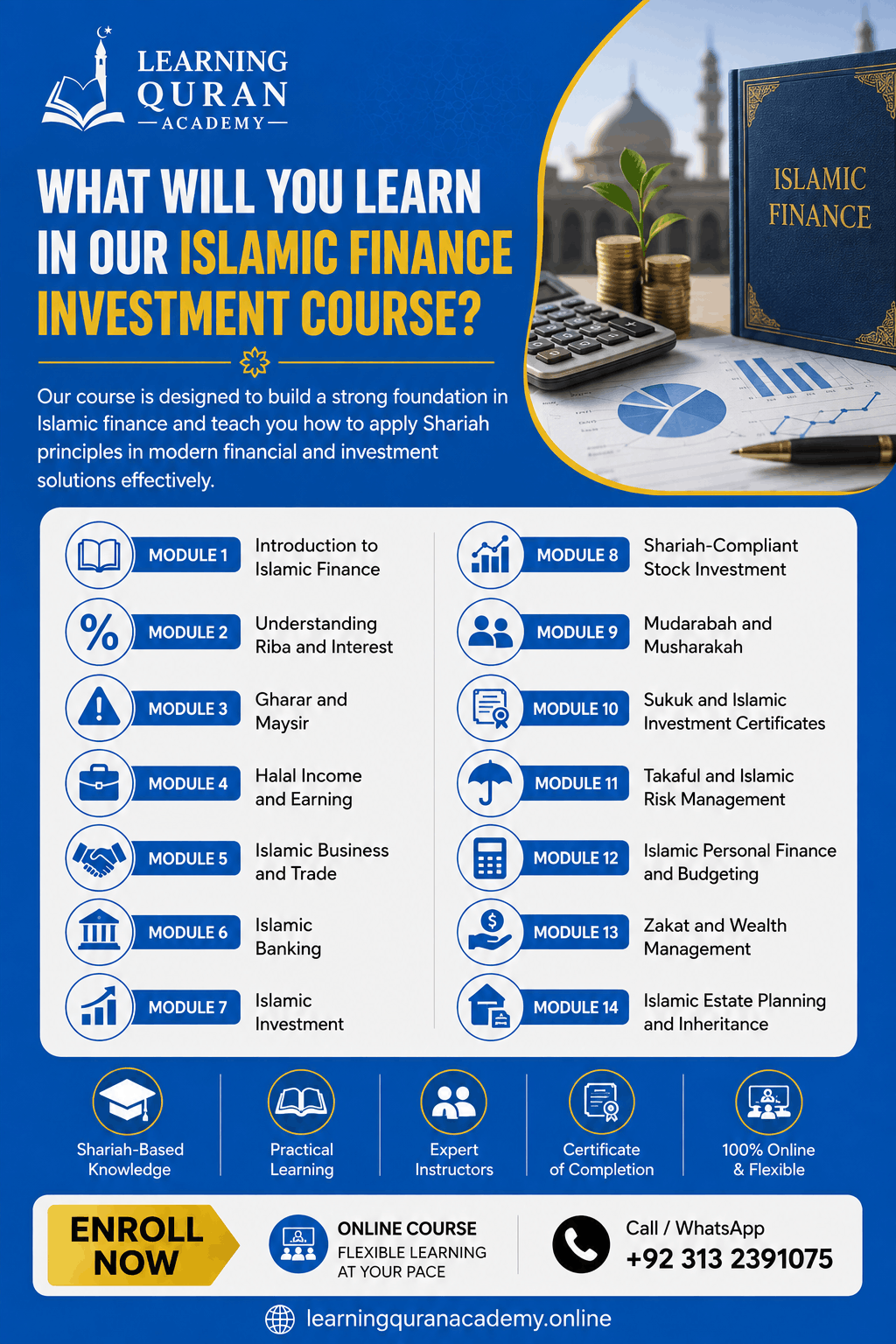
Module 3: Gharar and Maysir
Students will study two other important concepts that influence Islamic financial transactions.
Gharar relates to excessive uncertainty or ambiguity in certain contracts.
Maysir relates to gambling and prohibited games of chance.
Topics include:
Meaning of Gharar
Examples of excessive uncertainty
Meaning of Maysir
Gambling and financial transactions
Speculation and investment
Difference between legitimate risk and prohibited gambling
Practical examples from modern financial activities
Module 4: Halal Income and Earning
Islamic finance begins with the source of wealth.
Students will learn:
Principles of halal earning
Permissible and impermissible sources of income
Islamic business ethics
Employment income
Freelancing and online earning
Business income
Fraud and deception
Honesty in financial transactions
Rights of customers and business partners
This module helps students understand how Islamic principles can guide modern ways of earning money.
Module 5: Islamic Business and Trade
Trade and business are important parts of Islamic economic life.
Students will study:
Basic principles of Islamic trade
Buying and selling
Contracts
Pricing and transparency
Trust and honesty
Prohibited business practices
Conditions of valid transactions
Business partnerships
Ethical business conduct
Students will also learn why making a profit is not automatically prohibited and how Islamic principles distinguish legitimate trade from prohibited financial practices.
Module 6: Islamic Banking
This module introduces students to Islamic banking and its major concepts.
Topics include:
What is Islamic banking?
Islamic banking vs conventional banking
Shariah-compliant financial products
Murabaha
Ijarah
Mudarabah
Musharakah
Islamic deposit structures
Financing arrangements
Understanding the basic structure of Islamic financial products
The aim is to help students understand how Islamic financial institutions structure transactions according to Shariah principles.
Module 7: Islamic Investment
Students will learn the foundations of halal investing.
Topics include:
What is investment?
Investment vs gambling
Risk and return
Principles of halal investment
Long-term and short-term investment
Ownership-based investments
Shariah-compliant investment options
Evaluating financial products
Understanding investment risks
Students will learn why an investment should be evaluated not only according to its potential return but also according to its underlying activity and financial structure.
Module 8: Shariah-Compliant Stock Investment
Stocks are an important area of modern investment, so students will learn the basics of evaluating them from a Shariah perspective.
Topics include:
What are stocks?
How the stock market works
Shares and ownership
Shariah-compliant companies
Prohibited business activities
Business activity screening
Financial ratio screening
Interest-bearing debt
Interest-related income
Understanding Shariah stock-screening methodologies
Basic principles of investment purification
Students will learn the principles behind stock screening rather than relying on an outdated list of supposedly halal stocks.
Module 9: Mudarabah and Musharakah
Students will study two important Islamic partnership structures.
Mudarabah involves a partnership where one party generally provides capital while another manages the business or investment.
Musharakah involves partners contributing capital to a joint venture.
The module covers:
Definition of Mudarabah
Definition of Musharakah
Differences between the two
Capital contribution
Profit-sharing
Loss-sharing
Management responsibilities
Business examples
Practical applications
Module 10: Sukuk and Islamic Investment Certificates
Students will learn about Sukuk and how they differ from conventional interest-bearing bonds.
Topics include:
What is Sukuk?
Basic structure of Sukuk
Underlying assets and economic interests
Sukuk vs conventional bonds
Types of Sukuk
Sources of return
Basic risks
Shariah considerations
The goal is to give students a clear foundation for understanding Sukuk rather than treating them simply as “Islamic bonds.”
Module 11: Takaful and Islamic Risk Management
Takaful introduces the concept of cooperative risk management within an Islamic framework.
Students will learn:
What is Takaful?
Basic principles of Takaful
Risk-sharing
Conventional insurance vs Takaful
Family Takaful
General Takaful
Contributions and mutual assistance
Basic Shariah considerations
Module 12: Islamic Personal Finance and Budgeting
Islamic finance also applies to everyday personal money management.
Students will learn how to organize:
Monthly income
Household expenses
Saving
Emergency funds
Debt management
Financial goals
Family responsibilities
Charitable giving
Zakat planning
Long-term wealth management
The purpose is to help students develop responsible financial habits while keeping Islamic principles in view.
Module 13: Zakat and Wealth Management
Zakat is an essential part of Islamic financial responsibility.
Students will be introduced to:
Meaning and importance of Zakat
Nisab
Hawl
Zakatable wealth
Cash and savings
Gold and silver
Business assets
Investments
Basic Zakat calculation principles
Zakat and taxation: understanding the difference
Detailed individual Zakat cases can depend on the type of wealth and applicable rulings, so students will also learn when consultation with a qualified scholar is appropriate.
Module 14: Islamic Estate Planning and Inheritance
Wealth management does not end with earning and investing.
Students will receive an introduction to:
Islamic inheritance
Wasiyyah
Rights of heirs
Wealth distribution
Family financial responsibilities
Importance of following Islamic inheritance principles
This module helps students understand the importance of planning wealth distribution according to Islamic guidance.
Practical Islamic Finance Case Studies
A major part of effective learning is applying concepts to realistic situations.
Students can study practical examples involving:
- Interest-based loans
- Bank accounts
- Credit cards
- Online income
- Freelancing
- Business partnerships
- Stock investments
- Sukuk
- Insurance and Takaful
- Zakat on wealth
- Business transactions
- Personal budgeting
These examples help students connect Islamic financial principles with situations they may encounter in everyday life.
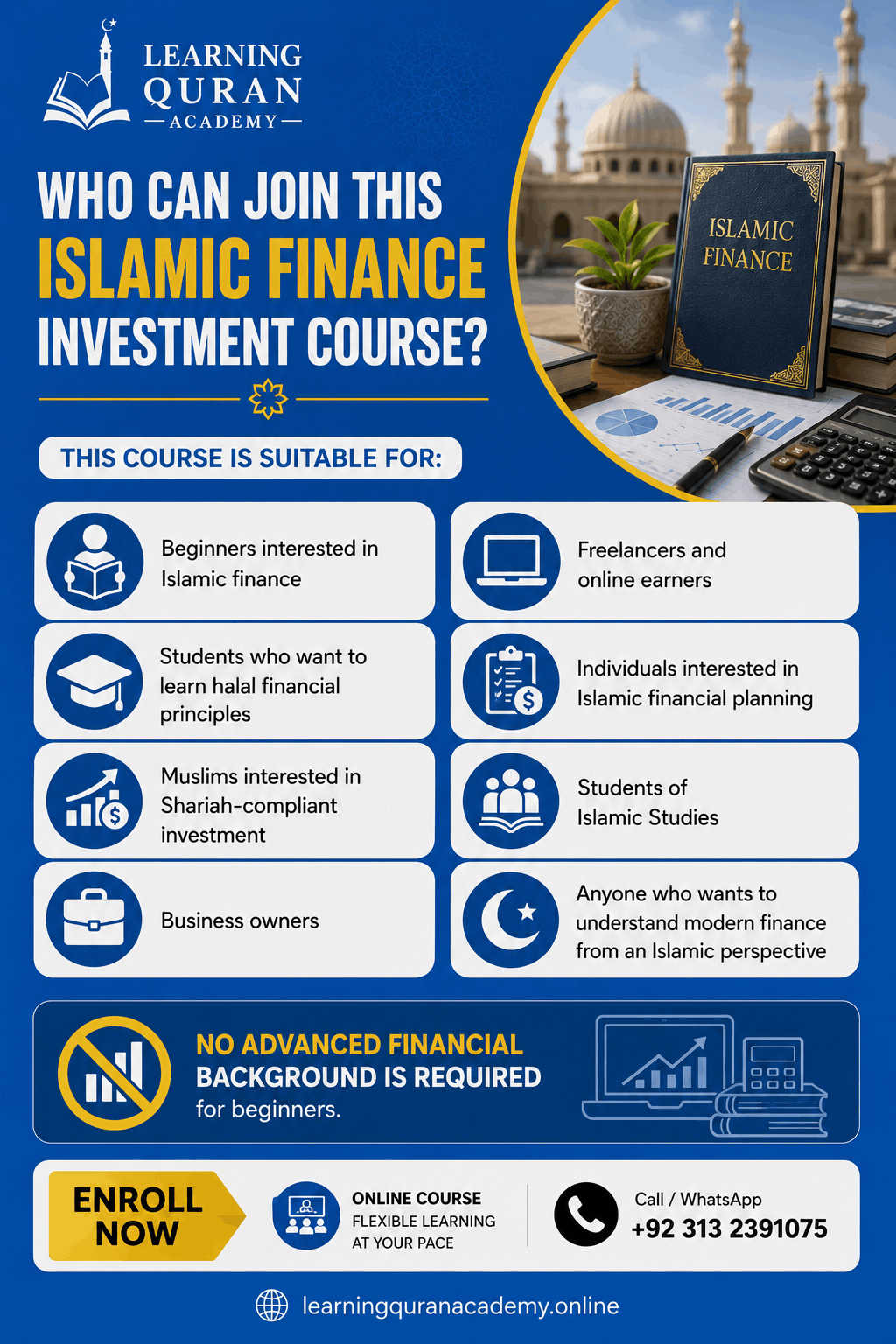
Who Can Join This Islamic Finance Investment Course?
This course is suitable for:
- Beginners interested in Islamic finance
- Students who want to learn halal financial principles
- Muslims interested in Shariah-compliant investment
- Business owners
- Freelancers and online earners
- Individuals interested in Islamic financial planning
- Students of Islamic Studies
- Anyone who wants to understand modern finance from an Islamic perspective
No advanced financial background is required for beginners.
What Will Students Gain From This Course?
After completing the course, students should have a stronger understanding of:
- Islamic financial principles
- Riba, Gharar, and Maysir
- Halal and Haram income
- Islamic banking
- Islamic business transactions
- Shariah-compliant investment
- Stock screening principles
- Mudarabah and Musharakah
- Sukuk
- Takaful
- Zakat and wealth management
- Islamic personal finance
- Islamic inheritance and estate planning
Students will also be better prepared to identify the key Shariah questions that should be considered before entering a financial transaction.
Why Study Islamic Finance Online?
Online learning allows students to study Islamic finance from home while following a structured curriculum.
Learning Quran Academy provides online Islamic education through a flexible learning model designed for students in different countries and time zones. The academy states that its online classes are available internationally and that its teachers work with students from countries including Pakistan, the UK, USA, Canada, and other locations.
For students who have busy schedules, flexible timing can make it easier to maintain regular learning without needing to travel to a physical classroom.
Live One-on-One Online Learning
Learning Quran Academy’s online learning model includes live one-on-one classes, allowing students to interact directly with their instructor rather than relying entirely on pre-recorded material. The academy also states that classes are available with flexible scheduling.
For an academic subject such as Islamic finance, direct interaction can be particularly useful because students may have questions about financial terminology, contracts, investment structures, and the application of Islamic principles.
Course Duration and Class Format
The exact duration of the Islamic Finance Investment Course can vary according to the student’s learning pace and the final course schedule.
Learning Quran Academy’s general online class structure provides:
- Live online classes
- One-on-one instruction
- 30-minute class sessions
- Flexible class timings
- Free trial classes before enrollment
- Regular progress evaluation
- Certificate of achievement after successful course evaluation
The academy’s homepage currently lists monthly plans based on different numbers of classes per week, with 30-minute class durations. General plans shown on the site include 3, 4, 5, and 6 days per week.
Because the published pricing is presented as the academy’s general online learning plans rather than a specific Islamic Finance course fee, prospective students should confirm the applicable Islamic Finance schedule and fee before enrollment.
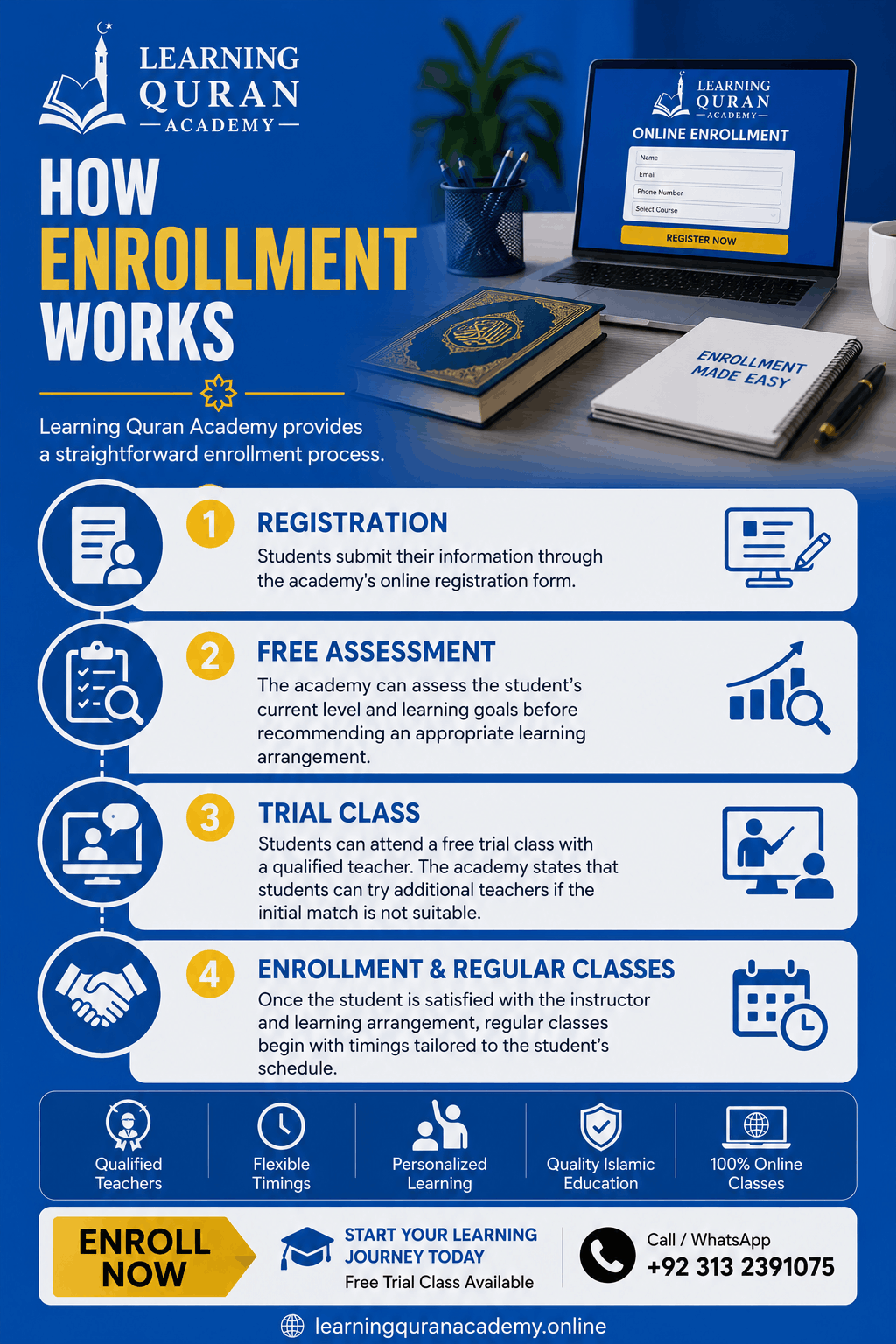
How Enrollment Works
Learning Quran Academy provides a straightforward enrollment process.
Step 1: Registration
Students submit their information through the academy’s online registration form.
Step 2: Free Assessment
The academy can assess the student’s current level and learning goals before recommending an appropriate learning arrangement.
Step 3: Trial Class
Students can attend a free trial class with a qualified teacher. The academy states that students can try additional teachers if the initial match is not suitable.
Step 4: Enrollment and Regular Classes
Once the student is satisfied with the instructor and learning arrangement, regular classes begin with timings tailored to the student’s schedule.
What Does Learning Quran Academy Offer?
Learning Quran Academy is an online Quran and Islamic learning institute providing education to children and adults. Its broader curriculum includes Quran reading with Tajweed, Hifz, Islamic studies, and other Islamic educational subjects.
The academy highlights several features of its learning model, including:
- Qualified teachers
- One-on-one classes
- Flexible timings
- 24/7 service
- Progress evaluation reports
- Certificates of achievement
- Online payment options
- Free trial classes
- Learning opportunities for students worldwide
The academy also states that it has been serving students for more than ten years and has students across more than 15 countries.