Table of Contents
ToggleMemorization of Quran from Masjid Nabawi Best Halaqat
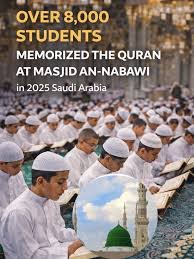
I’ve personally found Masjid an-Nabawi, the Prophet’s Mosque, to be a place of immense spiritual significance, where the Memorization of Quran from Masjid Nabawi and the vibrant center of Islamic learning truly feel alive within its blessed walls.
The numerous halaqat and study circles are dedicated to teaching the Quran and classical texts like mutoon, offering a golden opportunity for seekers of knowledge to immerse in the divine words and rich heritage of scholarship.
With esteemed scholars guiding students, the profound intellectual journey gains insights that illuminate hearts and minds, and the atmosphere,
imbued with the legacy of Prophet Muhammad ﷺ, makes every moment in these circles a cherished, transformative experience.
Free Memorization of Quran from Masjid Nabawi
Here you can study and memorize the Holy Quran in a way that feels deeply rooted in tradition and discipline.
From my own time sitting in the halaqah circles, I saw how Quran memorisation is structured with clarity: a student comes daily with a new portion and revision, and the teacher will listen, then test them on what they have already memorised.
For Recitation and revision, these halaqat are carefully catered to visitors, full-time students, and those who take a year off from studies and work to come to Masjid an-Nabawi with the goal of memorising the entire Quran.
There are six types of Quran halaqat: Halaqah of Quran Hifdh, Halaqah of Quran Revision, Halaqah of Ijazaaat in Quran for those seeking ijazah in the ten modes of recitation, Halaqah of Quran Recitation Correction focusing on tajweed,
articulation of letters, and pronunciation using Al Qaaida An Nooraniyya, Quran Recitation Correction for Visitors, and Quran for Those with Special Needs, including the deaf, hard of hearing, and blind. It’s truly a worthwhile investment in the Book of Quran.
2026 Nabawi Quran Classes New Registration
When I first explored the Administration of the Circles of the Glorious Qur’an and Mutoon Texts at the Prophet’s Masjid, I realized how organized the new user registration process is, especially with the جميع الحقوق محفوظة لإدارة حلقات القرآن الكربم والمتون العلمية بالمسجد النبوي notice.
These classes are provided by the Administration of the Circles of the Glorious Qur’an and Mutoon (Texts) at the Prophet’s Masjid: https://reg.qm.edu.sa/. To register as a New User visit: https://reg.qm.edu.sa/Minton/Account/NewRegistration.
You choose the form language (either English or Arabic) and enter required information like First Name, Father Name, Grandfather Name, Family Name, Nationality, Gender, Date of Birth, Email, Username, and Password.
The terms and conditions are clear: the user acknowledges the accuracy of information provided through the educational platform, and is prohibited from registering or accessing the platform by impersonating another user.
Do not allow others to use your granted account, and entering the platform is for legitimate purposes only.
You must commit to not using the platform, or any information, services, or tools on it to engage in any act that results in violation or crime under Saudi law.
In case of violation, the management of the Quran circles and scientific texts can take appropriate actions, including permanently canceling your account or referring the matter to the competent authorities. After completing registration, login, and for any queries or support, visit create-ticket.
Free Islamic Texts Halaqat in Masjid Nabawi
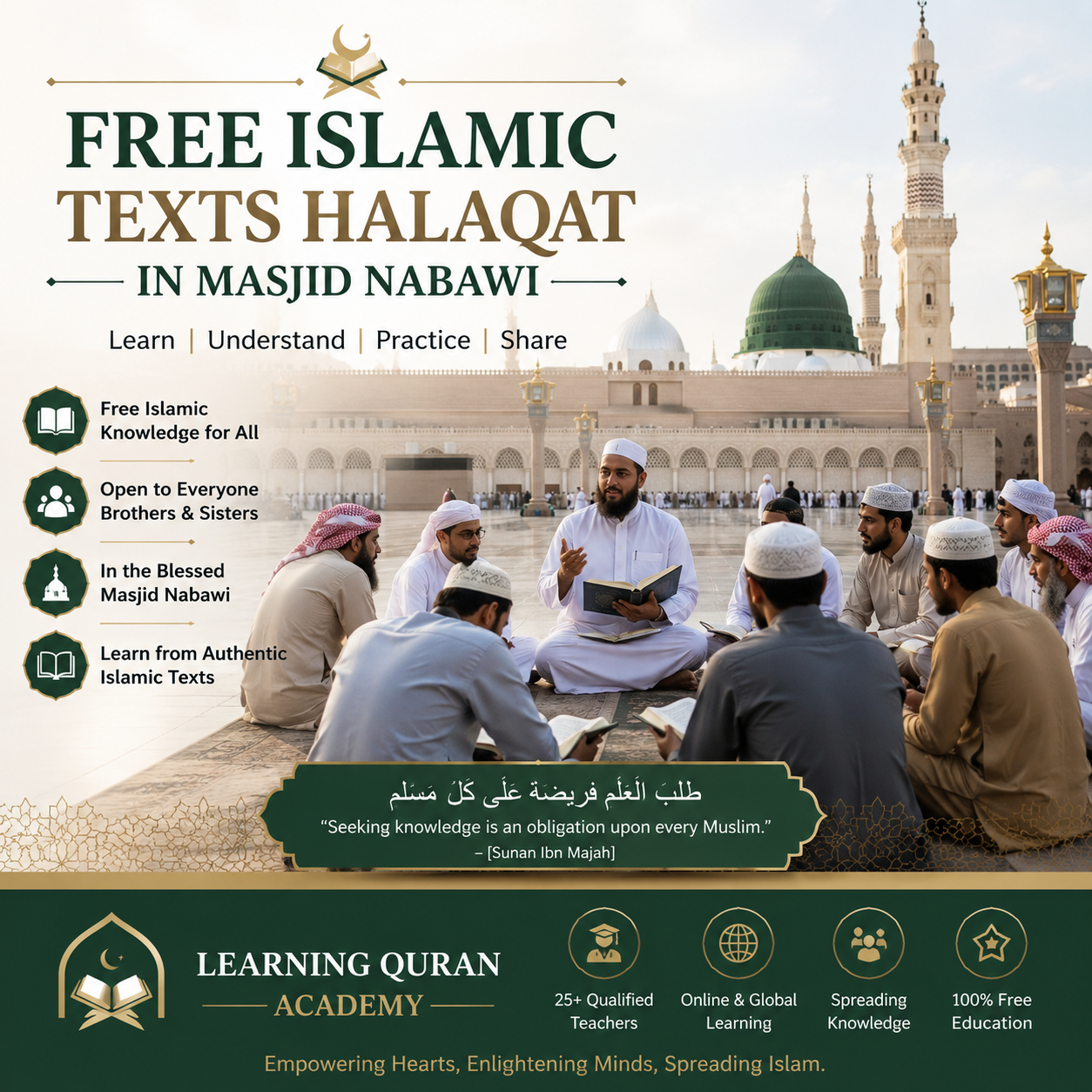
In these halaqat, students memorize various Islamic texts on subjects such as Adab, Aqeedah, Tawhid, Fiqh, Usul, al-Fiqh, Tajwid, and Hadith, and I’ve seen how this structure builds a deep foundation for Quran memorization too.
The program, designed by Shaykh Abdul Muhsin Al Qasim, Imam and Khateeb at Masjid an-Nabawi, gradually increases the memorization load with each level, so by the end students have memorized texts in various Islamic sciences, preparing them for further studies in each discipline.
There are six mutoon levels in total, an introductory level and five advanced levels: Introductory Level (Mukhtasar Al-Adhkaar Wal-Adaab, Al-Adhkaar Wal-Adaab),
- First Level (Nawaaqid Al-Islam, Al-Qawaaid Al-Arba’a, Al-Usul Ath-Thalathah, Al-Arba’oon An-Nawawiyyah),
- Second Level (Tuhfatul Atfaal, Shuroot As-Salah, Kitab At-Tawhid),
- Third Level (Manthumatul Bayqooniyya, Manthuma Abi Ishaq Al-Iybiri, Al-Muqaddimatul Ajroomiyya, Al-Aqeedatul Waasitiyya),
- Fourth Level (Al-Waraqaat, U’nwaan Al-Hikam, Ar-Rahbiyyah, Al-Aqeedatu Taahawiyya),
- Fifth Level (Buloogh Al-Maraam, Zaad Ul-Mustaqni’, Alfiyyah Ibn Maalik).
During these halaqat, there are no fees to pay; in fact, the mosque provides monetary rewards for passing the texts and exams.
Students are assigned to halaqat based on their age groups: Individuals aged 16 years and above, Individuals between 13 and 15 years, and Individuals between 5 and 12 years. Joining these halaqat is an excellent way to deepen your knowledge of Islam and enrich your life significantly.
Daily Attendance Rules for Nabawi Halaqat
Lessons take place in person all year round, with the exception of Ramadan, in which lessons take place online via zoom; attendance is registered, so if you are going to be absent on some days, you should inform your teacher before hand.
The teachers tend to listen to students on a first come basis, so if you arrive early, you can read your portion to your teacher sooner;
sometimes, if you are too late, the teacher may mark you as absent and not have time to listen to you, as there are many students to get through, and limited time.
Note, If your teacher is strict, and you miss days without informing them, they may get you in trouble.
Halaqah Manners & Rules for Students
In my time at Masjid an-Nabawi, I learned that each teacher has their own set of rules for their students, yet there are some general mannerisms to keep in mind:
a student should always aim to be on time and greet their teacher with Salam when joining the halaqah, as most students come up to the teacher and shake their hand.
The student should avoid talking to other students during the halaqah, and avoid using their phone, this can be disrespectful.
A student should also seek permission before leaving, or if they need to use the toilet. For the halaqaat of Quran, a student should avoid sitting in a position in which their feet are extended out to The Quran.
Free Bus Service for Nabawi Halaqat Students
From my experience attending halaqah sessions, the Free Bus transportation is provided to and from the masjid, though it depends on spot availability, neighborhood locality, and time slot.
General conditions apply: The student must be registered in a halaqah of quran or mutoon.
If the student is under 8 years old, they will not be permitted to use the bus by themselves, unless they are accompanied by an elder sibling, who is also a student, and a parent guardian must sign a consent form.
Note: Please contact your teacher for more information; if available, your teacher will provide you with a google form to fill out.
Quran Hifdh Exams & Rewards in Madina
Quran Hifdh exams in Madina evaluate memorization, recitation, and tajweed under expert scholars. Successful students receive certificates, awards, and recognition. These exams encourage discipline, spiritual growth, and reward in both this life and the hereafter.
Quran monthly exams
In my years of studying Quran at Masjid Nabawi, I found that the monthly exams take place in a structured way that truly motivates students to keep progressing;
these assessments are known as إختبار تنشيطي, and a student can enroll via their teacher every time they complete 25 pages of Quran hifdh.
The process is simple yet powerful: with their teacher, they review and refine their memorization, and upon passing the exam, they are rewarded with up to 50 SAR for every 25 pages they’re examined on.
From my own experience, this system creates a rhythm—complete a section, test it, and earn both spiritual and practical encouragement—making memorization feel achievable and continuously rewarding.
Quran semester exams
At the end of each semester, exams take place, known as إختبار فصلي, and the student, after months of daily Quran hifdh at Masjid Nabawi, is prepared by their teacher a while before this exam; a pre exam is held to determine whether they are in for the final exam.
The stakes feel real, because the Quran semester exams cover varying levels—for 5, 10, 15, 20, 25, 30 ijaaza of the quran—and students can receive up to 2000 SAR, depending on what they are tested on,
which is a huge motivator I’ve seen personally: the exam becomes not just a test, but a milestone that validates months of memorization and discipline.
Mutoon monthly exams
Once a student begins their Mutoon journey at Masjid Nabawi, monthly exams take place, known as إختبار تنشيطي, and they can enroll via their teacher every time they complete 1 stage or upon completion of 1 Level of mutoon hifdh;
the structure is designed to keep momentum, and I’ve seen how this steady rhythm helps students stay consistent.
Upon passing, the student can receive a reward of up to 50 SAR for every stage they’re examined on, and if they are examined on two stages at one time,
can receive up to 100 SAR, and so on, which makes the progress tangible and motivates learners to push through each level with confidence.
Notes (Exams Enrollment)
A quick Note for anyone looking to join the Memorization of Quran program at Masjid Nabawi: a student has to be a regular attendee of the halaqah to enroll in these exams, and enrollment is done via the teacher, so it requires teachers approval;
in my experience, this system keeps the classes disciplined and ensures that only committed students move forward. Your teacher will update you regarding specific exam dates,
and whether you can enroll, but Note, You need your student number to enroll into the exams and receive monetary rewards.
Quran Memorization Competitions in Madina
Throughout the year, competitions in both Quran, Mutoon, and Hifdh serve as a great motivation for students, and in my time there I witnessed how these events turn regular reciters into confident, disciplined memorizers.
Winners can receive prize money up to 15,000 SAR, depending on the competition, and Your teacher will let you know if you qualify to participate, as there are specific conditions for each type of competition.
2024 Waqar App Quran Registration Guide
Step 1: Install the Waqar Al-Haram App
- Download links (for convenience):
Waqar Alharam on the App Store (iOS / iPhone / iPad) - Waqar Al-Haram – Apps on Google Play (Android)
Step 2: Register the Student
Fill out the registration form with the following information:
- Student Location: Saudi Arabia or outside Saudi Arabia
- Date of Birth
- Full Name
- Gender
- Account Type: Select Student
- Country of Residence
- Nationality
- Email Address (verification email will be sent)
- Mobile Number (verification SMS will be sent)
- Language of Classes: Arabic / English / Urdu
- Time of Classes (choose as per availability)
Step 3: Receive Class Link
- After registration, within 1 week, the app will provide the link to attend the class.
Step 4: Change Language (If Needed)
- If you are registered in the wrong language class:
Request your teacher to change the class language. - If the teacher cannot understand your language, ask another student to translate your request.
Step 4: Change Language (If Needed)
- If you are registered in the wrong language class:
Request your teacher to change the class language. - If the teacher cannot understand your language, ask another student to translate your request.
2021 Online Quran Halaqah Registration Steps
Step 1 – Registration
- Go to the WAQAR (وقار) website: reg.qm.edu.sa
- Register for the episodes of the Prophet’s Mosque Quran and Al-Mighton sections (regular & remote).
Step 2 – Fill the Form
- Answer the complete form with your details.
- Send the completed form to the employee in the Telegram chat.
- Wait for a reply from the staff.
Telegram Contact
- Telegram Contact: @Halagat_The_Mosuque_of_Prophet
- Join Telegram Channel: t.me/joinchat/AAAAAFg1N4Opljh3bRDgNA
Required Questions
- Q1: Would you like to register in the Holy Quran section?
- Q2: Would you like to register in the Knowing Meton section?
- Q3: Does the student live in Medina?
Required Information
- Name (as in identity or passport)
- Identity / Residence number
- Nationality
- Date of Birth / Age
- Mobile number (with WhatsApp)
- Student’s number in Waqar program
- Period to be registered
- Student’s educational level
Create Account
- Create account at المسجد النبوي قرآن متون
Attend Interview
- After registration, attend the Zoom interview call
Timings
- Sunday to Thursday
- Morning: 7:00 AM – 11:00 AM
- Evening: After Asr prayer till Isha Azan (Madina time)
Conclusion
Memorizing the Quran at Masjid an-Nabawi is a deeply rewarding journey, supported by structured halaqat, dedicated scholars, and a clear registration system.
From free Quran memorization classes to mutoon studies, the programs offer guidance for students of all levels, while attendance rules, mannerisms, and exam systems ensure discipline and steady progress.
The free bus service, support helpdesk, and multiple registration options (2020, 2021, 2024, 2026) make access easy for local and international students.
Overall, the environment at the Prophet’s Mosque is ideal for sincere learners seeking spiritual growth and academic excellence.