Table of Contents
ToggleHusband's Duties in the Quran: A Complete Guide to a Husband's Responsibilities
Marriage in Islam is not simply a contract between two people. It is an amanah (trust) before Allah, carrying rights, responsibilities, mercy, and accountability for both spouses. When people search for Husband’s Duties in the Quran, they often want to know what Allah actually expects from a husband: Is he responsible only for financial support? What does qiwamah mean? How should he treat his wife? What does the Quran say about kindness, protection, intimacy, and family leadership?
The Quran answers these questions through several connected principles rather than one single list. A husband’s role includes financial provision, kind treatment, protection, companionship, spiritual responsibility, justice, and respect for his wife’s rights.
Understanding these duties together gives a much clearer picture of what it means to be a responsible Muslim husband.
What Does the Quran Say About Husband’s Duties in the Quran
The Quran does not place every marital responsibility in one verse. Instead, it discusses different aspects of marriage throughout the Quran.
For example, Allah commands husbands:
“And live with them in kindness.”
Quran 4:19
The Quran also says:
“And they have rights similar to those against them, according to what is reasonable.”
Quran 2:228
And when discussing family responsibility, Allah says:
“O you who have believed, protect yourselves and your families from a Fire…”
Quran 66:6
These verses show that husband’s responsibilities in Islam are not limited to earning money or exercising authority. They include caring for the family, fulfilling rights, maintaining good character, and helping create a home that is physically, emotionally, and spiritually safe.
1. What does the Quran say about hope?
2. Which Quran verse gives the most hope?
3. How can the Quran help during difficult times?
4. What is the connection between hope and fear in Islam?
5. Which prophet's story teaches hope?
6. Does having hope mean that hardship will disappear?
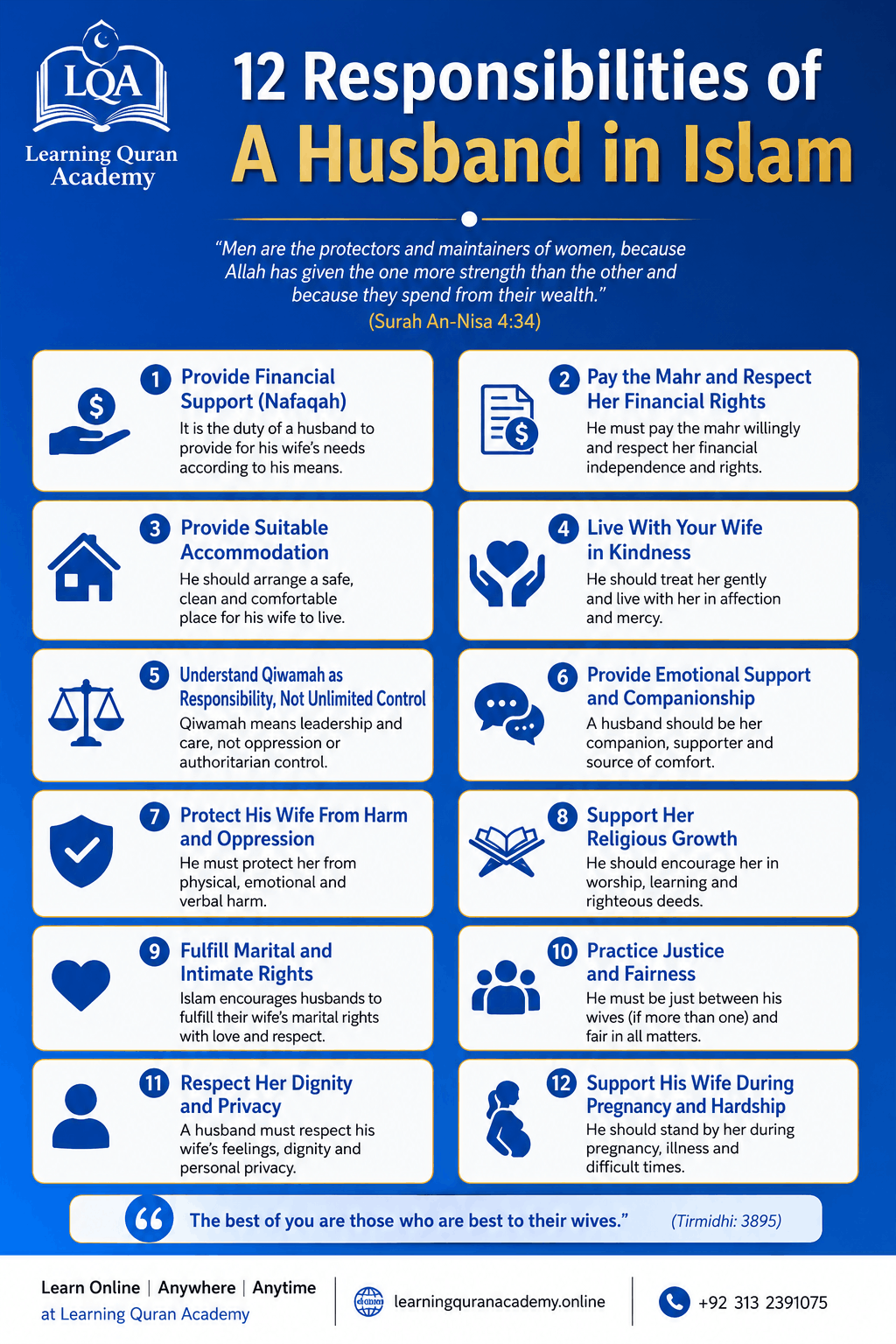
1. Provide Financial Support (Nafaqah)
One of the clearest responsibilities of a husband is nafaqah, or reasonable financial maintenance.
A husband is responsible for providing his wife with essential needs such as:
- Food and daily necessities
- Suitable clothing
- Appropriate accommodation
- Basic household expenses
- Other reasonable needs according to his circumstances
Allah says:
“Let the wealthy man spend according to his wealth, and the one whose provision is restricted, let him spend from what Allah has given him.”
Quran 65:7
This verse establishes an important principle: financial responsibility is connected to a person’s means.
A husband with substantial resources should not deliberately make his family live in unnecessary hardship. At the same time, a husband experiencing genuine financial difficulty is not expected to provide beyond his ability.
The purpose of nafaqah is responsibility and care—not competition over wealth.
2. Pay the Mahr and Respect Her Financial Rights
Another important husband’s duty in Islam is fulfilling the wife’s right to mahr.
Allah says:
“And give the women their dowries graciously.”
Quran 4:4
Mahr is the wife’s property. It is not automatically the property of her parents, and a husband cannot simply take it back because he provided it.
This is particularly important because Islamic marriage does not remove a woman’s independent financial rights.
A responsible husband should therefore:
- Fulfill the agreed mahr
- Respect his wife’s ownership
- Avoid financial manipulation
- Never use money as a weapon of humiliation or punishment
- Provide according to his legitimate responsibility
Financial leadership in a household must always remain connected to justice and trust.
3. Provide Suitable Accommodation
A wife has a right to appropriate housing, and the Quran discusses accommodation alongside financial provision.
Allah says in Quran 65:6 that husbands should provide accommodation according to their means and should not cause harm or hardship to their wives.
A suitable marital home is not necessarily a luxurious home. Its purpose is to provide reasonable:
- Safety
- Privacy
- Stability
- Comfort
- Protection from unnecessary harm
This is especially important when extended-family arrangements create ongoing conflict or a lack of privacy. A husband should consider his wife’s legitimate needs rather than assuming that the cheapest or most convenient arrangement is automatically acceptable.
4. Live With Your Wife in Kindness
If someone asks for the clearest Quranic instruction regarding how a husband should treat his wife, Quran 4:19 deserves special attention.
Allah says:
“And live with them in kindness.”
Quran 4:19
The Arabic expression mu’asharah bil-ma’ruf conveys the idea of honorable, decent, and appropriate marital conduct.
In everyday life, this can mean:
- Speaking respectfully
- Listening instead of immediately dismissing concerns
- Avoiding humiliation
- Showing appreciation
- Being patient with ordinary mistakes
- Considering her feelings
- Maintaining good manners during disagreement
A husband’s character is not truly tested when everything is going well. It becomes visible when he is angry, financially stressed, tired, or disappointed.
That is why good treatment cannot be limited to occasional romantic gestures. It should become the normal character of the household.
5. Understand Qiwamah as Responsibility, Not Unlimited Control
One of the most misunderstood concepts in discussions about husband’s duties in the Quran is qiwamah.
Allah says in Quran 4:34 that men are qawwamun over women. The verse connects this responsibility with what Allah has given some over others and with the financial spending that men undertake for their families.
Qiwamah should therefore be understood through the broader responsibilities of:
provision + protection + responsibility + accountability.
It should not be presented as unlimited permission to control a wife’s every decision.
A husband who claims leadership but refuses financial responsibility, ignores his wife’s wellbeing, or humiliates her has focused on authority while neglecting the responsibility attached to it.
Islamic family leadership is not about asking, “How much control do I have?”
It is about asking:
“How responsibly am I carrying the trust Allah has given me?”
6. Provide Emotional Support and Companionship
Financial provision is important, but a marriage cannot thrive on money alone.
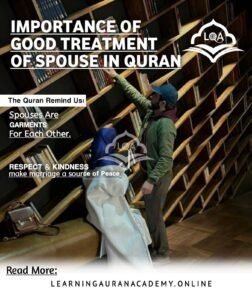
Allah describes marriage beautifully in Surah Ar-Rum 30:21:
“And He placed between you affection and mercy.”
The verse also describes spouses as a source of sakinah, or tranquility.
This gives us an important dimension of husband’s responsibilities: emotional companionship.
A husband should make an effort to:
- Spend meaningful time with his wife
- Listen to her concerns
- Show affection
- Appreciate her efforts
- Offer comfort during difficult periods
- Avoid emotional neglect
- Make her feel valued within the marriage
A husband may provide an excellent house and still leave his wife emotionally alone. Quranic marriage calls for something more complete: provision together with affection and mercy.
7. Protect His Wife From Harm and Oppression
Islam does not make marriage a justification for abuse.
The Islamic legal principle la darar wa la dirar expresses the prohibition of causing harm or responding to harm with harm.
Therefore, a husband should protect his wife from unnecessary physical, emotional, and psychological harm rather than becoming the source of it.
This includes avoiding:
- Physical abuse
- Threats and intimidation
- Humiliation
- Deliberate emotional cruelty
- Financial manipulation
- Public embarrassment
- Unreasonable isolation
- Using religious language to justify abuse
A husband should be able to say that his wife is safe in his home—not merely financially supported there.
8. Support Her Religious Growth
A husband’s responsibility also extends to the spiritual wellbeing of his household.
Allah says:
“O you who have believed, protect yourselves and your families from a Fire…”
Quran 66:6
This does not mean that a husband must personally be a scholar. It means he should take the family’s relationship with Allah seriously.
Practical examples include:
- Encouraging Salah
- Supporting Quran learning
- Making Islamic education accessible
- Encouraging good character
- Creating an environment where religious practice is respected
- Learning when he does not know
- Helping his family find trustworthy Islamic teachers and resources
Religious leadership should be accompanied by personal example. It is difficult to encourage patience, honesty, prayer, or good character while consistently behaving in the opposite way.
9. Fulfill Marital and Intimate Rights
A healthy Islamic marriage includes legitimate physical and emotional intimacy.
A wife’s needs should not be ignored simply because the husband has fulfilled his financial obligations. Marriage involves mutual companionship and legitimate marital rights.
The Quran’s description of marriage through sakinah, mawaddah, and rahmah provides the wider framework for understanding intimacy.
A husband should therefore approach marital relations with:
- Mutual consideration
- Affection
- Respect
- Privacy
- Emotional sensitivity
- Awareness of his wife’s legitimate needs
Intimacy should never be deliberately weaponized as a means of humiliation, manipulation, or revenge.
10. Practice Justice and Fairness
Justice is a fundamental part of Islamic marriage.
A husband should avoid favoritism, unnecessary comparison, unfair financial treatment, and behavior that deliberately makes his wife feel inferior.
If a man has more than one wife, the responsibility of justice becomes particularly serious. Financial provision, housing arrangements, time, and other rights must be approached according to the relevant Islamic rules.
Even in a monogamous marriage, justice matters.
A husband should not judge his wife by standards he refuses to apply to himself.
11. Respect Her Dignity and Privacy
Respect is not an optional extra in marriage.
A husband should protect his wife’s dignity in private and public. That means avoiding jokes that embarrass her, exposing private marital matters, insulting her in front of relatives, or constantly discussing her weaknesses with friends.
The Prophet ﷺ also provided a practical example of kindness and good companionship in his household.
One useful rule for modern marriages is simple:
Problems should be solved without destroying a person’s dignity.
A disagreement does not give either spouse permission to turn a private mistake into public humiliation.
12. Support His Wife During Pregnancy and Hardship
Pregnancy, illness, financial difficulty, and emotional stress can place additional pressure on a marriage.
The Quran reminds us of the hardship mothers experience during pregnancy and childbirth. In Quran 31:14, Allah mentions the weakness upon weakness experienced by the mother.
A thoughtful husband should therefore respond with greater patience during difficult periods.
This may mean:
- Helping with practical responsibilities
- Providing appropriate financial support
- Being emotionally available
- Reducing unnecessary stress
- Accompanying his wife when support is needed
- Showing appreciation for the sacrifices involved
The principle is broader than pregnancy: when one spouse becomes vulnerable, the other should respond with mercy rather than exploitation.
How the Prophet ﷺ Demonstrated Good Husbandhood
The Quran provides the principles, while the Sunnah gives Muslims a practical example of how those principles can appear in everyday life.
The Prophet Muhammad ﷺ showed affection toward his family, spent time with his wives, listened to them, and participated in household matters.
He also taught that the best believers are those with the best character and that the best people are those who are best toward their families.
This is important because Islamic husbandhood is not merely theoretical. It should be visible in ordinary behavior—how a man speaks at home, handles disagreement, shows affection, spends money, responds to mistakes, and treats his wife when nobody else is watching.
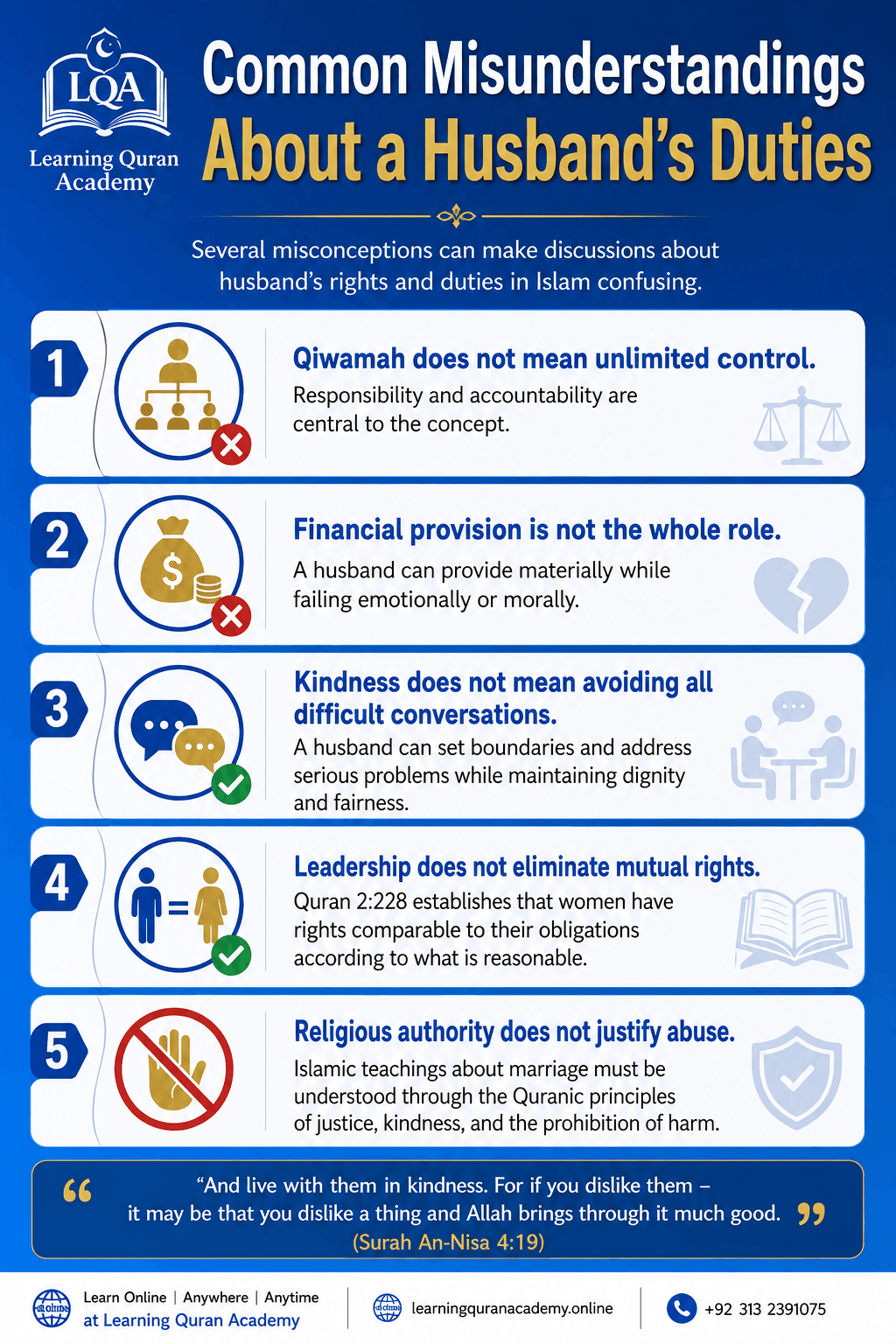
Common Misunderstandings About a Husband's Duties
Several misconceptions can make discussions about husband’s rights and duties in Islam confusing.
Qiwamah does not mean unlimited control. Responsibility and accountability are central to the concept.
Financial provision is not the whole role. A husband can provide materially while failing emotionally or morally.
Kindness does not mean avoiding all difficult conversations. A husband can set boundaries and address serious problems while maintaining dignity and fairness.
Leadership does not eliminate mutual rights. Quran 2:228 establishes that women have rights comparable to their obligations according to what is reasonable.
Religious authority does not justify abuse. Islamic teachings about marriage must be understood through the Quranic principles of justice, kindness, and the prohibition of harm.
Key Takeaways: Husband’s Duties in the Quran
A husband’s responsibilities can be remembered through six simple principles:
- Provide — fulfill reasonable financial obligations, including nafaqah and mahr.
- Protect — provide safety, suitable accommodation, and security.
- Respect — preserve his wife’s dignity, privacy, and legitimate rights.
- Support — offer emotional companionship, affection, and practical help.
- Guide — encourage Islamic learning and the spiritual wellbeing of the household.
- Show mercy — handle disagreements, hardship, and mistakes with patience and good character.
These principles are interconnected. Provision without kindness is incomplete. Leadership without responsibility is dangerous. Religious guidance without personal example is weak. Marriage without mercy loses the tranquility that the Quran describes.