Table of Contents
ToggleSalah for New Muslims
Salah for new Muslims is the five-times-daily prayer that Muslims perform as an essential act of worship. If you are new to Islam, you can learn Salah gradually by first understanding the prayer times, preparation, Rak’ahs, essential recitations, and basic prayer movements.
Why Is Salah Important for New Muslims?
Salah is important for new Muslims because it strengthens their relationship with Allah and establishes regular worship. Its key benefits include:
- Remembrance of Allah and a stronger spiritual connection.
- Developing patience, humility, and devotion.
- Seeking guidance, forgiveness, and blessings.
- Supporting self-purification and helping avoid wrongdoing and immorality.
- Finding tranquility of the heart through remembrance of Allah.
- Following the Quranic instruction to seek help through patience and prayer (Surah Al-Baqarah 2:153).
- Remembering that Allah is with the patient and that prayer encourages greater remembrance (Surah Ar-Ra’d 13:28).
- Understanding that Salah helps protect against immorality (Surah Al-Ankabut 29:45).
What Are the Five Daily Prayers?
The five daily prayers are the five obligatory prayers performed at their prescribed prayer times:
- Fajr prayer: The pre-dawn prayer, performed from dawn until before sunrise.
- Dhuhr prayer (Zuhr): The early afternoon prayer, beginning after the zenith, when the sun has passed its highest point.
- Asr prayer: The afternoon prayer, performed later in the daylight hours.
- Maghrib prayer: The sunset prayer, beginning after sunset.
- Isha prayer: The night prayer, performed after twilight has disappeared and continuing into the night.
Prayer timings change throughout the year because they are connected to sunrise, sunset, dawn, twilight, the sun decline, and other movements of the sun. A new Muslim should therefore check reliable local prayer timings rather than memorizing fixed clock times.
Different Types of Salah
Not every Salah has the same ruling. Understanding the main types of Salah helps a new Muslim distinguish between obligatory worship and additional acts of devotion:
- Fardh prayer: An obligatory prayer that Muslims are required to perform.
- Wajib: A required form of worship in Islamic jurisprudence, with its detailed ruling depending on the school of thought.
- Sunnah prayer: Prayer based on the Prophet’s practice, with Sunnah Muakkadah referring to emphasized Sunnah and Ghair Muakkadah to non-emphasized Sunnah.
- Nafl prayer: A voluntary prayer performed as additional worship.
- Supererogatory prayer: An additional prayer beyond the obligatory prayers.
- Recommended prayer: Prayer encouraged as part of voluntary worship.
For beginners, the priority is to establish the five daily prayers and learn their obligatory Rak’ahs correctly before gradually adding voluntary prayers.
How Many Rak'ahs Are in Each Salah?
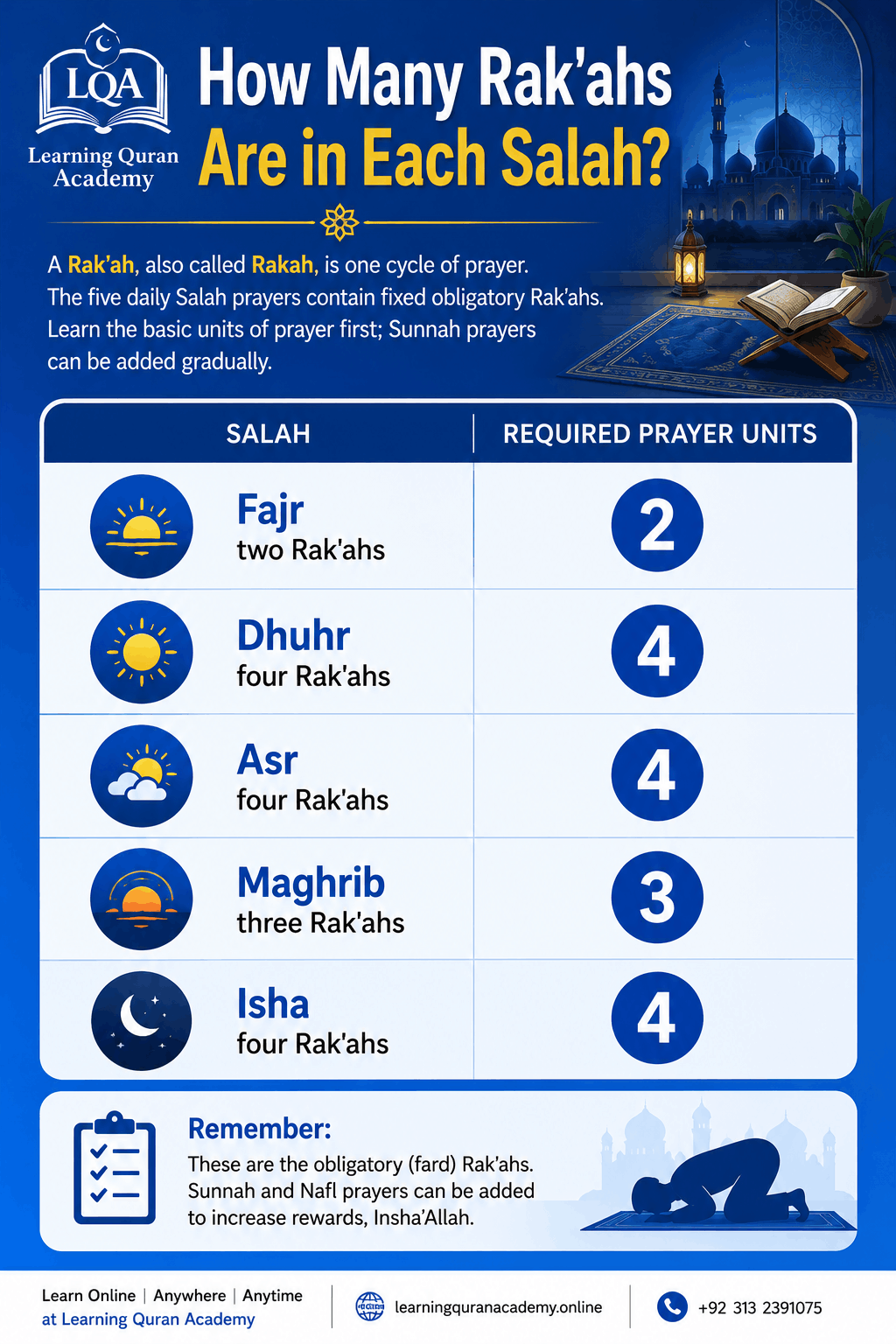
A Rak’ah, also called Rakah, is one cycle of prayer. The five daily Salah prayers contain fixed obligatory Rak’ahs. Learn the basic units of prayer first; Sunnah prayers can be added gradually.
Salah
Required prayer units
Fajr two Rak’ahs
Dhuhr four Rak’ahs
Asr four Rak’ahs
Maghrib three Rak’ahs
Isha four Rak’ahs
2
4
4
3
4
- First Rak’ah: Standing, recitation, bowing, and two prostrations
- Second Rak’ah: The same sequence, followed by sitting
- Third Rak’ah: Added in Maghrib, Dhuhr, Asr, and Isha
- Fourth Rak’ah: Added in Dhuhr, Asr, and Isha
- Complete Rak’ah: One full set of Salah movements and recitations
Preparation Before Salah
Proper preparation before Salah helps a Muslim pray with cleanliness, focus, and confidence. Before beginning, check purity, clothing, place, time, direction, covering, and Niyyah. These are important prerequisites of valid prayer.
- Wudu, Wudhu, or ablution: Basic purification before prayer.
- Ghusl: Required after major impurity, including a wet dream.
- Tayammum: Alternative purification when water cannot be used.
- Clean body and clean clothes: Maintain a proper state of cleanliness.
- Clean prayer place: A prayer mat may be used but is not compulsory.
- Prescribed times: Each Salah has a specific prayer time.
- Qiblah or Qibla: Face the direction of prayer toward the Ka’bah, Kaaba, in Makkah or Mecca.
- Awrah or Satr: Properly covering Awrah and required private areas.
- Niyyah: Inner intention to offer the specific Salah.
A mature Muslim and sane adult Muslim is responsible for Salah. Women do not pray during menstruation or post-natal bleeding after childbirth, and resume after purification.
What to Do Before Performing Salah
Before beginning prayer, take a moment for proper prayer preparation. These prayer prerequisites help you approach Salah in a state of purification, cleanliness, and readiness:
- Perform Wudu or ablution and ensure ritual purity where required.
- Make your Niyyah, or intention to pray, for the specific Salah.
- Check the correct prayer time and ensure you are praying within the prescribed time.
- Face the Qiblah or Qibla, the direction of the Ka’bah.
- Wear clean clothing and pray in a clean place. A prayer mat can be useful when available.
- Ensure the required Awrah is properly covered.
- Check the relevant prayer requirements before starting.
How to Pray Salah Step by Step
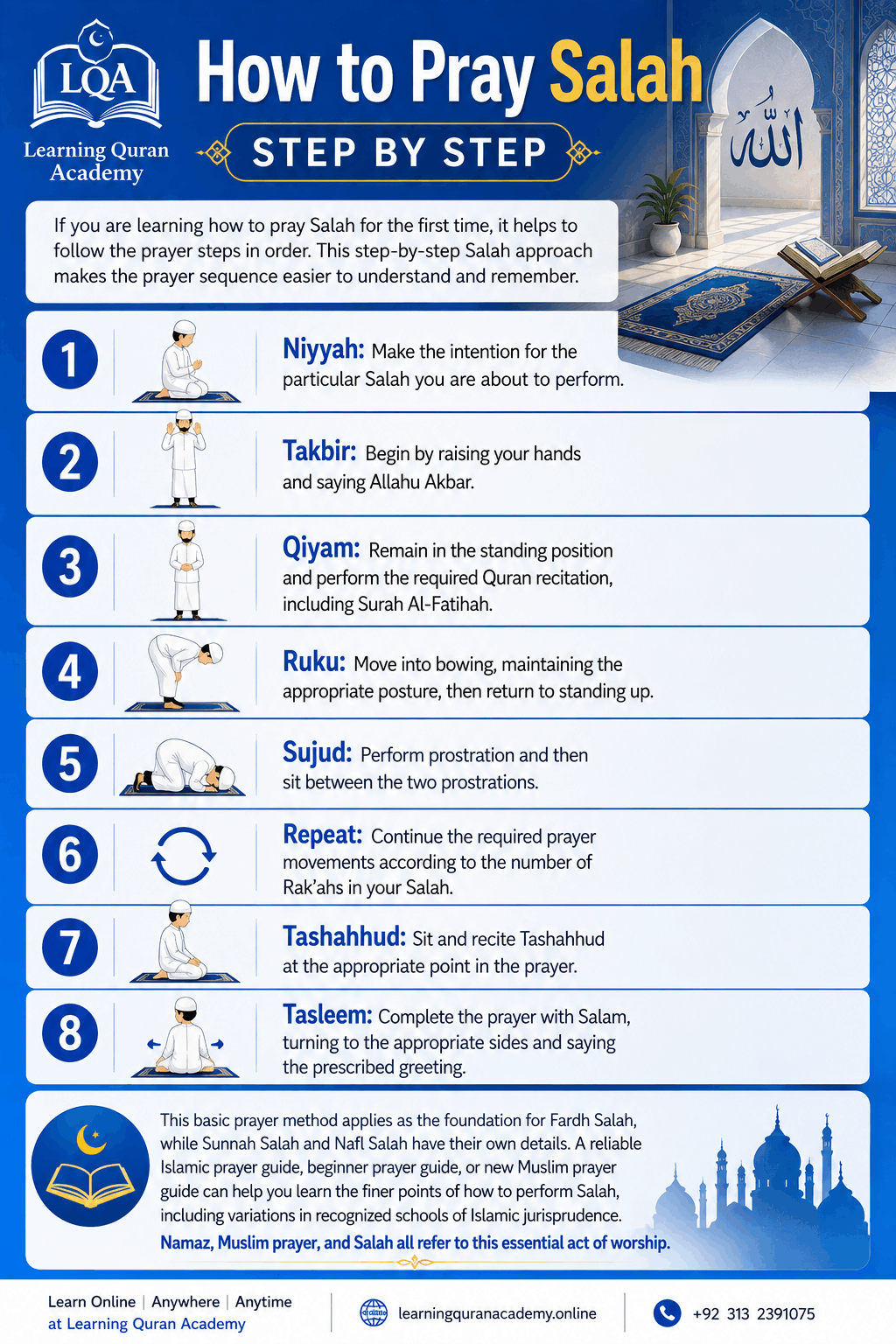
If you are learning how to pray Salah for the first time, it helps to follow the prayer steps in order. This step-by-step Salah approach makes the prayer sequence easier to understand and remember.
- Niyyah: Make the intention for the particular Salah you are about to perform.
- Takbir: Begin by raising your hands and saying Allahu Akbar.
- Qiyam: Remain in the standing position and perform the required Quran recitation, including Surah Al-Fatihah.
- Ruku: Move into bowing, maintaining the appropriate posture, then return to standing up.
- Sujud: Perform prostration and then sit between the two prostrations.
- Repeat: Continue the required prayer movements according to the number of Rak’ahs in your Salah.
- Tashahhud: Sit and recite Tashahhud at the appropriate point in the prayer.
- Tasleem: Complete the prayer with Salam, turning to the appropriate sides and saying the prescribed greeting.
This basic prayer method applies as the foundation for Fardh Salah, while Sunnah Salah and Nafl Salah have their own details. A reliable Islamic prayer guide, beginner prayer guide, or new Muslim prayer guide can help you learn the finer points of how to perform Salah, including variations in recognized schools of Islamic jurisprudence. Namaz, Muslim prayer, and Salah all refer to this essential act of worship.
How to Pray One Rak'ah Step by Step
This simple sequence shows how one Rak’ah is performed. Make your intention to pray through Niyyah in the heart; it does not need a long spoken formula. Some details, such as hand placement, differ between recognised schools of Islamic law.mymasjid+1
- Begin with Takbir and say Allahu Akbar
- Stand in the standing position, called Qiyam
- Place the right hand over the left hand below the navel
- Recite Ta’awwudh to seek refuge from Shaytan, then Bismillah
- Read Surah Fatihah as the required Fatihah recitation, followed by Quran recitation where applicable
- Move to Ruku for bowing, with hands on knees and the back straight; say Subhana Rabbiyal Adheem
- Return to standing up and say Sami Allahu liman hamidah, then Rabbana lakal hamd
- Go into Sujud, or prostration, with the forehead, nose, palms, knees, and toes on the ground; say Subhana Rabbiyal A’la
- Rise into sitting, called Jalsah, then perform the second Sujud
- At the final sitting, recite Tashahhud, raise the index finger as taught in your school, and finish with Tasleem and Salam to the right side and left side: Assalamu alaykum wa rahmatullah
What Do You Say During Salah?
The words of Salah combine Arabic recitation, Quran recitation, praise, and Dhikr. Learn the essential phrases first, listening to a reliable teacher or recitation recording so that your pronunciation develops steadily.
- Opening: Takbir: Allahu Akbar
- Before Al-Fatihah: Ta’awwudh and Bismillah hir Rahman nir Raheem
- Standing: Surah Al-Fatihah: Alhamdu lillahi Rabbil Alameen; Maliki Yawmid Deen; Iyyaka na’budu wa iyyaka nasta’een; Ihdinas Siratal Mustaqeem; Siratal latheena an’amta alayhim; then Ameen
- Bowing: Subhana Rabbiyal Adheem
- Rising from bowing: Sami’Allahu liman hamidah, followed by Rabbana lakal hamd
- Prostration: Subhana Rabbiyal A’la
- Between prostrations: Rabbighfir li as a brief prayer supplication
- Final sitting: Tashahhud, including Attahiyyat, then Salawat such as Allahumma salli ala Muhammad
- Ending: Salam: Assalamu alaikum wa rahmatullah
How to Learn Surah Al-Fatihah for Salah
Surah Al-Fatihah, also known as Surah Fatiha, is the first chapter of Quran. For a new Muslim or beginner, focus on careful Fatiha memorization, rather than speed. Listening, repeating, and checking pronunciation with a qualified teacher supports accurate Quran recitation.
1. Learn Bismillah: “Bismillah hir Rahman nir Raheem”
2. Learn Alhamdu lillahi Rabbil Alameen
3. Learn Ar-Rahman Ar-Raheem
4. Learn Maliki Yawmid Deen
5. Learn Iyyaka na’budu wa iyyaka nasta’een
6. Learn Ihdinas Siratal Mustaqeem
7. Complete the verse-by-verse recitation, then say Ameen
8. Repeat daily for memorization and improve your Arabic recitation
What Are Ruku and Sujud in Salah?
Ruku is the bowing position in which the worshipper keeps the back straight and places the hands on knees, saying Subhana Rabbiyal Adheem. After standing up from Ruku, the worshipper returns to the standing position.
Sujud, also called Sajdah, is prostration with the forehead, nose, palms, knees, and toes touching the ground. Say Subhana Rabbiyal A’la, then rise into sitting or Jalsah before the next prostration. These prayer movements demonstrate humility, submission, and worship of Allah.
Tashahhud and Ending the Prayer
In the final Rak’ah, the worshipper sits for Tashahhud and recites At-Tahiyyat, including the testimony of faith or Shahadah. The index finger is used according to the practice followed. The worshipper then recites Salawat, including Allahumma salli ala Muhammad, mentioning Prophet Ibrahim and seeking blessings and salutations.
The prayer ends with Tasleem or Salam, saying Assalamu alaikum wa rahmatullah toward the right side and left side, marking the end of prayer and completion of Salah.
Dua and Dhikr After Salah
After Salah, Muslims may make dua after Salah and engage in Dhikr, the remembrance of Allah. This time can be used for personal supplication, gratitude, Shukr, and seeking forgiveness and blessings.
- Make post-prayer supplication sincerely.
- Practice Allah’s remembrance through authentic Dhikr.
- Express Ameen after appropriate supplications.
- Continue worship and Ibadah beyond the prayer
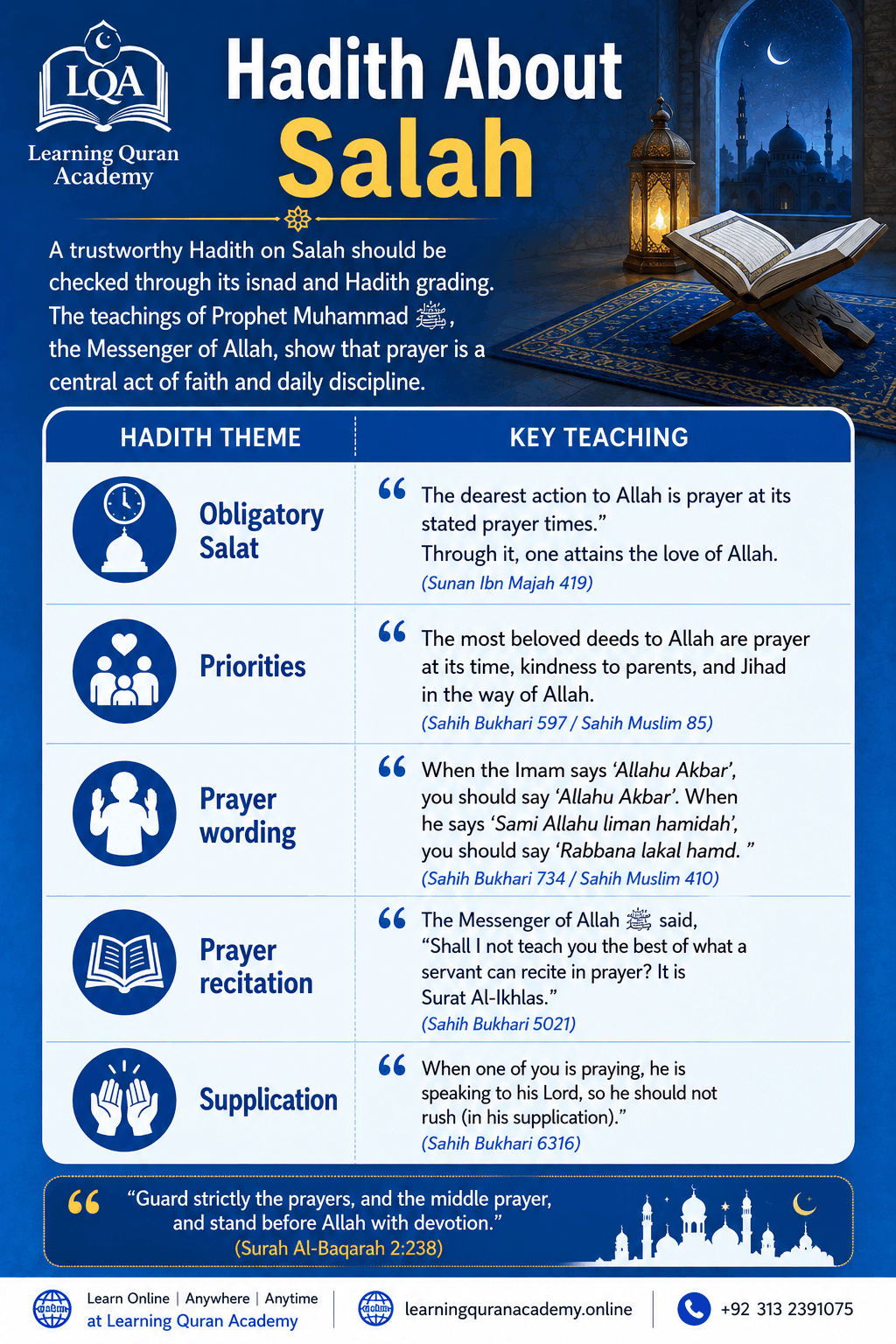
Hadith About Salah
A trustworthy Hadith on Salah should be checked through its isnad and Hadith grading. The teachings of Prophet Muhammad, the Messenger of Allah, show that prayer is a central act of faith and daily discipline.
- Obligatory Salat: Prayer at its stated prayer times is described as the dearest action and a means of attaining the love of Allah.
- Priorities: Kindness towards parents follows prayer, then Jihad in the way of Allah.
- Prayer wording: Reports include Takbir and Sami Allahu liman hamidah.
- Prayer recitation: Surat Al-Ikhlas may be included as a recitation after Al-Fatihah.
- Supplication: A believer may make supplication during suitable places in Salah.
- The narration about the dearest deed is reported from Abdullah ibn Mas‘ud in Al-Bukhari and Sahih Muslim.
Quran Verses About Salah
The Quran verses about Salah connect prayer with time, discipline, morality, and the remembrance of Allah. They encourage believers to establish prayer consistently as part of spiritual self-purification
- Surah Al-Baqarah 2:238: Guard the obligatory prayers, especially the middle prayer.
- Surah Hud 11:114: Pray at the two ends of the day and during parts of the darkness of night; good deeds remove wrong actions.
- Surah Al-Isra 17:78: Pray from the decline of the sun until night and observe the Qur’an of dawn.
- Surah Al-A’raf 7:31: Wear beautiful apparel when praying.
- Surah Al-Ankabut 29:45: Salah restrains a person from wrongdoing; remembrance of Allah is greatest.
- Surah Ar-Ra’d 13:28: Hearts find peace through the remembrance of Allah.
Common Questions New Muslims Have About Salah
These new Muslim prayer questions are normal. A beginner prayer guide should give confidence, not pressure: learn gradually, pray sincerely, and ask a qualified teacher when a ruling is unclear.
- How to pray Salah? Learn the prayer movements, recitations, Rak’ahs, and correct Qiblah direction step by step.
- How to learn Salah? Begin with Wudu, one prayer at a time, and daily repetition.
- Salah for beginners: what if I don’t know Arabic? Learn the essential Arabic gradually and seek reliable guidance.
- How long does it take to learn Salah? The basics can be learned steadily; confidence grows through practice.
- What if I make mistakes? Do not give up; correct Salah mistakes as you learn.
- How to memorize Surah Fatiha? Use short daily repetition, listening, and learning Arabic pronunciation.
- What about missed prayer? Ask a trusted scholar about your circumstances and make a plan to protect future prayer times.
Common Mistakes Beginners Make in Salah
Common Salah mistakes usually happen while a learner is becoming familiar with the prayer sequence. Watch for these beginner prayer mistakes:
- Incorrect Wudu, wrong Qiblah, or missing prayer time.
- Forgetting Surah Al-Fatihah or using an incorrect Takbir.
- An incorrect Rak’ah count, incorrect Ruku, or incorrect Sujud.
- Rushing Salah, poor pronunciation, or missing Tashahhud and Salam.
- Lack of concentration, unnecessary distractions, or an incorrect prayer posture.
Learning Salah as a New Muslim
A new Muslim or someone who has embraced Islam should approach learning Salah gradually. A practical prayer guide can take you through each stage:
- Beginner stage: Learn essential prayer movements, recitations, and memorize text.
- Intermediate stage: Improve prayer practice, pronunciation, and prayer confidence.
- Advanced stage: Deepen your understanding through Salah education and Islamic knowledge.
Learning from a qualified teacher and reliable Islamic source, following Prophet’s instruction, and maintaining regular practice makes gradual learning much easier.
How to Build a Daily Salah Routine
A consistent daily Salah routine begins by organizing the five daily prayers around your normal day. Create a simple prayer schedule using accurate prayer timings:
- Establish a regular Fajr routine, Dhuhr routine, Asr routine, Maghrib routine, and Isha routine.
- Prioritize consistency rather than trying to change everything at once.
- Connect daily worship with your existing worship routine.
- Use prayer as a regular moment of remembrance of Allah.
- Build discipline, strengthen faith, and support spiritual growth as part of your Muslim lifestyle.
Salah According to Quran and Sunnah
The correct understanding of Salah comes from the Quran and Sunnah, including the Sunnah of Prophet Muhammad, his Prophet’s practice, Hadith, and Quran. These sources provide Islamic guidance and Prophetic instruction regarding the Salah method, prayer movements, and prayer recitations.
The rulings of Fardh, Sunnah, and Nafl are discussed within Islamic jurisprudence, Fiqh, and different Madhhab or schools of thought, including Hanafi, Shafi’i, Maliki, and Hanbali. Some differences of opinion exist, so beginners should follow qualified scholarship and avoid assuming every difference invalidates an otherwise valid Salah.