Table of Contents
ToggleQuranic Verses on Self-Control: A Complete, Sourced Guide
Self-control is one of the most frequently discussed themes in Islamic scripture — but it’s also one of the most frequently mishandled online, where hadith get quoted as if they were Quranic verses, and vague paraphrases replace exact references. This guide keeps every source separate and checkable: what the Quran states directly, what the Hadith adds, and what scholarly commentary explains.
Quick Answer: What Do Quranic Verses on Self-Control Teach? The Quran teaches self-control through four themes: restraining anger (3:134), controlling desire or the nafs (79:40–41), practicing patience or sabr (2:45), and meeting provocation with calm instead of retaliation (7:199–200). Paired with authentic Hadith, these verses form a practical framework for managing anger, desire, and impulse in daily life — and, read together with the verses on worship and consistency below, they also form the basis for lasting self-discipline, not just momentary restraint.
What Does the Quran Directly Say About Self-Control?
Before going verse by verse, it helps to be clear about categories:
- What the Quran states directly: specific ayat instructing believers to restrain anger, resist the nafs’s inclination toward wrong, and practice patience.
- What the Hadith adds: the Prophet’s ﷺ own teaching on anger, defined as physical and emotional self-mastery, along with practical advice like changing position or performing wudu when angry.
- What later scholarship explains: commentary (tafsir) on how these verses apply — for example, what “guarding the nafs from hawa (desire)” means in daily practice.
Keeping these apart avoids a common mistake in articles on this topic: presenting a hadith as if it were Quranic text, or a scholar’s paraphrase as if it were a direct quotation.
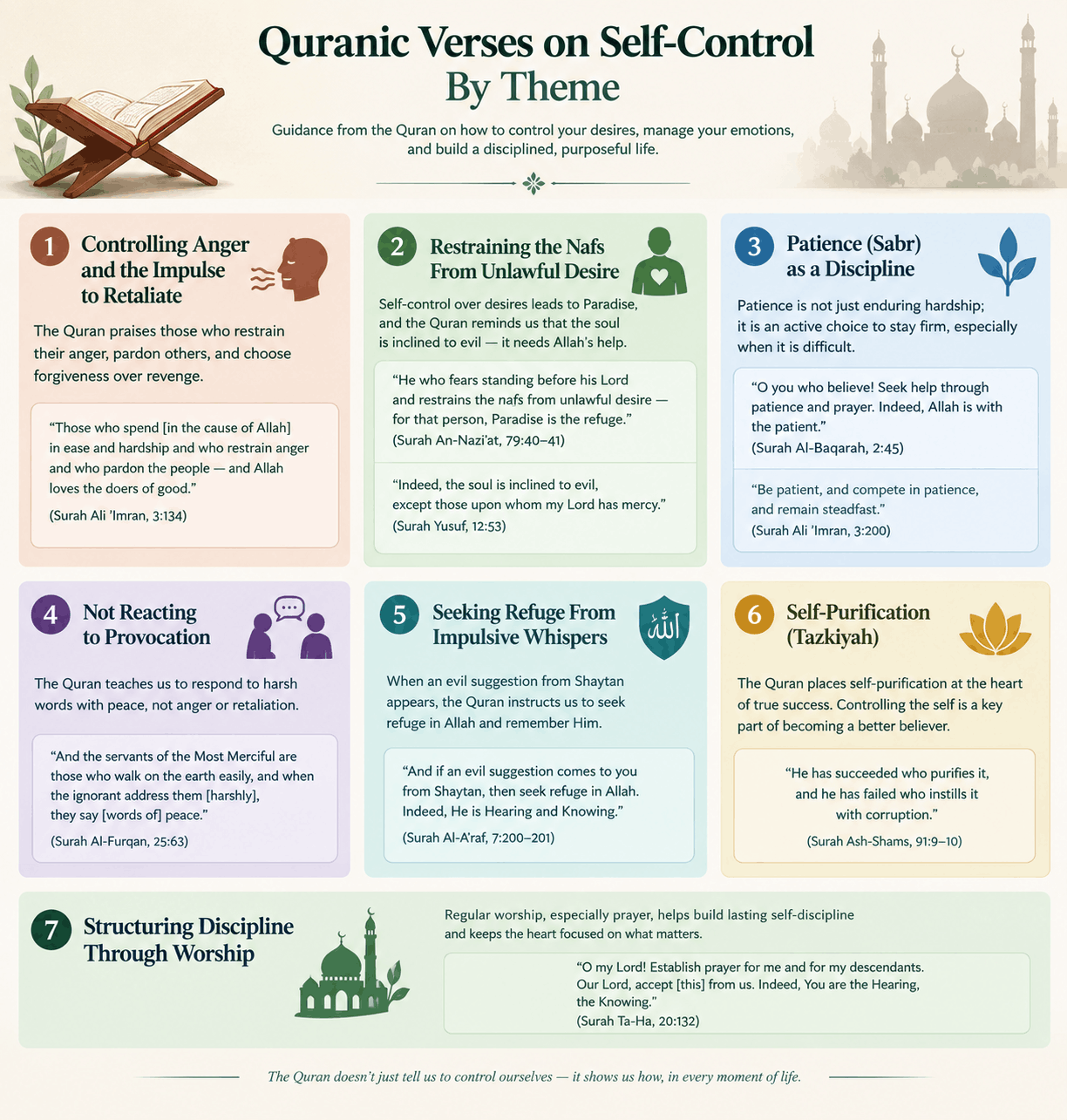
Quranic Verses on Self-Control, By Theme
1. Controlling Anger and the Impulse to Retaliate
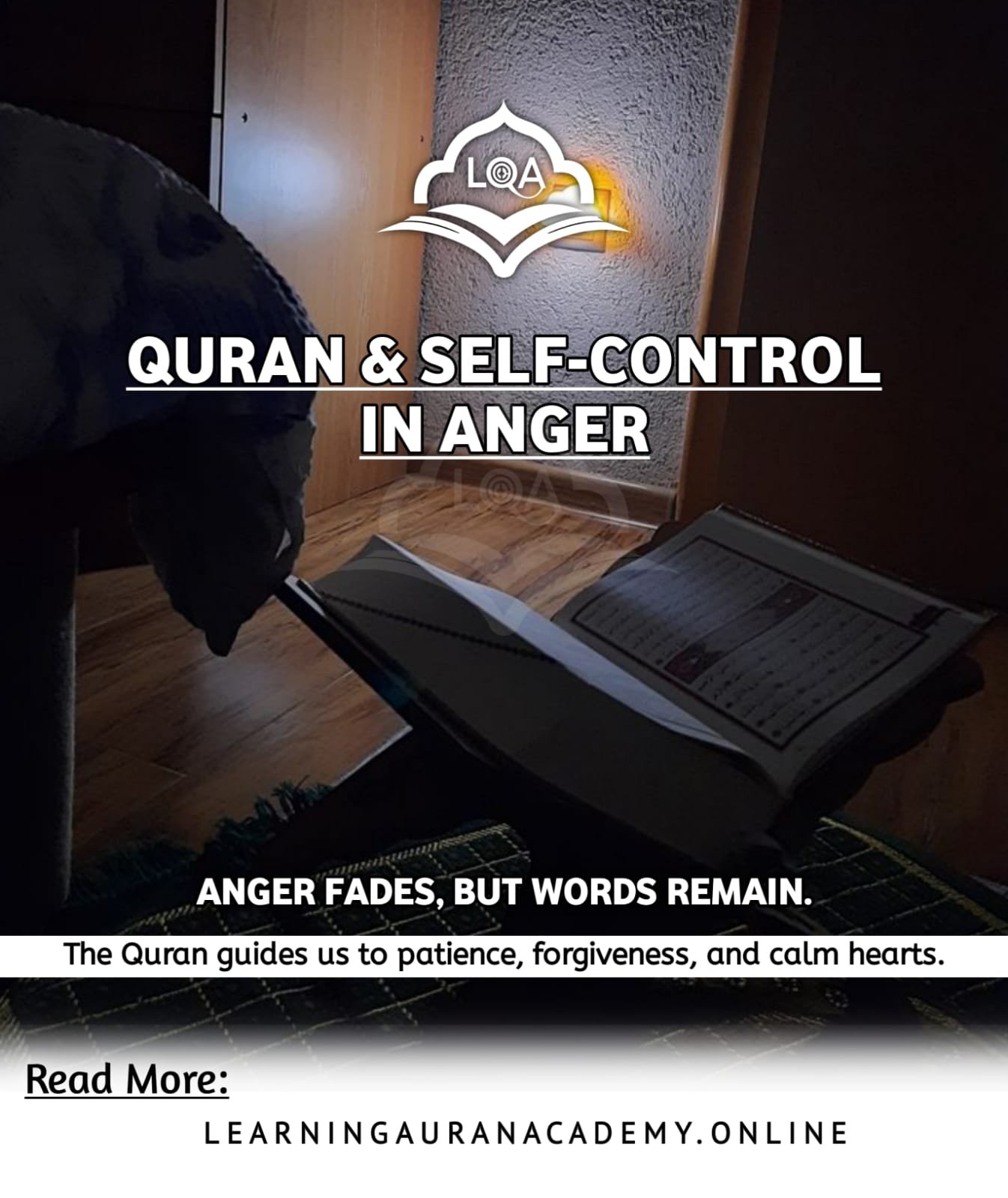
Surah Ali ‘Imran (3:134) describes the righteous as those who spend in ease and hardship, restrain their anger, and pardon people — paired directly with Allah’s love for those who do good.
Surah Ash-Shura (42:37) similarly praises those who avoid major sins and, when angry, forgive.
Surah Al-A’raf (7:199) instructs the Prophet ﷺ — and by extension believers — to hold to forgiveness, enjoin what is right, and turn away from the ignorant, rather than engage on their terms.
2. Restraining the Nafs From Unlawful Desire
Surah An-Nazi’at (79:40–41) states that whoever feared standing before their Lord and restrained the nafs from unlawful desire (hawa) — for that person, Paradise is the refuge. This is one of the Quran’s clearest single-verse statements connecting self-restraint directly to the afterlife.
Surah Yusuf (12:53) adds an important caution against self-righteousness on this point: even the verse’s speaker acknowledges that “the soul is inclined to evil, except those upon whom my Lord has mercy” — self-control is described as something built with Allah’s help, not pure willpower alone.
3. Patience (Sabr) as a Discipline
Surah Al-Baqarah (2:45) instructs believers to seek help through patience and prayer, noting that this is difficult except for the humbly submissive.
Surah Ali ‘Imran (3:200) commands believers to be patient, to compete in patience, and to remain steadfast — treating patience as something to actively build, not merely endure.
4. Not Reacting to Provocation
Surah Al-Furqan (25:63) describes the servants of the Most Merciful as those who walk on the earth without arrogance, and when the ignorant address them harshly, respond only with words of peace — a model of de-escalation rather than confrontation.
5. Seeking Refuge From Impulsive Whispers
Surah Al-A’raf (7:200–201) instructs that if an evil suggestion from Shaytan provokes a person, they should seek refuge in Allah — and notes that the God-conscious, when touched by such an impulse, remember Allah and immediately regain clarity. This treats self-control partly as a spiritual reflex to train, not only a willpower exercise.
6. Self-Purification (Tazkiyah)
Surah Ash-Shams (91:9–10) states directly that whoever purifies their soul has succeeded, and whoever corrupts it has failed — placing self-discipline at the center of what the Quran defines as success.
7. Structuring Discipline Through Worship
Surah Ta-Ha (20:132) instructs believers to enjoin prayer on their household and remain steadfast in it, tying regular worship to sustained self-discipline rather than treating them as separate goals.
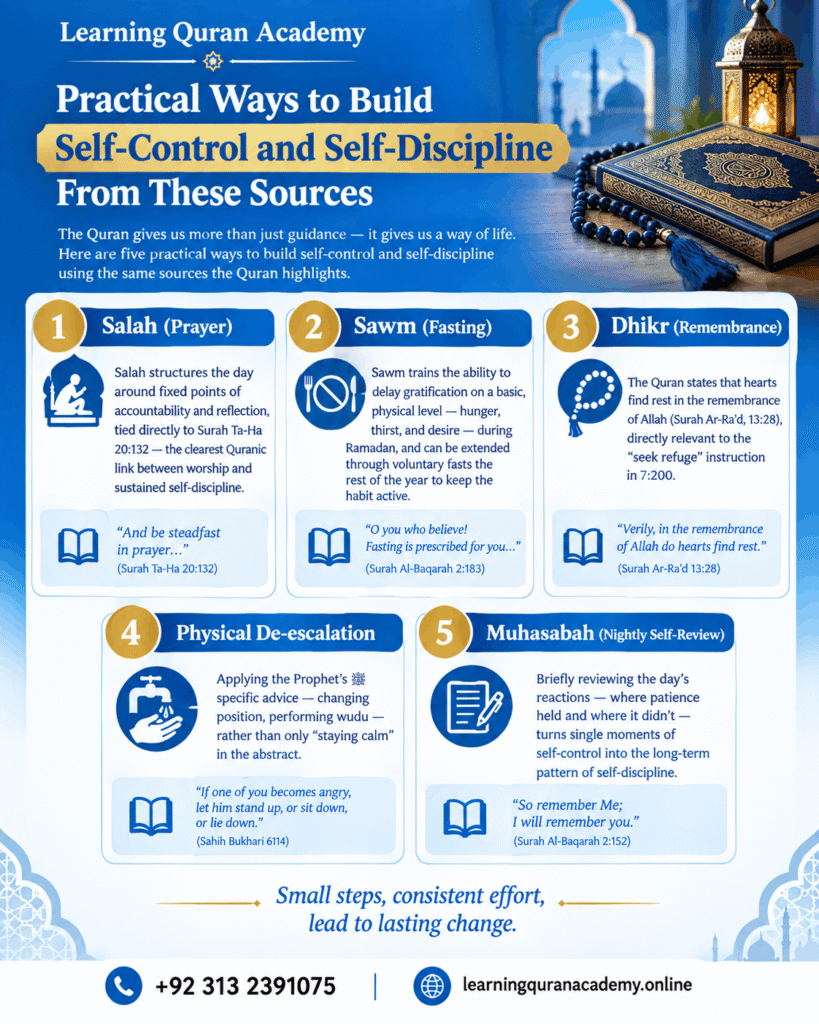
Self-Control vs. Self-Discipline in the Quran
1. Self-Control
Self-control means controlling your reaction at the moment of anger, temptation, desire, or provocation. Islam teaches Muslims to restrain themselves instead of acting on harmful impulses. The Quran praises those who restrain anger (3:134) and those who control their unlawful desires (79:40–41).
2. Self-Discipline
Self-discipline is built through regular and repeated practice. It means training yourself to remain committed to good actions even when they are difficult. Regular Salah, fasting, Dhikr, patience, and other acts of worship can strengthen this quality.
3. How They Work Together
Self-control helps you stop yourself from doing wrong in the present moment, while self-discipline helps you build habits that make good choices easier over time. In Islam, both are important for developing Taqwa and a strong character.
Simple example:
If someone makes you angry and you choose not to respond harshly, that is self-control. If you regularly practice patience and control your reactions in daily life, that is self-discipline.
What the Hadith Adds About Self-Control
The Sunnah gives practical shape to these Quranic principles, particularly around anger:
- Physical strength is not the standard. The Prophet ﷺ said: “The strong person is not the one who overpowers others, but the one who controls himself when angry” (Sahih al-Bukhari 6114; Sahih Muslim 2609).
- Suppressing anger carries a specific, weighty reward. The Prophet ﷺ said that whoever suppresses their anger while able to act on it, Allah will call them before all creation on the Day of Judgment and let them choose their reward (Sunan Abi Dawud 4777; Jami’ at-Tirmidhi 2021 — graded hasan).
- Practical de-escalation advice. The Prophet ﷺ advised that when angry, a person should sit down if standing, lie down if sitting, and perform ablution (wudu) to cool the physical response (Musnad Ahmad; graded hasan by several scholars) — a concrete step, distinct from the vaguer “remain silent” advice often circulated without a clear source.
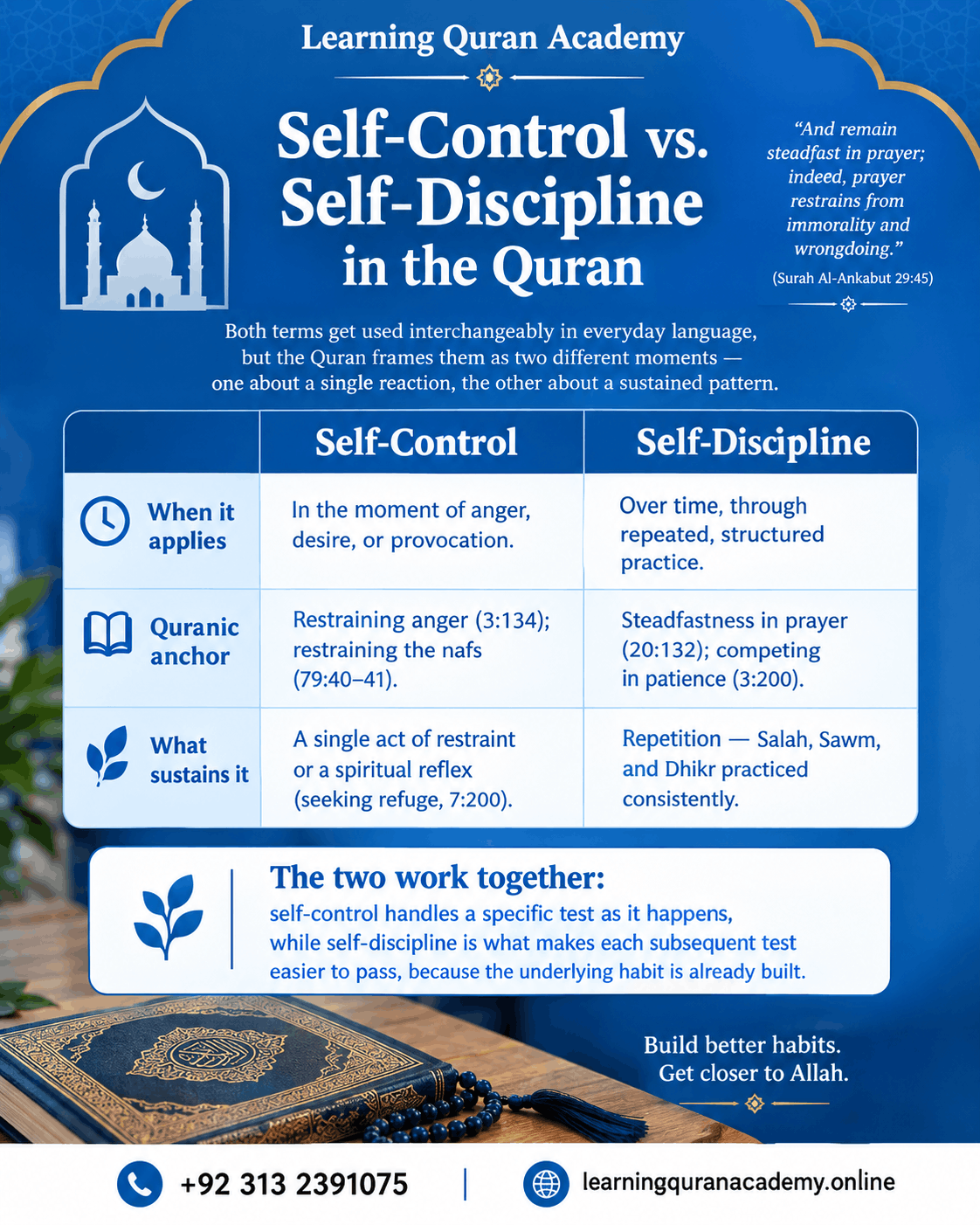
Practical Ways to Build Self-Control and Self-Discipline From These Sources
- Salah (prayer): structures the day around fixed points of accountability and reflection, tied directly to Surah Ta-Ha 20:132 — the clearest Quranic link between worship and sustained self-discipline.
- Sawm (fasting): trains the ability to delay gratification on a basic, physical level — hunger, thirst, and desire — during Ramadan, and can be extended through voluntary fasts the rest of the year to keep the habit active.
- Dhikr (remembrance): the Quran states that hearts find rest in the remembrance of Allah (Surah Ar-Ra’d, 13:28), directly relevant to the “seek refuge” instruction in 7:200.
- Physical de-escalation: applying the Prophet’s ﷺ specific advice — changing position, performing wudu — rather than only “staying calm” in the abstract.
- Muhasabah (nightly self-review): briefly reviewing the day’s reactions — where patience held and where it didn’t — turns single moments of self-control into the long-term pattern of self-discipline.