Table of Contents
ToggleTarbiyah in Islam: Meaning, Principles & Raising Righteous Children
A child can learn a hundred Islamic rules and still struggle to live by them.
A child can memorize Surah after Surah, know how to make wudu, and remind others to pray—but the deeper question is: What kind of person are they becoming?
This is where Tarbiyah in Islam becomes so important.
Tarbiyah is not simply teaching children what is halal and haram. It is the gradual process of nurturing their faith, character, manners, worship, emotional strength, and sense of responsibility so that Islamic values become part of who they are.
For parents, this means Tarbiyah does not happen only during Quran lessons or Islamic Studies classes. It happens at the dinner table, during disagreements between siblings, when a parent loses their temper, when a child makes a mistake, and in the ordinary moments that make up family life.
What Is Tarbiyah in Islam?
The Arabic word Tarbiyah (تربية) is commonly associated with nurturing, cultivating, upbringing, and development.
In an Islamic context, it is broadly used for the process of helping a person grow in faith, knowledge, character, worship, manners, and responsible conduct.
It is therefore broader than simply teaching information.
A useful way to understand the process is:
Knowledge → Understanding → Practice → Character → Consistency
A child may know that lying is wrong. Tarbiyah helps that child develop the honesty and self-control needed to tell the truth when lying would be easier.
A child may know that Salah is obligatory. Tarbiyah helps them gradually understand its importance and develop consistency in prayer.
Tarbiyah, Ta’lim and Ta’dib
These three terms are often discussed in Islamic educational thought:
- Ta’lim generally refers to teaching and acquiring knowledge.
- Ta’dib is associated with developing adab, manners, and refined conduct.
- Tarbiyah is commonly used more broadly for nurturing and developing a person over time.
The terminology can overlap, and scholars may use these words differently in different contexts. For parents, however, the practical lesson is clear: Islamic upbringing should develop both what a child knows and who that child becomes.
Why Is Tarbiyah Important in Islam?
Children are an amanah, a responsibility entrusted to parents.
Allah says:
“O you who have believed, protect yourselves and your families from a Fire…”
Surah At-Tahrim 66:6
Allah also says:
“And enjoin prayer upon your family and be steadfast therein.”
Surah Taha 20:132
These verses highlight two important aspects of parenting: guidance and consistency.
Parents are not simply responsible for providing food, clothing, education, and physical safety. They also have a responsibility to guide their families toward faith and righteous conduct.
But Tarbiyah does not produce instant results.
You cannot expect one conversation about honesty to produce an honest adult. You cannot expect one lecture about Salah to create lifelong consistency.
Character develops through repeated teaching, practice, example, encouragement, correction, and patience.
What Does the Quran Teach About Tarbiyah?
One of the clearest examples of parent-child Tarbiyah appears in Surah Luqman 31:13–19.
Luqman’s advice to his son covers several dimensions of development.
He begins with Tawhid, warning his son against shirk (31:13). He then teaches awareness of Allah, accountability for one’s deeds (31:16), Salah and responsibility toward good (31:17), patience, humility, and proper social conduct (31:18–19).
This is a powerful model of holistic Islamic upbringing.
Luqman did not teach his son only:
“Believe.”
He also taught him:
“Pray, be patient, behave with humility, and treat people properly.”
In other words:
Belief → Worship → Accountability → Character → Conduct
That is an important foundation for understanding Tarbiyah in the Quran.
Islamic Parenting: The Parent Is the First Teacher
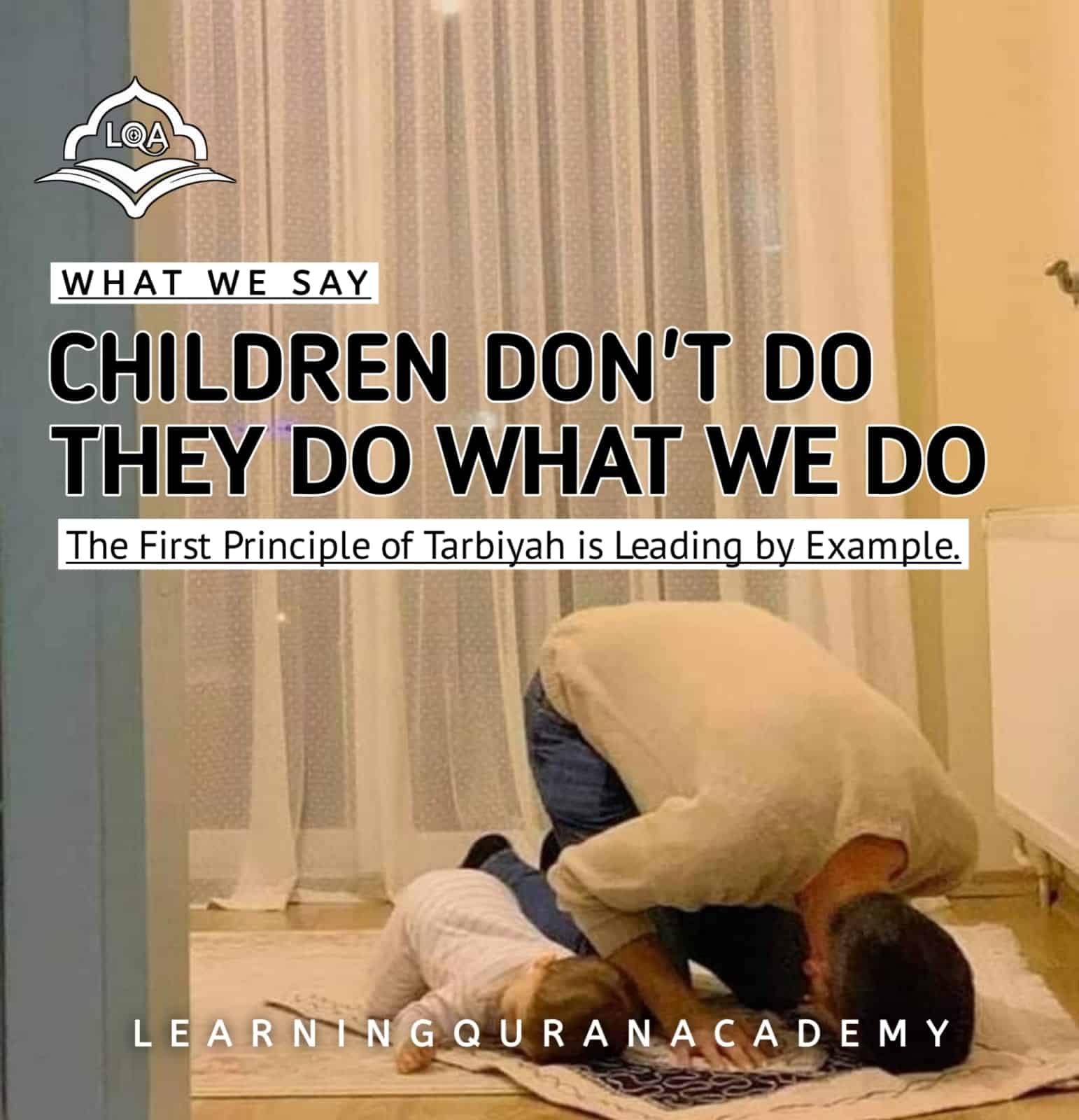
Islamic parenting begins with something parents sometimes overlook: their own behavior.
If you want your child to speak respectfully, they should regularly hear respectful speech from you.
If you want honesty, let them see you being honest when honesty costs you something.
If you want patience, let them see how you respond when something goes wrong.
Children certainly learn through direct instruction, but they also learn through observation and repetition.
Your behavior becomes part of their education.
This does not mean parents have to be perfect. In fact, allowing a child to see a parent admit a mistake and apologize can itself become a valuable lesson in humility and accountability.
Stages of Tarbiyah: How Islamic Upbringing Changes With Age
One mistake in parenting is assuming that the same method should work for a five-year-old, a ten-year-old, and a teenager.
Children’s understanding, emotional maturity, independence, and responsibilities change as they grow. Effective Tarbiyah should therefore develop with them.
Early Childhood: Building Love and Trust
In the early years, the emphasis should be on:
- love for Allah
- affection and security
- simple Islamic vocabulary
- Quran exposure
- good manners
- short duas
- stories from the Quran and Seerah
- learning through play and repetition
At this stage, children respond strongly to what they experience.
Instead of giving long explanations about gratitude, a parent can simply say:
“Alhamdulillah, Allah gave us this food.”
Small statements repeated over time can help create a natural Islamic worldview.
Middle Childhood: Building Habits and Responsibility
As children become more capable, parents can gradually introduce:
- regular Salah
- Quran reading
- Islamic responsibilities
- honesty and accountability
- household duties
- greater understanding of halal and haram
- age-appropriate discussions about behavior and consequences
This is where instruction and practice should increasingly work together.
Adolescence: Building Identity and Independent Judgment
Teenagers need a different kind of Tarbiyah.
They are beginning to ask:
- Who am I?
- Why am I Muslim?
- Why should I follow this rule?
- How do I deal with peer pressure?
- How should I respond to what I see online?
- What does Islam say about the issues I face?
At this stage, parents should not rely only on commands.
They should create opportunities for conversation, reasoning, trust, responsibility, and Islamic identity-building.
The goal is to help teenagers make sound decisions when their parents are not present.
7 Core Principles of Tarbiyah in Islam
1. Be the Role Model First
Children notice far more than parents realize.
They notice how you speak to your spouse, how you respond to mistakes, how you treat other people, and what happens when you become angry.
If parents want children with good akhlaq, they should make good akhlaq visible at home.
2. Build Love for Allah Alongside Rules
Islamic education should not become a long list of:
“Don’t do this.”
“Don’t do that.”
Children also need to understand who Allah is and why we worship Him.
Teach them to recognize Allah’s blessings. Help them understand that Salah is not merely a task to complete but an act of worship and connection with their Creator.
As children mature, these simple ideas can develop into deeper understanding of Tawhid, worship, accountability, gratitude, and reliance upon Allah.
3. Teach With Mercy and Wisdom
Discipline has a place in parenting, but Tarbiyah should not be reduced to punishment.
The Prophet ﷺ emphasized gentleness and mercy in his interactions.
He also taught parents about gradually establishing Salah during childhood. The well-known narration in Sunan Abi Dawud, Hadith 495 instructs parents to command children to pray at seven and mentions a further disciplinary instruction at ten.
The important lesson for parents is that religious responsibility should be taught progressively, not introduced suddenly when a child is older.
Correction should teach the child what was wrong, why it matters, and what they can do differently.
4. Be Fair Between Your Children
Children are highly sensitive to unfair treatment.
Islam places strong emphasis on justice between children. The Prophet ﷺ rejected favoritism when a parent wanted him to witness a gift given to one child.
The narration is recorded in Sahih al-Bukhari, Hadith 2587, and Sahih Muslim, Hadith 1623.
Fairness does not always mean treating every child identically. Children have different ages, needs, personalities, and circumstances.
The goal is to avoid unjust favoritism and give each child appropriate care and attention.
5. Keep Emotional Connection at the Center
The Prophet ﷺ demonstrated affection and mercy toward children.
When Aqra’ ibn Habis saw the Prophet ﷺ kissing his grandson, Al-Hasan ibn Ali, he remarked that he did not kiss his own children. The Prophet ﷺ responded:
“Whoever does not show mercy will not be shown mercy.”
Sahih al-Bukhari 5997; Sahih Muslim 2318.
This provides an important lesson for Islamic parenting:
Correction should not destroy connection.
Play with your children.
Listen to them.
Ask about their day.
Give them affection.
Let them know they can come to you when they are confused, afraid, or struggling.
6. Make Dua for Your Children
Parents can teach, advise, model, encourage, and provide opportunities—but guidance ultimately belongs to Allah.
Allah records the supplication:
“Our Lord, grant us from among our wives and offspring comfort to our eyes and make us an example for the righteous.”
Surah Al-Furqan 25:74
Dua should therefore be part of family Tarbiyah.
Do not make dua only when your child has a problem. Ask Allah regularly for their iman, character, knowledge, righteous companions, and steadfastness.
7. Teach Responsibility, Not Just Obedience
The goal of Tarbiyah is not simply to produce a child who obeys while a parent is watching.
The long-term goal is to help develop a Muslim who can make good decisions when nobody is watching.
Give children age-appropriate responsibilities.
Let them help at home.
Teach them to keep promises.
Allow reasonable consequences for poor choices.
Teach them how to solve problems rather than solving every problem for them.
This gradually develops confidence, resilience, responsibility, and independent judgment while keeping those qualities rooted in Islamic values.
How Tarbiyah Builds Islamic Character
Good Tarbiyah should eventually become visible in a child’s akhlaq.
Parents should intentionally cultivate qualities such as:
- honesty
- patience
- gratitude
- humility
- mercy
- self-control
- respect
- responsibility
- courage
- forgiveness
But character should not be taught only through definitions.
For example, instead of merely saying:
“You must be patient.”
A parent can say:
“I know you’re disappointed, but let’s be patient and think about what we can do next.”
The child then experiences patience instead of simply hearing about it.
That difference is at the heart of effective Islamic character building.
Raising Muslim Children in a Changing World
Today’s children encounter influences through social media, online entertainment, school environments, friendships, and wider culture.
Simply telling children to avoid every outside influence is rarely enough.
They also need the faith, knowledge, confidence, and judgment to navigate those influences.
A strong Tarbiyah process should help develop:
- a confident Muslim identity
- emotional resilience
- self-control
- critical thinking
- good judgment
- respect for others
- courage to resist harmful peer pressure
- the ability to recognize right and wrong
- a strong relationship with Allah
The goal is not to raise children who behave well only when they are inside the home.
It is to raise Muslims who can carry their values with them wherever they go.
Practical Tarbiyah Tips for Parents
You do not need a complicated parenting program to begin.
Try these simple habits:
Connect everyday life with Allah
When something good happens, teach children to recognize the blessing and say Alhamdulillah.
Build a regular Quran routine
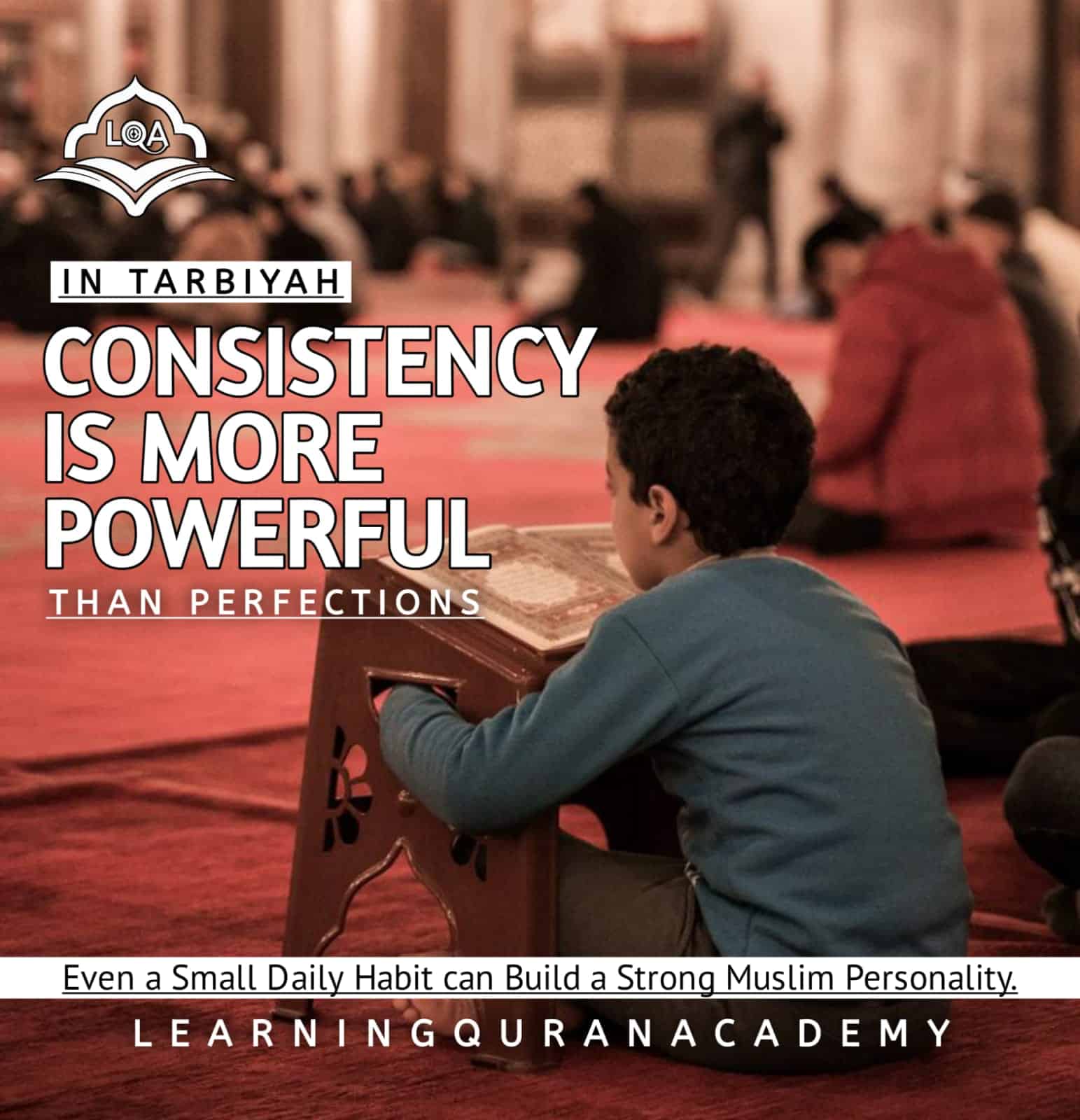
Even a short daily session can become a meaningful lifelong habit.
Explain the “why”
Instead of always saying “because I said so,” give children an age-appropriate reason.
Use stories
Stories from the Quran and authentic Seerah can make Islamic values easier to understand.
Give children responsibility
Small household responsibilities teach trustworthiness and accountability.
Correct without humiliating
Explain what was wrong and help the child understand how to correct it.
Praise character
Do not praise only grades and achievements. Notice honesty, effort, kindness, patience, and responsibility.
Make family dua
Teach children that they can turn to Allah with both their problems and their blessings.
Common Mistakes That Weaken Tarbiyah
Even parents with good intentions can make mistakes.
Teaching Islam without modeling it
Children quickly notice contradictions between words and behavior.
Focusing only on punishment
Fear may produce temporary compliance, but it does not automatically create understanding or love for Islam.
Expecting instant results
Character develops gradually.
Comparing siblings
Constant comparison can damage confidence and create resentment.
Ignoring emotional needs
Spiritual education and emotional connection should support each other.
Leaving all Islamic education to teachers
Teachers are important, but parents remain central to a child’s everyday environment.
Tarbiyah Is a Lifelong Process
Although Tarbiyah is often discussed in relation to children, spiritual and moral development does not stop at childhood.
Parents also need to continue improving their patience, sincerity, worship, and character.
Sometimes one of the strongest Tarbiyah lessons a parent can give is:
“I made a mistake. I was wrong. Please forgive me.”
That moment can teach humility, accountability, and repentance more powerfully than a long lecture.
Learn Islamic Parenting and Tarbiyah With Learning Quran Academy
Understanding the principles of Tarbiyah is one thing. Applying them consistently in family life is another.
At Learning Quran Academy, Islamic learning can be approached as more than memorizing information. Quran education, Islamic knowledge, manners, and character development can work together to help students build a stronger foundation.
Parents looking for structured guidance can explore our Islamic Parenting and Tarbiyah Course.
Explore the Islamic Parenting and Tarbiyah Course
If you are looking for structured Quran learning for yourself or your child, you can also: