
Types of Tafsir With Examples
The Holy Qur’an is the final and perfectly preserved Book of Allah Almighty, revealed not for a single nation or a specific era, but as guidance for all humanity until the Day of Judgment.
Exploring the meanings of the Qur’an requires interpretation, and a true understanding is attained through Tafsir. While mere recitation alone is not sufficient to fully grasp its verses, rulings, and deep wisdom, the systematic study of the Qur’an provides the aid needed to deepen one’s understanding.
In this article, I will share my insights on Types of Tafsir With Examples, guiding readers through the different approaches that enrich comprehension and provide meaningful exploration of the Quranic text.
Scholars of Islam have developed various approaches and methods to explain the Qur’an, combining academic rigor with spiritual insight. These exercises in interpretation offer multiple perspectives, allowing readers to engage in a significant journey of learning and exploration.
This blog will examine the main types of Tafsir in a clear, simple, and approachable manner, making them accessible for everyday students of the Qur’an. The aim is to provide a diverse, timeless understanding while fostering appreciation for the depth of Qur’anic knowledge.
Table of Contents
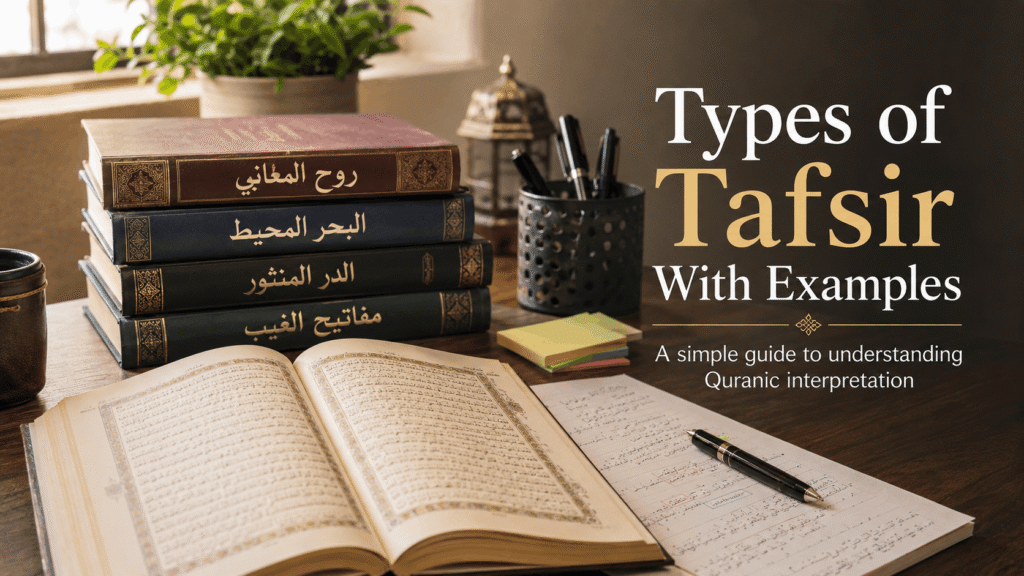
Definition of Tafsir & Types of Tafsir With Examples
In my experience, studying the Quran deeply over the years has shown that Tafsir (تفسير) is more than just explanation; it is a meticulous science that uncovers the meanings of Quranic verses, their implications, lessons, and rulings.
It helps explore the depths of Allah’s guidance, clarify complex points, and enhance understanding. Tafsir derives meaning from context, knowledge, and textual study, offering elucidation and insight, making the rich word of the Quran accessible while helping seekers of knowledge appreciate its meaning.
Importance of Different Types of Tafsir
The Quran was revealed over 23 years, addressing varied situations and audiences in a rich, multi-layered language filled with parables, metaphors, and concise expressions. Different types of Tafsir emerged to address multiple levels of understanding, from literal meaning to spiritual insights, while considering historical context and circumstances of revelation (Asbab al-Nuzul).
They help reconcile confusions, clarify contradictory verses at first glance, derive legal rulings in Islamic law (Fiqh), and explore linguistic nuances, appreciating the beauty, precision, and depth of Arabic.
Read more:Tafsir of surah al kawthar meaning and lessons
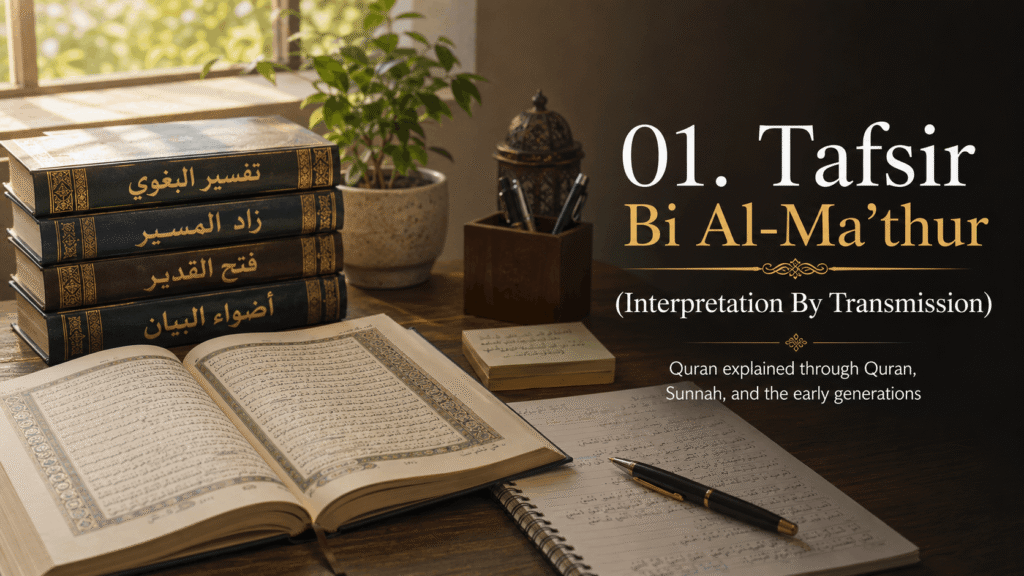
01. Tafsir Bi Al-Ma’thur (Interpretation By Transmission)
From My Years Of Study, I’ve Found That Tafsir Bil-Ma’thur Is The Most Authentic And Preferred Type For Interpreting The Quran Because It Relies On Reliable Sources Of Islamic Knowledge, Emphasizing Textual Authority And Traditional Guidance. Scholars Use This Methodology To Ensure Clarity, Understanding, And Authenticity, Referencing The Main Accepted Sources To Derive Explanation And Insight.
Cross-Referencing Quranic Verses
By Cross-Referencing One Quranic Verse With Another, Scholars Provide Elucidation, Meaning, And Guidance, Revealing Interconnected Interpretations And Contextual Understanding Of The Revelation.
Guidance Through The Sunnah
The Prophet Muhammad (Pbuh) As The Foremost Interpreter Offers Explanation Through Sayings, Actions, Approvals, And Hadith, Providing Clarification, Textual Insight, And Guidance Drawn From The Sunnah, Establishing Authority And Teaching.
Insights From The Companions
The Sahaba Conveyed Their Interpretations Of Quranic Verses Based On The Prophet’s Revelations, Offering Textual Elucidation, Authority, Context, And Guidance, As They Were Direct Witnesses To The Tradition.
Lessons From The Successors
The Tabi’in, Or Successors, Learned From The Companions, Providing Explanations, Textual Insight, Contextual Understanding, And Tradition-Based Guidance, Ensuring Authority And Clarity In Interpretation.
Example: Surah Al-Fatiha, Ayah 7
“The Path Of Those Upon Whom You Have Bestowed Favor, Not Of Those Who Have Evoked [Your] Wrath Or Of Those Who Are Astray” (Surah Al-Fatiha, Ayah 7). This Clear And Authentic Interpretation Distinguishes The Jews As Evoked Wrath And Christians As Astray, Exemplifying The Prophet Muhammad’s (Pbuh) Sunnah As A Guide For Textual Understanding And Insight.
Explanation Of Tafsir Bil-Ma’thur
Tafsir Bil-Ma’thur Provides An Explanation Based On The Prophet Muhammad (Pbuh), Highlighting Evoked Wrath For Jews And Astray For Christians, Emphasizing Sunnah, Textual Authority, Clarity, Guidance, Tradition, And Deeper Understanding, Offering Insight And Elucidation.
02. Tafsir Bil-Ra’y (Interpretation By Opinion/Reason)
In My Experience, Tafsir Bil-Ra’y (Also Called Bil-Dirayah Or Bil-Ma’qul) Thrives On Independent Reasoning And Intellect, Allowing Scholars To Analyze The Quran Within The Bounds Of Islamic Principles And Established Knowledge.
This Methodology Requires Careful Study, Evaluation, And Insight To Distinguish Praiseworthy Interpretations From Blameworthy Ones, Ensuring Comprehension, Accurate Analysis, And Proper Understanding Of The Text Through Thoughtful Reasoning And Intellectual Interpretation.
Attributes Of Praiseworthy Tafsir Bil-Ra’y
Praiseworthy Tafsir Bil-Ra’y Applies Arabic Linguistics, Grammar, Morphology, And Semantics, Considers Asbab Al-Nuzul And Circumstances Of Revelation, And Accounts For Abrogated And Abrogating Verses (Nasikh Wa Mansukh). Scholars Integrate Fiqh, Jurisprudence, Hadith, Usul Al-Fiqh, And Salaf Predecessors’ Interpretations To Ensure Sound Reasoning, Intellectual Analysis, And Approved Understanding.
Risks Of Blameworthy Tafsir Bil-Ra’y
Blameworthy Tafsir Bil-Ra’y Occurs When Personal Opinions Or Desires Override Essential Islamic Knowledge, Leading To Misinterpretation, Deviation, Inadequate Comprehension, Misguidance, And Intellectual Error, Highlighting The Importance Of Cautious Methodology And Scholarly Evaluation.
Example: Observing Ramadan
“The Month Of Ramadan Is That In Which Was Revealed The Quran, A Guidance For The People And Clear Proofs Of Guidance And Criterion. So Whoever Sights [The New Moon Of] The Month, Let Him Fast It” (Surah Al-Baqarah, Ayah 185).
Application Of Tafsir Bil-Ra’y
Scholars Using Tafsir Bil-Ra’y Examine The Linguistic Implications Of Sighting The Moon, Debating Personal, Collective, Or Astronomical Calculations, Applying Arabic Knowledge, Islamic Law Principles, And Intellectual Effort To Derive Practical Rulings For The Start Of Ramadan, Balancing Local And Global Schools Of Thought Within An Established Methodology.
03. Tafsir Al-Ilmi (Scientific Interpretation)
In My Experience, Tafsir Al-Ilmi Bridges The Quranic Verses With Modern Scientific Discoveries And Theories, Highlighting The Miraculous Consistency Of The Quran With Observable Facts.
This Approach Relies On Careful Observation, Analysis, And Reasoning, Integrating Textual Study, Methodology, And Empirical Evidence To Provide Meaningful Guidance, Deeper Understanding, And Insightful Interpretation Of Phenomena Described In The Quran, Ensuring That Spiritual Insight And Validation Coexist With Scientific Exploration.
Example: Observing Darkness In The Deep Sea
“Or [They Are] Like Darknesses Within An Unfathomable Sea That Is Covered By Waves, Above Which Are Waves, Above Which Are Clouds Of Darkness… And He To Whom Allah Has Not Granted Light—For Him There Is No Light” (Surah An-Nur, Ayah 40).
Application Of Tafsir Al-Ilmi
Scholars In Tafsir Al-Ilmi Study Modern Oceanography, Observing Internal Waves In Deep Oceans That Are Distinct From Surface Waves, Using The Verse To Interpret The Layered Phenomena, Providing Insight, Foresight, And Enhanced Understanding, While Combining Textual Interpretation, Scientific Observation, And Critical Reasoning To Connect Quranic Knowledge With Contemporary Discoveries.
04. Tafsir Al-Fiqhi (Jurisprudential Interpretation)
In Studying Tafsir Al-Fiqhi, I Found That It Carefully Derives Legal Rulings And Practical Applications From Quranic Verses Dealing With Commandments, Prohibitions, And Regulations, Providing A Structured Framework For Islamic Law. Through Detailed Textual Analysis, Study, And Examination, This Methodology Offers Deep Understanding, Precise Interpretation, And Actionable Guidance, Connecting Principles, Jurisprudence, And Real-World Applications While Maintaining Scholarly Insight Into The Quran.
Example: Clarifying Trade And Interest
“But Allah Has Permitted Trade And Has Forbidden Interest (Riba)” (Surah Al-Baqarah, Ayah 275).
Application Of Tafsir Al-Fiqhi
Tafsir Al-Fiqhi Examines Riba In Its Various Forms—Riba An-Nasi’ah, Riba Al-Fadl, And Unequal Exchange In Commodities—Highlighting The Difference Between Legitimate Trade And Prohibited Dealings, Integrating Sunnah, Principles Of Jurisprudence, And Careful Observation To Provide Precise Legal Rulings, Thoughtful Interpretation, And Comprehensive Guidance For Financial Transactions In Islamic Practice.
05. Tafsir Al-Lughawi (Linguistic Interpretation)
Exploring Tafsir Al-Lughawi Has Shown Me How Linguistic Tafseer Delves Into The Quran’s Vocabulary, Grammar, Syntax, Rhetoric, And Balagha, Revealing The Literary Beauty And Precise Meaning Of Words And Phrases As Understood By The Arabs. Through Textual Analysis, Study, And Elucidation, This Approach Enhances Comprehension, Providing Insight, Interpretation, And Guidance In Context While Clarifying The Language And Meaning Of The Quran.
Example: The Word “Ummah” (أمة)
The Ummah In The Quran Reflects A Nation, Community, Or Group Of People, With Context, Concept, And Usage Clarified Through Study, Textual Analysis, And Elucidation, Guiding Accurate Interpretation.
Tafsir Al-Lughawi Explanation
Tafsir Al-Lughawi Explains Ummah Across Contexts, Highlighting Connotations, Roots, Periods Like Ummatin Ma’dudah, Exemplary Leaders Such As Abraham, And The Obedience To Allah, Emphasizing Method, Accuracy, Richness, Precision, And Understanding Of The Arabic Language In Every Verse.
06. Tafsir Al-Ishari (Symbolic/Allusive Interpretation)
Exploring Tafsir Al-Ishari Reveals The Deeper, Subtle, And Spiritual Meanings Of Quranic Verses, Connecting Sufi And Mystical Experiences To Literal Meaning, While Uncovering Hidden Signs, Allusions, And Symbolic Insight. Through Textual Analysis, Study, Elucidation, And Careful Comprehension, This Approach Provides Profound Guidance, Understanding, And Interpretation Of The Quranic Text.
Caution
Tafsir Al-Ishari Must Be Approached With Caution And Extreme Care, Ensuring It Does Not Contradict The Literal Meaning Of The Quran, The Sunnah, Or Consensus Of Early Scholars, Avoiding Blameworthy Misguidance While Enhancing Spiritual Knowledge, Study, And Principled Understanding.
Example
Consider Surah Al-Kahf, Ayah 60-82, Narrating The Story Of Musa (Moses) And Al-Khidr, Describing Events, Characters, And Lessons In The Text, Providing Guidance, Understanding, And Insight Into Revelation.
Tafsir Al-Ishari Explanation
Tafsir Al-Ishari Interprets The Literal Story—Boat, Boy, Wall—As Symbolic Of The Material World, Damaged Or Detached In The Spiritual Journey, Facing Tyrannical Kings, Desires, And Oppressive Rulers. Killing Or Suppressing Nafs, Repairing And Rebuilding Inner Foundations, Supporting The Weak, Reflects Divine Wisdom, Mercy, Spiritual Purification, Character Development, And Profound Insight Into The Narrative.
07. Tafsir Al-Ma’na (Interpretation Of Meaning)
Tafsir Al-Ma’na Emphasizes The Meanings Of Words And Phrases In The Quran, Analyzing Linguistic And Grammatical Elements To Enhance Interpretation, Explanation, And Understanding. Through Detailed Study, Textual Analysis, Comprehension, Elucidation, And Critical Insight, Scholars Can Reveal The Depth Of The Quranic Text While Maintaining Clarity And Precision.
Characteristics
This Approach Relies On Linguistic Analysis Of Word Roots, Syntax, And Semantics To Clarify Meaning, Expression, And Understanding, Aiming To Elucidate The Text In A Straightforward Manner While Combining Interpretation, Comprehension, Study, Textual Analysis, And Insight.
Examples
Tafsir Al-Ma’na Is Prevalent In Works Focused On Clarifying Quranic Language, Such As The Writings Of Ibn Ashur And Al-Suyuti, Where Explanation, Interpretation, Understanding, Textual Study, Analysis, And Insight Converge To Deepen Appreciation Of The Quranic Text.
08. Tafsir Al-Nasikh Wa Al-Mansukh (Interpretation Of Abrogation)
Tafsir Al-Nasikh Wa Al-Mansukh Examines Verses Of The Quran That Abrogate (Nasikh) Or Are Abrogated (Mansukh) By Others, Providing Interpretation, Explanation, Understanding, Textual Study, Analysis, And Insight. This Method Allows Scholars To Trace The Evolution Of Revelation And Understand The Dynamic Nature Of Quranic Rulings While Maintaining Clarity In Textual Comprehension.
Characteristics
It Highlights Legal Implications, Tracks Changes In Rulings And Laws Within Islamic Jurisprudence, And Requires Contextual Awareness Of The Chronological Order Of Revelation, Combining Interpretation, Study, Analysis, Guidance, And Insight.
Examples
Scholars Like Ibn Al-Jawzi Have Addressed This Topic, Emphasizing The Dynamic Nature Of Quranic Revelation, Where Interpretation, Explanation, Study, Analysis, Understanding, And Insight Are Essential For Legal And Historical Clarity.
09. Tafsir Al-Tafsir (Commentary On Commentaries)
Tafsir Al-Tafsir Involves Commentary On Existing Works, Aiming To Elaborate, Critique, Or Provide Alternative Interpretations. This Method Enhances Explanation, Understanding, Textual Study, Analysis, And Insight, Allowing Scholars To Engage With Past Tafseer In A Meaningful Way And Refine Previous Perspectives.
Characteristics
It Employs Intertextual Analysis Of Previous Tafsir, Helping Scholarly Discourse Build Or Challenge Established Interpretations, Contributing To The Broader Conversation In Islamic Scholarship, And Enriching Study, Understanding, Explanation, Textual Evaluation, And Insight.
Examples
Scholars Like Al-Maturidi And Al-Ma’mar Have Produced Works That Critique Or Expand Previous Tafsir, Providing Deeper Interpretation, Explanation, Study, Analysis, Understanding, And Insight.
Benefits Of Enrolling In An Academy For Online Quran Tafseer Course
Flexibility And Global Accessibility
Enrolling In Learning Quran Academy Offers Flexible, Affordable, Access To Online Quran Tafseer Courses For Students Worldwide, From The States, Middle East, Europe, Or Asia. Classes Adapt To Any Location, Ensuring Muslims Across The Globe Gain Genuine Islamic Information, Participation, Learning, Study, Guidance, And Understanding Without Barriers.
Personalized Guidance And Interactive Learning
With Individualized Direction, Customized One-Against-One Sessions With Scholars Allow Students To Clarify Queries, Correct Misconceptions, And Deepen The Meanings Of The Quran. Participatory Media Like Live Sessions, Discussion Boards, And Groupwork Enrich Study, Guidance, Understanding, Engagement, And Insight.
Affordable Access To Islamic Education
Learning Quran Academy Provides Affordable Islamic Education By Minimizing Travel And Accommodation Costs. Cheap Course Bundles Make Learning, Study, Education, Guidance, Understanding, Participation, And Knowledge Accessible Even To Resource-Poor Students.
Conclusion
Understanding The Different Types Of Tafsir With Examples Enhances Our Appreciation Of The Quran’s Depth And Wisdom.
While Tafsir Bil-Ma’thur Forms The Basis For An Authentic Understanding, Exploring Other Approaches Can Offer Valuable Insights Into The Quran’s Legal, Linguistic, Scientific, And Spiritual Dimensions When Studied Responsibly With Proper Knowledge.
To Gain A Comprehensive Grasp Of These Interpretations, Join The Exclusive Online Quran Tafseer Course At Learning Quranacademy And Benefit From Personalized Guidance,Interactive Learning, Expert Consultation, And Personalized Guidance To Deepen Your Understanding Of The Quranic Verses And Explore What We Learn From Quran.
Faq Types Of Tafsir With Examples
What Are The Methods Of Tafseer?
The Main Methods Of Tafseer Include Qura1n By Quran, Tafseer By Sunnah, Companions’ Interpretations, Language-Based Analysis, And Opinion-Based Reasoning. Scholars Follow These Steps To Ensure Accurate Understanding, Guidance, And Insight Into Quranic Verses.
What Are The Six Sources Of Tafsir?
Six Primary Sources Of Tafsir Are The Quran Itself, Authentic Hadith, Narrations Of Companions, Narrations Of Successors, Arabic Language Analysis, And Reasoned Deduction. These Sources Provide Accurate Interpretation, Insight, And Understanding Of Quranic Guidance.
What Are The Different Types Of Interpretation Of The Quran?
Scholars Interpret The Quran Through Various Methods Including Tafsir Bil-Ma’thur, Bil-Ra’y, Linguistic Analysis, Jurisprudential Interpretation, Mystical Insight, And Modern Approaches, Clarifying Clear (Muhkamat) And Ambiguous (Mutashabihat) Verses For Deeper Understanding And Guidance.
What Are The Four Types Of Tafsir?
The Four Major Types Of Tafsir Are Bil-Ma’thur (Transmission), Bil-Ra’y (Opinion), Al-Lughawi (Linguistic), Al-Fiqhi (Jurisprudential). Each Type Uses Quranic Verses, Hadith, Reasoning, And Language To Provide Accurate Explanation, Guidance, And Insight.
Can I Touch Tafsir Without Wudu?
Yes, Books Of Tafsir Can Be Touched Without Wudu, As They Are Considered Explanatory Texts, Not The Quran Itself. This Allows Students To Study, Read, And Gain Insight Into Verses Without Physical Purification Requirements.
What Is The Most Popular Tafsir?
Tafsir Al-Tabari Is The Most Famous, Alongside Qurtubi, Baghawi, Sa’dī, Ibn Kathir, And Al-Jalalayn. These Works Provide Detailed Quranic Commentary, Guidance, And Interpretation, Widely Used By Scholars And Students For Comprehensive Understanding.
Who Is The Father Of Tafsir?
Ibn Abbas Is Considered The Father Of Tafsir. His Interpretations And Narrations Explain Quranic Verses In Detail, Providing Authentic Guidance, Insight, And A Foundation For Early Islamic Scholarship.
What Are The Stages Of Tafsir?
The Stages Of Tafsir Include Linguistic Analysis Of Vocabulary, Grammar, And Syntax, Contextual Study Of Revelation Circumstances, And Reasoned Interpretation. These Steps Help Scholars Achieve Accurate Understanding, Guidance, And Insight Into Quranic Meanings.