Table of Contents
ToggleHow the Quran Teaches Hope: Verses, Stories & Practical Lessons
Quick Answer : The Quran teaches hope by reminding believers that Allah’s mercy is greater than their mistakes and difficulties. It encourages people to trust Allah and never lose hope in His mercy. Even during hardship the Quran points toward patience prayer and faith. This message gives the heart strength to keep moving forward and believe that relief can come after difficulty.
Hope is a central theme in the Quran. Rather than encouraging believers to ignore hardship, the Quran teaches them to face difficulties with faith, patience, repentance, prayer, and trust in Allah.
It reminds us that Allah’s mercy is greater than our mistakes and that hardship does not mean that Allah has abandoned His servants.
The Quran presents hope as something connected to faith and action. A believer hopes in Allah’s mercy while continuing to worship Him, make dua, seek forgiveness, remain patient, and take the appropriate practical steps in life.
What Does the Quran Say About Hope?
The Quran teaches believers not to lose hope in Allah’s mercy, even after serious mistakes. Allah says:
“Do not despair of the mercy of Allah.”
Quran, Surah Az-Zumar 39:53
This verse gives powerful reassurance to people who have sinned or feel distant from Allah. The verse continues by calling people to return to their Lord and seek forgiveness. Therefore, Quranic hope is not simply positive thinking. It is hope that leads a person back to Allah through repentance and obedience.
Hope also requires trust. A believer may not know how a difficult situation will end, but faith teaches that Allah knows what His servants do not know. This allows a person to remain patient without assuming that every difficulty will immediately disappear.
Quran Verses About Hope During Hardship
1. Ease With Hardship
Allah says:
“For indeed, with hardship comes ease. Indeed, with hardship comes ease.”
Quran, Surah Ash-Sharh 94:5–6
These verses provide reassurance during difficult periods. The Quran does not teach that believers will never experience hardship. Instead, it repeatedly reminds them that hardship is not the whole story.
A believer can therefore respond to difficulty with sabr, dua, and trust rather than despair.
2. Never Despair of Allah's Mercy
Allah says:
“Do not despair of the mercy of Allah.”
Quran, Surah Az-Zumar 39:53
This is one of the Quran’s clearest reminders against despair. The verse addresses people who have committed sins and calls them to return to Allah.
Its message is especially important for anyone who believes that their past mistakes make forgiveness impossible. Allah’s mercy gives the believer a reason to repent rather than give up.
3. Seeking Allah's Help
Allah says:
“Allah does not burden a soul beyond its capacity.”
Quran, Surah Al-Baqarah 2:286
This verse occurs within a powerful supplication in which believers ask Allah for forgiveness, mercy, and help. It teaches believers to turn to Allah when they feel unable to manage their responsibilities and difficulties.
The verse should not be understood as meaning that a believer will never feel overwhelmed or distressed. Rather, it encourages reliance on Allah and teaches believers to seek His help while facing their responsibilities.
4. The Dua of Ayyub (A.S.)
Allah describes the supplication of Prophet Ayyub (A.S.):
“Indeed, adversity has touched me, and You are the Most Merciful of the merciful.”
Quran, Surah Al-Anbiya 21:83
Ayyub (A.S.) acknowledged his suffering while directing his heart toward Allah’s mercy. His example demonstrates that patience does not require pretending that pain does not exist. A believer can recognize hardship, make dua, and still remain hopeful in Allah.
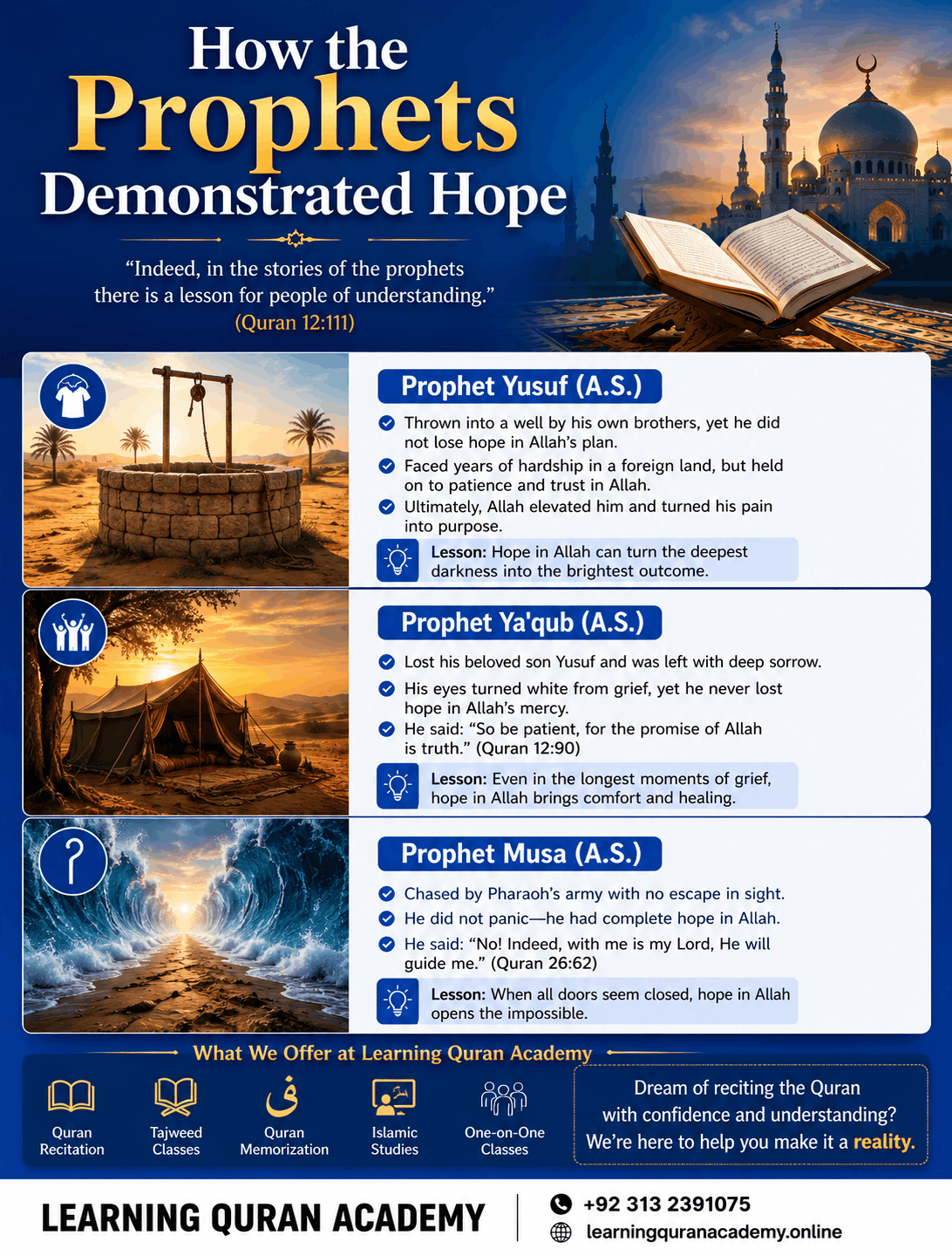
How the Prophets Demonstrated Hope
The Quranic stories of the prophets provide practical examples of faith during severe trials.
Prophet Yusuf (A.S.)
The story of Yusuf (A.S.) contains separation, betrayal, slavery, false accusation, and imprisonment. Yet Allah eventually gave him authority and reunited him with his family.
Allah says:
“Indeed, whoever fears Allah and is patient—then indeed, Allah does not allow to be lost the reward of those who do good.”
Quran, Surah Yusuf 12:90
The story teaches that a difficult chapter does not determine the final outcome of a believer’s life. Yusuf’s example combines taqwa, patience, forgiveness, and trust in Allah.
Prophet Ya'qub (A.S.)
When Ya’qub (A.S.) suffered the loss of Yusuf, he did not respond by abandoning faith. He expressed his grief while continuing to place his hope in Allah.
The Quran records his words:
“So patience is most fitting. And Allah is the One sought for help against that which you describe.”
Quran, Surah Yusuf 12:18
His example shows that sadness and hope can exist together. Being hopeful does not mean that a believer never feels pain.
Prophet Musa (A.S.)
When Musa (A.S.) and his people were pursued by Pharaoh’s army and appeared trapped, his companion expressed fear. Musa responded:
“No! Indeed, with me is my Lord; He will guide me.”
Quran, Surah Ash-Shu’ara 26:62
This is a powerful example of trusting Allah when circumstances appear impossible. Hope in Islam is therefore not based on having control over every situation. It is based on knowing that Allah’s knowledge and power are greater than ours.
Hope and Fear in Islam
Islam teaches a balance between hope and fear. A believer should hope in Allah’s mercy while remaining conscious of accountability.
Allah says:
“Inform My servants that I am indeed the Forgiving, the Merciful. And that My punishment is the painful punishment.”
Quran, Surah Al-Hijr 15:49–50
Hope encourages repentance, worship, and perseverance. Fear encourages accountability and helps prevent complacency.
These two qualities work together. Too much fear can lead a person toward despair, while careless hope can lead to neglecting repentance and obedience. Balanced faith allows a believer to remain hopeful without becoming careless.
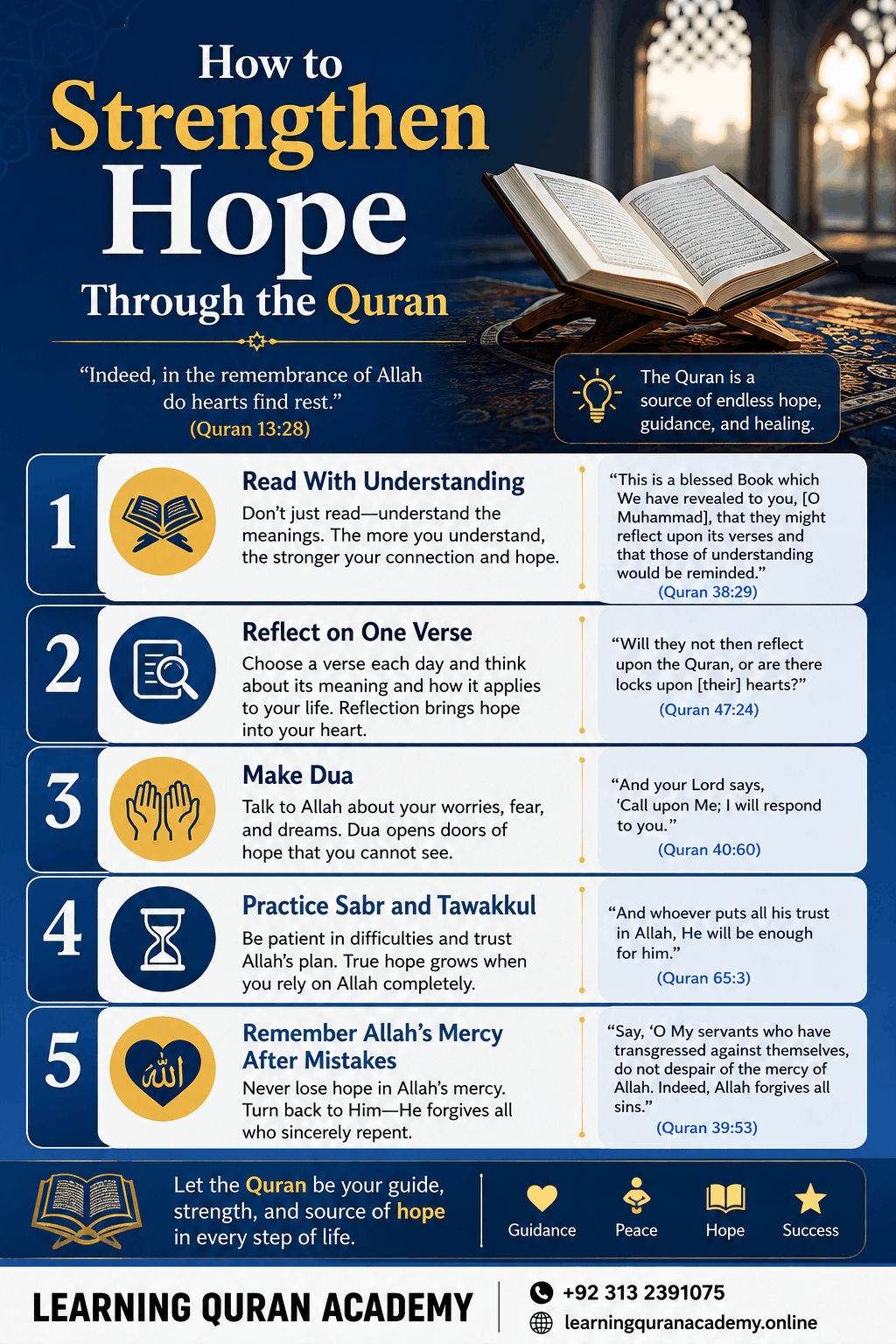
How to Strengthen Hope Through the Quran
Developing hope can become part of a daily Quran routine.
1. Read With Understanding
Do not limit yourself to recitation. Read the translation and, when possible, consult a reliable Tafsir to understand the context of the verses.
2. Reflect on One Verse
Choose one verse about Allah’s mercy, patience, repentance, or trust and think about how it applies to your current circumstances.
3. Make Dua
Turn the lessons of the Quran into personal supplication. Ask Allah for forgiveness, guidance, patience, and strength.
4. Practice Sabr and Tawakkul
Hope should lead to action. Continue doing what is right while trusting Allah with the outcome.
5. Remember Allah's Mercy After Mistakes
A mistake should become a reason to repent, not a reason to abandon worship. Surah Az-Zumar 39:53 provides a clear reminder that believers should not despair of Allah’s mercy.
What Quranic Hope Does Not Mean
Quranic hope is not the belief that every problem will immediately disappear or that every dua will be answered exactly as requested.
It also does not mean ignoring practical responsibilities.
A hopeful Muslim can:
- make dua while seeking practical solutions;
- feel sadness while remaining patient;
- acknowledge difficulty without despair;
- repent after sin;
- trust Allah while taking appropriate action.
This is the difference between genuine hope in Allah and simple wishful thinking.
Key Takeaways
The Quran teaches hope through Allah’s mercy, patience during hardship, repentance after mistakes, and trust in His wisdom.
The stories of Yusuf, Ya’qub, Ayyub, and Musa (peace be upon them) show that hardship can be faced with faith without denying the reality of pain.
The most important lessons are:
- Never despair of Allah’s mercy.
- Remain patient during hardship.
- Turn to Allah through dua.
- Learn from the Quran rather than relying only on emotion.
- Balance hope with accountability.
- Combine tawakkul with responsible action
Learn Quranic Guidance With Learning Quran Academy
At Learning Quran Academy, students can study the Quran with structured lessons designed to improve their understanding, recitation, and connection with Islamic teachings. If you want to explore Quranic guidance, Tafsir, Tajweed, or other Islamic studies in a structured learning environment, you can explore the academy’s available Quran courses and choose a program suited to your learning goals.