Table of Contents
ToggleBest Juz Amma Memorization Course Online
Juz Amma is the 30th and final juz of the Quran. It contains 37 surahs (Surah An-Naba to Surah An-Nas) and 564 verses, and it is where most students begin memorizing. The Learning Quran Academy Juz Amma Memorization Course helps children, adults, and beginners memorize all 37 surahs with one-to-one teachers, live Tajweed correction, and a daily revision system that keeps what you memorize.
Course at a glance
What you memorize: All 37 surahs of Juz Amma (564 verses)
Format: One-to-one live online classes
Who it is for: Children, adults, sisters, beginners
Prerequisite: Able to read Arabic (or complete Noorani Qaida first)
Session length: [30 / 45 / 60 minutes]
Classes per week: [5 to 6]
Typical duration: About 4 to 6 months at a steady pace
Tajweed correction: In every lesson
Free trial: [Yes ]
What Makes a Juz Amma Memorization Course Good?
Many academies call their course “the best”. Here is what to check before choosing any of them, including ours.
- Teacher qualifications. Look for a teacher with an ijazah or verified training in recitation, not just fluency.
- Tajweed correction during memorization. Fixing pronunciation after you have memorized a verse is much harder than getting it right the first time.
- A revision system. Most students forget because revision is missing, not because the lessons were too hard.
- A realistic timeline. Be careful with promises like “memorize Juz Amma in a week”. That would be about 80 new verses a day.
- One-to-one attention. A teacher who listens to you alone can catch small errors that a group class misses.
- Clear progress tracking. Reports, tests, and milestones show whether you are actually progressing.
- Transparent fees and policies. Price, schedule, missed-class, and trial policies should be easy to find.
- A trial class. You should be able to meet the teacher before you commit.

What You Will Memorize: Juz Amma at a Glance
- Starts with: Surah An-Naba (78)
- Ends with: Surah An-Nas (114)
- Surahs: 37
- Verses: 564 (Hafs ‘an ‘Asim count, standard Madinah Mushaf)
- Length: about 23 pages (pages 582 to 604)
- Longest surahs: An-Nazi’at (46 verses), Abasa (42), An-Naba (40)
- Shortest surahs: Al-Asr, Al-Kawthar, An-Nasr (3 verses each)
Juz Amma is not the “shortest” juz. It has the most surahs and verses of any juz. It feels short because most verses are brief.
Course Curriculum: Four Balanced Stages
Our course starts with the short surahs at the end of the Mushaf and moves backward toward the longer ones. We divide the juz into four stages so that each stage carries a manageable load.
Stage 1 (90 verses): An-Nas, Al-Falaq, Al-Ikhlas, Al-Masad, An-Nasr, Al-Kafirun, Al-Kawthar, Al-Ma’un, Quraysh, Al-Fil, Al-Humazah, Al-Asr, At-Takathur, Al-Qari’ah, Al-Adiyat.
Stage 2 (153 verses): Az-Zalzalah, Al-Bayyinah, Al-Qadr, Al-Alaq, At-Tin, Ash-Sharh, Ad-Duha, Al-Layl, Ash-Shams, Al-Balad, Al-Fajr.
Stage 3 (109 verses): Al-Ghashiyah, Al-A’la, At-Tariq, Al-Buruj, Al-Inshiqaq.
Stage 4 (212 verses): Al-Mutaffifin, Al-Infitar, At-Takwir, Abasa, An-Nazi’at, An-Naba.
Students who already know some surahs can be placed at the right point after the trial class.
How Each Lesson Works
A typical [45-minute] session follows the traditional three-part hifz structure:
- Sabqi / Manzil (10 minutes): recite the previous lesson and an older portion from memory.
- Correction and listening (10 minutes): the teacher corrects Makharij and Tajweed on the new portion.
- Sabaq, the new lesson (20 minutes): listen, repeat, and memorize the new verses with the teacher.
- Feedback (5 minutes): the teacher notes weak spots and sets the next target.
At home, the student listens to the new portion several times, recites it aloud, and does short daily revision
How Long Does It Take to Memorize Juz Amma?
The time depends on age, reading ability, Tajweed level, daily practice, and revision. Based on 564 verses, here is what different paces look like for new memorization only (revision time is extra):
- New verses per day: 3
Approximate time: about 6 months - New verses per day: 5
Approximate time: about 4 months - New verses per day: 8
Approximate time: about 2.5 months - New verses per day: 10
Approximate time: about 2 months
Most of our students work at [3 to 5] verses per class day, which puts a steady finish at about [4 to 6] months. Very fast schedules are possible only for confident readers with strong daily study time, and they still need revision.
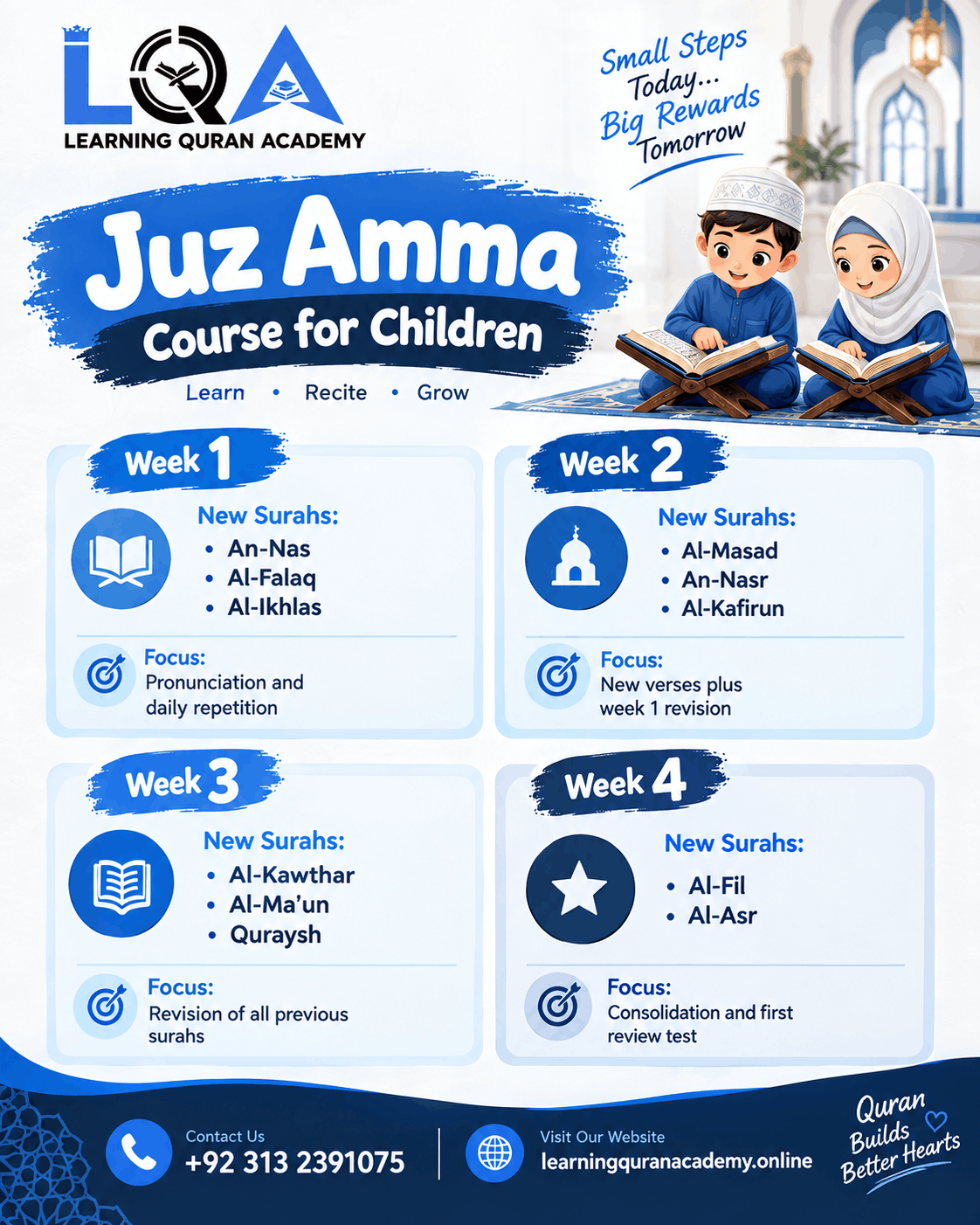
Juz Amma Course for Children
- Short sessions (15 to 25 minutes) with a listening-first approach.
- Small goals, such as one short surah per week in the early stages.
- Immediate correction of pronunciation.
- Regular revision and monthly parent updates.
Sample first four weeks for a beginner child:
- Week: 1
New surahs: An-Nas, Al-Falaq, Al-Ikhlas
Focus: Pronunciation and daily repetition - Week: 2
New surahs: Al-Masad, An-Nasr, Al-Kafirun
Focus: New verses plus week 1 revision - Week: 3
New surahs: Al-Kawthar, Al-Ma’un, Quraysh
Focus: Revision of all previous surahs - Week: 4
New surahs: Al-Fil, Al-Asr
Focus: Consolidation and first review test
Juz Amma Course for Adults
- A fixed 30 to 45 minute daily routine that fits work and family.
- Flexible morning, evening, and weekend timings [confirm].
- More weight on revision, since adults often memorize quickly but forget when life gets busy.
- Understanding of meaning to strengthen retention.
Juz Amma Course for Sisters
Our Juz Amma course is available for sisters who prefer to learn with a female Quran teacher. Classes are conducted online with a qualified female teacher who provides personalized Tajweed correction, memorization guidance, and regular revision support. Sisters can choose a suitable class schedule according to their availability and can request a female teacher when enrolling in the course.
Tajweed Is Built Into the Course
Memorizing an error makes it harder to fix later, so correction happens at the point of memorization. The rules that matter most in Juz Amma include:
- Makharij: correct articulation of letters.
- Madd: elongation.
- Ghunnah: the nasal sound on noon and meem.
- Qalqalah: the echo on ق ط ب ج د when they carry sukoon.
- Noon Sakinah and Tanween: Izhar, Idgham, Iqlab, Ikhfa.
- Meem Sakinah: its three rules.
- Waqf and Ibtida: where to stop and how to resume.
Many learners cannot hear their own mistakes, especially on letters that do not exist in their first language, which is why a qualified teacher matters.
How We Track Your Progress
- [Weekly / biweekly / monthly] written progress report.
- Recitation test after each stage.
- A checklist of memorized surahs.
- Parent or student feedback call
- Certificate on completion
Why Juz Amma Is a Good Place to Start Hifz
- Its surahs are short, so progress is visible quickly.
- Their rhythm and rhyme make them easier to retain.
- Many of them are recited in daily prayer, which gives natural revision.
- They contain the core beliefs of Islam in concentrated form.
Authentic narrations also highlight some of its surahs:
- The Prophet ﷺ said that Surah Al-Ikhlas equals a third of the Quran (Sahih al-Bukhari 5013).
- Aisha (may Allah be pleased with her) reported that at bedtime the Prophet ﷺ would recite Al-Ikhlas, Al-Falaq, and An-Nas, blow into his hands, and wipe over his body (Sahih al-Bukhari 5017).
- The Prophet ﷺ said that whoever reads a letter from the Book of Allah earns a good deed, and each good deed is multiplied tenfold (Sunan al-Tirmidhi 2910).
Self-Study vs Group Class vs One-to-One
| Self-study | Group class | One-to-one | |
|---|---|---|---|
| Tajweed correction | Rare | Limited | Constant |
| Pace fits you | Yes | No | Yes |
| Accountability | Low | Medium | High |
| Cost | Lowest | Lower | Higher |
| Best for | Confident readers | Budget-conscious | Beginners, children, and anyone who wants accuracy |
Common Mistakes When Memorizing Juz Amma
- Taking too much new material at once.
- Skipping revision.
- Ignoring Tajweed errors.
- Confusing similar verses across surahs.
- Relying only on listening and never reading the Mushaf.
- Not understanding the meaning.
- Studying at irregular times.
- Never testing yourself.
- Letting older lessons weaken while adding new ones.
How Parents Can Help
- Set a fixed daily time.
- Listen to your child recite each day, even if you cannot correct Tajweed.
- Encourage rather than pressure.
- Keep in touch with the teacher.
- Celebrate small milestones.