Table of Contents
ToggleDo you know the birth and death date of Prophet Muhammad
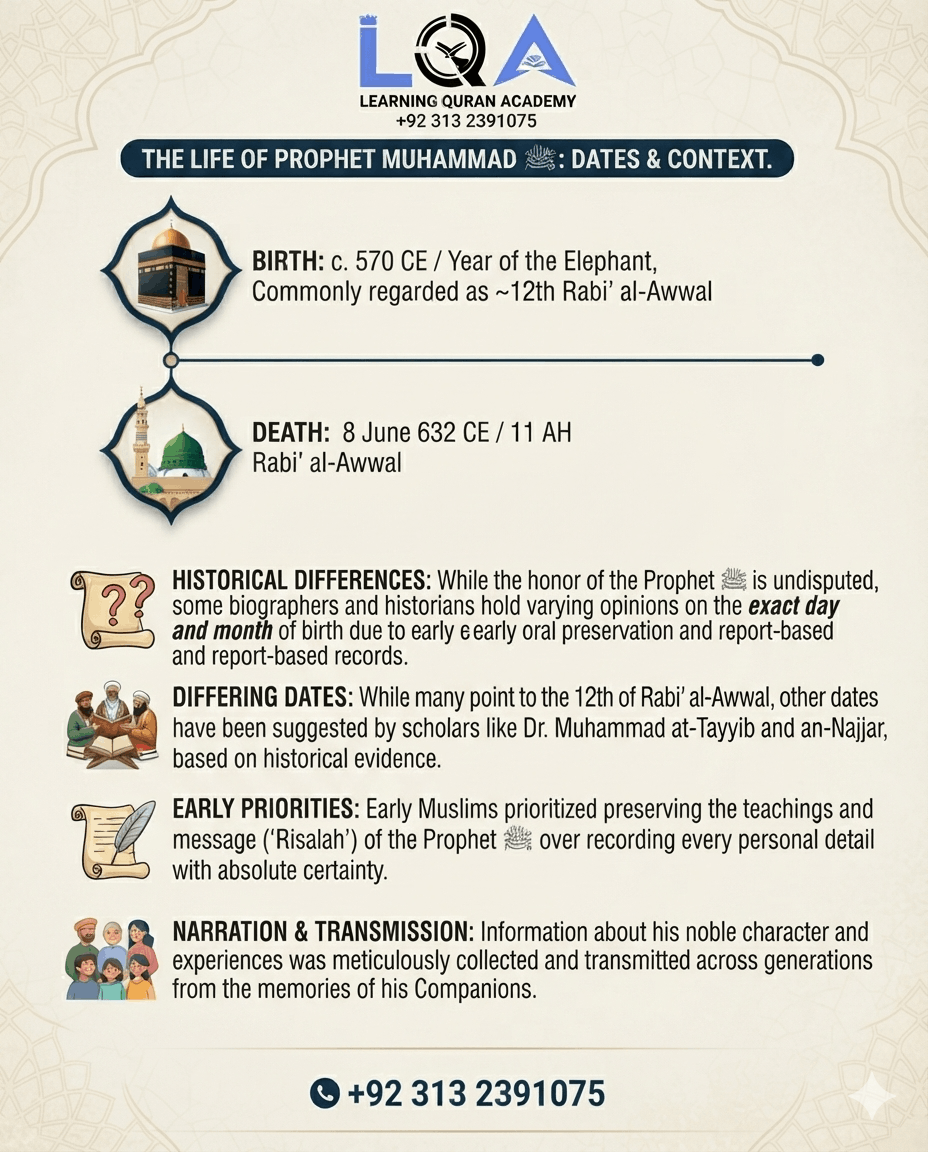
The birth and death date of Prophet Muhammad ﷺ are as follows:
Birth: Year 570 CE, month of Rabi’ al-Awwal (around 12th Rabi’ al-Awwal)
Death: 8 June 632 CE, month of Rabi’ al-Awwal, year 11 AH
Different Opinions on the Birth and Death Date of Prophet Muhammad Explained
The birth and death date of Prophet Muhammad are important parts of Islamic history, but some differences exist among biographers and historians regarding the exact day and month.
While Muslims agree on the honor and special status of the Prophet ﷺ, the exact date of his birth has different views because early historical records were preserved through narration and reports.
Birth of Prophet Muhammad
The birth of the Prophet Muhammad ﷺ is remembered as a moment of great blessing and mercy from Allah.
Many Muslims know that the Prophet ﷺ was born in Makkah during the Year of the Elephant, but there is some difference of opinion about the exact date.
Some scholars mention 12th Rabi al-Awwal, while others suggest different dates based on historical evidence.
These differences are not related to the importance of the Prophet’s ﷺ life or his role as the final Messenger.
Scholars such as Dr. Muhammad at-Tayyib and other researchers have studied the works of early writers, including an-Najjar, to understand the historical background and the reason behind the difference.
The early Muslims focused more on preserving the teachings and message of the Prophet ﷺ rather than recording every personal detail with complete certainty.
After the Prophet ﷺ began to convey the message of Islam, people started recording his actions, words, and events. At the age of forty years, he received revelation and guided people toward the worship of one Allah.
The memories of the Prophet’s ﷺ companions were carefully collected and transmitted across generations.
Many Companions narrated incidents they witnessed and shared details of his noble character, experiences, and important events.
These reports became a valuable source for understanding his story, life-story, and the information about the beginning of Islam.
Death of Prophet Muhammad
Death of Prophet Muhammad
The death or demise of Prophet Muhammad ﷺ marked the end of his earthly life, but his teachings and legacy continued to guide his followers.
The Prophet ﷺ passed away in Madinah after completing his mission and spreading the message of Islam.
The exact details of his passing, including his age and the historical period, are well recorded through Islamic sources.
Most scholars mention that he passed away at the age of sixty-three years. Historical biographers collected reports from the Prophet’s ﷺ companions, preserving memories, incidents, and experiences related to his final days.
The records, narrations, and documentation of this time help Muslims understand the Prophet’s ﷺ final moments and the continuation of his mission.
His story, teachings, and remembrance remain alive among Muslims, who continue to study his life story and follow his example.
Exact Year and Day of Prophet Muhammad’s Birth Revealed
The exact year and day of the birth of Prophet Muhammad ﷺ have been discussed by scholars and historians for centuries.
While studying this topic, I found that books such as As-Seerah an-Nabawiyyah by Ibn Kathir, Ar-Raheeq al-Makhtum by Safi ar-Rahman al-Mubarakfuri, and Nur al-Yaqeen mention different historical reports about the Prophet’s ﷺ birth.
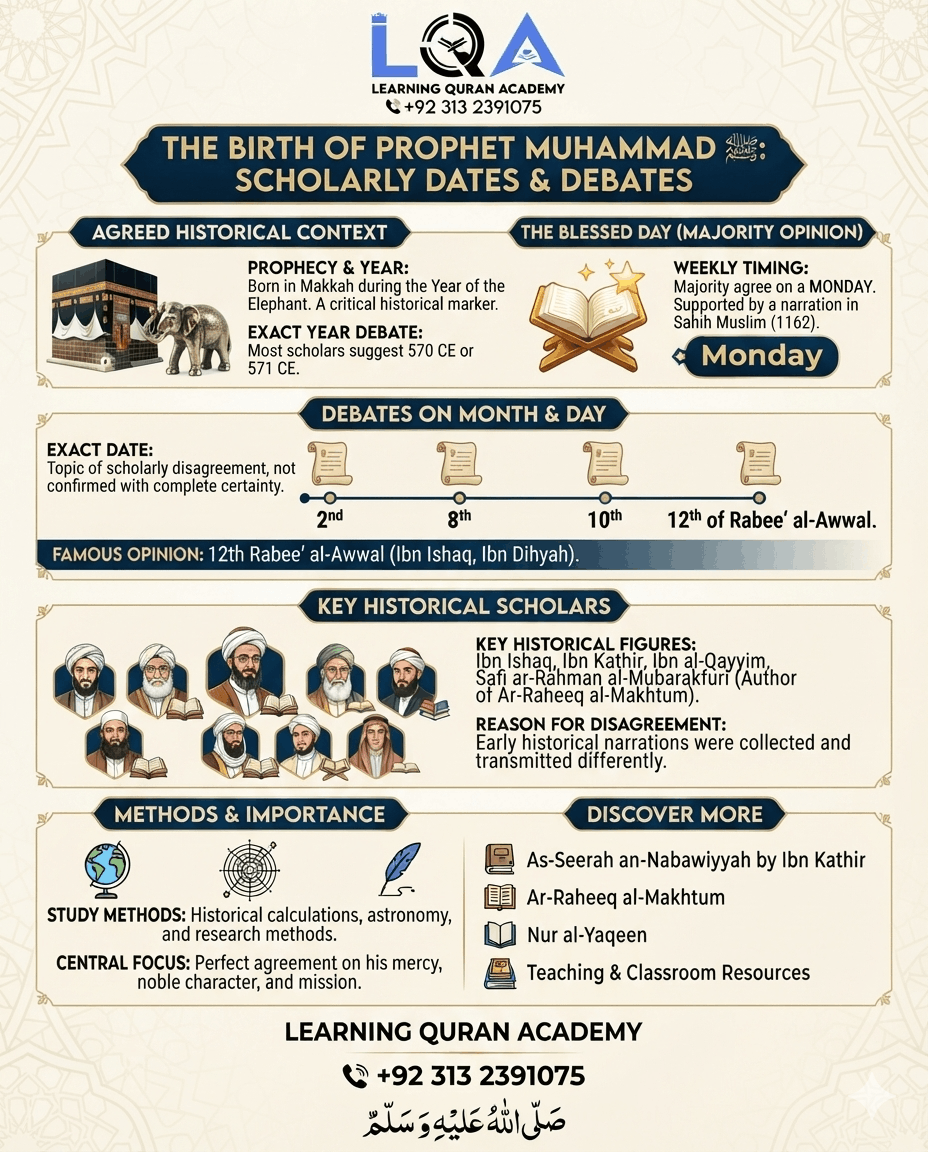
Most scholars agree that Prophet Muhammad ﷺ was born in Makkah during the Year of the Elephant. This event provides an important historical reference for his birth. However, researchers have different opinions about the exact year, with many suggesting 570 CE or 571 CE.
The majority of scholars agree that the Prophet ﷺ was born on a Monday. This is based on the narration of Abu Qatadah al-Ansari, where the Prophet ﷺ explained that Monday was the day of his birth. This narration is recorded in Sahih Muslim (1162).
Some historians, including Ibn Ishaq, Ibn Kathir, Ibn al-Qayyim, and other scholars, discussed various reports about the date. The differences mainly come from the way early historical narrations were collected and transmitted.
Debates on the Month and Day of Prophet Muhammad’s Birth
The exact month and day of Prophet Muhammad’s ﷺ birth remain a topic of scholarly disagreement. During my research, I found that different books mention several opinions. Some reports suggest the 2nd, 8th, 10th, or 12th of Rabee‘ al-Awwal.
The famous opinion among many Muslims is the 12th of Rabee‘ al-Awwal, based on reports from scholars such as Ibn Ishaq and Ibn Dihyah. However, other historians have preferred different dates after examining historical evidence.
Books like As-Seerah an-Nabawiyyah, Ar-Raheeq al-Makhtum, and Nur al-Yaqeen discuss these different views and explain that the exact date is not confirmed with complete certainty. Some scholars also used historical calculations, astronomy, and research methods to study the timeline.
Although there are differences about the exact date, Muslims have complete agreement that the arrival of Prophet Muhammad ﷺ was a great mercy and blessing from Allah. The main focus remains his noble character, his mission, and the guidance he brought for humanity.
When Did Prophet Muhammad Pass Away? Complete Details
While researching the death date of Prophet Muhammad ﷺ, I found that historians carefully studied different reports to understand this important moment.
The passing of the Prophet ﷺ was a deeply emotional event for Muslims, and scholars recorded every detail with great care.
The most accepted view is that Prophet Muhammad ﷺ passed away on a Monday in 11 AH, during the month of Rabee‘ al-Awwal.
Some reports, including those mentioned by Ibn Qutaybah, discuss the final days of the Prophet ﷺ and confirm that he was later buried in Madinah.
Although there are different narrations about the exact date, the fact of his passing in 11 AH is agreed upon by scholars.
Historical Views on the Death Date of Prophet Muhammad
During my research, I noticed that historians had different opinions about the exact date of the death of Prophet Muhammad ﷺ. The majority of scholars mention the 12th of Rabee‘ al-Awwal, while some historical reports suggest the 1st or 2nd of the month.
Scholars such as al-Khawarizmi, Ibn al-Kalbi, Abu Makhnaf, As-Suhayli, al-Hafiz Ibn Hajar, and Ibn Kathir discussed these narrations in their works. Books like Ar-Rawd al-Unuf, As-Seerah an-Nabawiyyah, and Fath al-Bari provide valuable references about this topic.
Reading these historical discussions, I found it interesting how scholars preserved even small details about the Prophet’s ﷺ final days. Their dedication shows the importance of protecting Islamic history and the memory of the Prophet’s ﷺ mercy and guidance.
Mawlid Celebration: Different Opinions Among Muslims
The topic of Mawlid is discussed differently among Muslims. Some people celebrate it as a cultural event to express their love for Prophet Muhammad ﷺ, while others focus more on following the practices of the early generations of Islam.
During my study, I learned that the main purpose should always remain respecting the Prophet’s ﷺ teachings, character, and message. Whether discussing his birth or death date, Muslims agree on his importance as a source of mercy, guidance, and inspiration.
The Prophet’s ﷺ life teaches values like justice, fairness, compassion, truthfulness, honesty, devotion to Allah, prayer, fasting, and good deeds. These teachings help Muslims reconnect with his example and apply his guidance in their daily lives.
12 Rabi al-Awwal 2026 Date and Expected Celebrations
Rabi’ al-Awwal is the third month of the Islamic lunar calendar. The exact date of 12 Rabi al-Awwal changes every year because the Islamic calendar depends on the sighting of the moon.
The 12th of Rabi’ al-Awwal in 2026 is expected to fall around 4 September 2025 in some calendar estimations, but the final date can vary depending on moon sighting and local announcements.
The Islamic lunar year is about 11 to 12 days shorter than the solar year, which is why Islamic dates move earlier each year on the Gregorian calendar.
Why 12 Rabi al-Awwal Is Important in Islam Today
The 12th Rabi’ al-Awwal holds special significance for many Muslims because it is commonly associated with the birth anniversary of Prophet Muhammad (SAW). Many Muslims remember this day as Mawlid un-Nabi or Eid Milad un-Nabi.
For many believers, this occasion is a time of:
- Expressing love and gratitude for Prophet Muhammad ﷺ.
- Reflecting on his life, teachings, and character.
- Learning about his mercy, patience, and guidance.
While researching this topic, I noticed that celebrations differ from place to place. Some of my friends celebrate this day by gathering with family, listening to Seerah talks, reciting poetry, sharing food, and remembering the teachings of the Prophet ﷺ.
How Muslims Celebrate 12 Rabi al-Awwal Around the World
Celebrations of Mawlid vary according to cultures and Islamic traditions. Some Muslims observe it quietly, while others arrange larger gatherings.
Common practices include:
- Reciting Quran and making dhikr (remembering Allah).
- Listening to talks about the Seerah and the role of Prophet Muhammad ﷺ.
- Reciting nasheeds and poetry about his noble character.
- Distributing food among family, friends, and the needy.
- Giving charity (sadaqah) and helping less fortunate people.
Different groups of Muslims have different views about Mawlid.
Some scholars consider it a way of showing love and remembrance, while others view it as an innovation (bid‘a) because it was not practiced by the earliest generations of Islam.
Sunni schools of law, Shia Muslims, Salafism, Deobandism, and Ahmadiyya communities may have different approaches toward this day.
Importance of Rabi al-Awwal and Its Spiritual Meaning
Rabi’ al-Awwal is important in Islam because it is connected with major events in the life of Prophet Muhammad (PBUH), including his birth and the Hijra (migration) to Medina.
The Hijra became a major turning point in Islamic history and the foundation of the Hijri calendar.
For Muslims worldwide, this month is a reminder to follow Islamic principles, strengthen faith, and reflect on the Prophet’s ﷺ teachings.
The true importance of this month is not only in gatherings but also in improving character, practicing kindness, and following the message of Islam in daily life.
Conclusion
The birth and death date of Prophet Muhammad holds immense historical and spiritual significance, marking key moments in Islamic history and faith.
Understanding these dates helps Muslims worldwide reflect on his life, teachings, and values of mercy, justice, and devotion.
Celebrations like Mawlid and remembrance practices are observed differently across cultures, emphasizing love and respect for the Prophet.
Learning Quran Academy for Spiritual Dev encourages believers to study these events deeply, connect with the Prophet’s legacy, and apply his guidance in daily life.