
Table of Contents
ToggleVirtues of Sayyidul Istighfar with Explanation
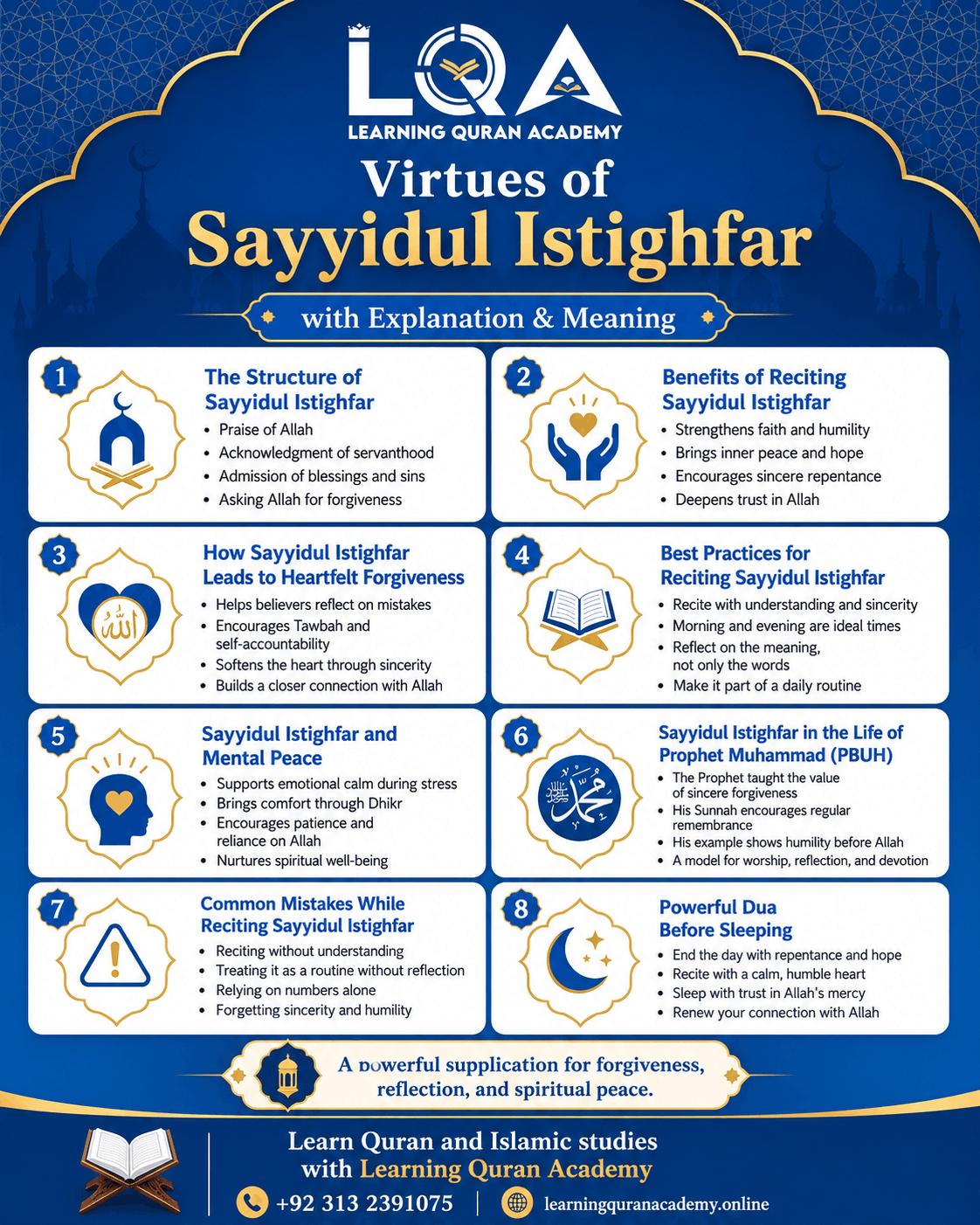
Virtues of Sayyidul Istighfar with Explanation are clearly seen through the deep meaning and powerful message of this blessed supplication.
Sayyidul Istighfar, also known as Syed ul Istighfar, is the Master of Istighfar Duas and a powerful Istighfar Dua taught by Prophet Muhammad ﷺ in the Sunnah.
It is a heartfelt Dua and Islamic supplication that guides a servant to turn towards Allah, the Rabb, with humility, submission, and sincere seeking forgiveness.
Its words reflect Tawheed, La ilaha illa Allah, and the believer’s complete trust in the mercy of Allah.
Through learning, understanding, and reciting it, Muslims experience the true virtues of Sayyidul Istighfar with explanation, strengthening their faith, spiritual awareness, and closeness with Allah.
Pronunciation
The Pronunciation of Sayyidul Istighfar helps Muslims perform accurate recitation and understand the correct transliteration of this blessed Dua.
I personally learned the proper way of reciting it from my teacher, who guided me in understanding the Arabic pronunciation, correct articulation, and proper phonetics.
Learning it with the guidance of an experienced teacher helped me improve my Dua recitation and develop more confidence in fluent Islamic recitation.
Sayyidul Istighfar (Arabic with Breaks for Pronunciation)
- اللَّهُمَّ أَنْتَ رَبِّي
- Allahumma anta Rabbi
- لَا إِلٰهَ إِلَّا أَنْتَ
- La ilaha illa anta
- خَلَقْتَنِي
- Khalaqtani
- وَأَنَا عَبْدُكَ
- Wa ana abduka
- وَأَنَا عَلَىٰ عَهْدِكَ وَوَعْدِكَ
- Wa ana ala ahdika wa wa‘dika
- مَا اسْتَطَعْتُ
- Mastata‘tu
- أَعُوذُ بِكَ
- A‘udhu bika
- مِنْ شَرِّ مَا صَنَعْتُ
- Min sharri ma sana‘tu
- أَبُوءُ لَكَ
- Abu’u laka
- بِنِعْمَتِكَ عَلَيَّ
- Bini‘matika alayya
- وَأَبُوءُ بِذَنْبِي
- Wa abu’u bidhanbi
- فَاغْفِرْ لِي
- Faghfir li
- فَإِنَّهُ لَا يَغْفِرُ الذُّنُوبَ إِلَّا أَنْتَ
- Fa innahu la yaghfiruz-zunuba illa anta
virtues of sayyidul istighfar with explanation & Meaning
During my study and reflection on the Meaning and English translation of Sayyidul Istighfar, I found that its words beautifully describe a believer’s connection with Allah, the Lord, and Creator.
While studying this Dua, I realized that it is not just a request for forgiveness but a complete expression of worship, where the servant accepts the covenant, promise, and obedience owed to Allah.
A deeper review of its meaning shows how confession of sins, acknowledgment of blessings, and seeking forgiveness lead a person to ask Allah for pardon, as none can forgive sins except Allah.
The Structure of Sayyidul Istighfar
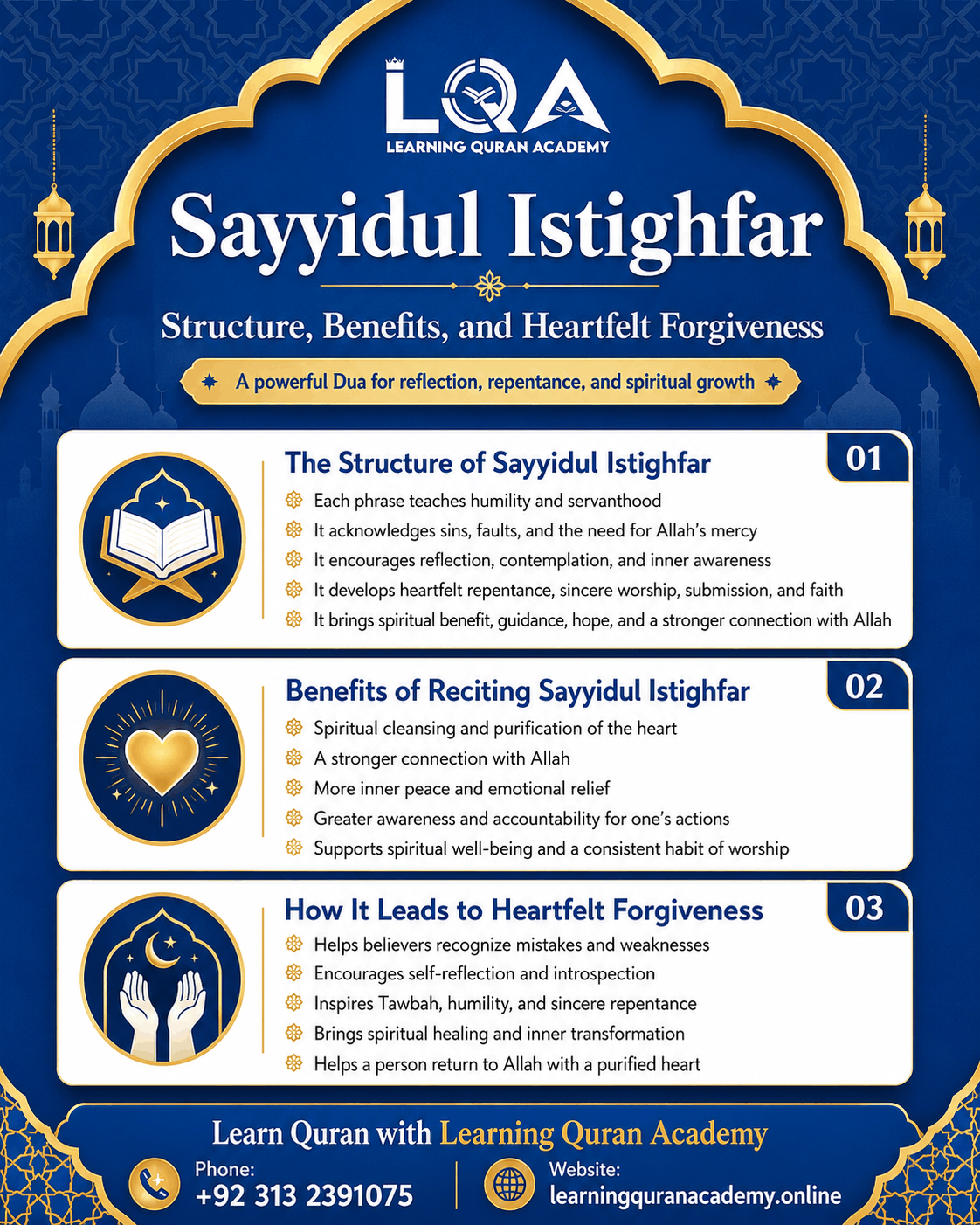
The Structure of Sayyidul Istighfar became clearer to me when I learned its meaning and explanation from my teacher.
He taught me how each phrase of the Dua carries a lesson of humility, acknowledgment of sins, and a sincere plea for forgiveness.
During my study, I understood that this Dua helps a believer recognize their faults, shortcomings, and the need for Allah’s mercy.
My teacher explained how its deep meaning encourages reflection, contemplation, and inner awareness.
Through mindful recitation and spiritual understanding, I learned that Sayyidul Istighfar develops heartfelt repentance, sincere worship, submission, and faith.
Its recitation brings spiritual benefit, guidance, hope in Allah, and a stronger connection with Allah according to Islamic teachings.
Benefits of Reciting Sayyidul Istighfar
The Benefits of Reciting Sayyidul Istighfar became more meaningful when my friend shared his experience after learning it from the Imam of his mosque. He mentioned that when he started reciting it regularly, he felt a positive change in his heart and daily life.
Through this practice, he experienced:
- Spiritual cleansing and purification of the heart
- A stronger connection with Allah
- More inner peace and emotional relief
- Greater awareness and accountability for his actions
Through sincere recitation and remembrance of Allah or Dhikr, he felt spiritual growth and a deeper relationship with Allah. This experience showed him how Sayyidul Istighfar can support spiritual well-being, Islamic spirituality, and the development of a consistent habit of worship.
How Sayyidul Istighfar Leads to Heartfelt Forgiveness
Sayyidul Istighfar guides a believer toward heartfelt forgiveness by encouraging recognizing mistakes, self-reflection, and introspection.
A beautiful example can be found in the life of righteous people who always turned to Allah with humility and sincere repentance.
It is mentioned about many pious servants of Allah that they would constantly seek forgiveness, recognize their weaknesses, and depend on Allah’s mercy.
Their sincere remorse and regret became a means of spiritual healing and inner transformation.
Through Tawbah, reflection, and self-accountability, they developed strong faith, humility, and a deep connection with Allah.
Such experiences remind believers that sincere Istighfar can bring emotional peace, spiritual growth, and help a person return to Allah with a purified heart.
Best Practices for Reciting Sayyidul Istighfar
Following the best practices for reciting Sayyidul Istighfar becomes easier when we look at how Prophet Muhammad (PBUH) taught his companions the importance of sincere remembrance and seeking forgiveness.
The Prophet ﷺ guided the Sahabah to remember Allah regularly, especially during morning and evening times, with focus, humility, and sincerity.
The companions learned not only the words of the Dua but also the feeling and purpose behind it.
They experienced that consistent remembrance of Allah brought peace to their hearts, strengthened their faith, and increased their connection with Allah
By following the Sunnah of the Prophet ﷺ, they developed a balanced habit of worship, reflection, and mindful recitation that continued to guide their lives.

Sayyidul Istighfar and Mental Peace
Reciting Sayyidul Istighfar with understanding can become a source of mental peace for many believers.
I once heard a doctor share the experience of his patient who was going through a difficult phase filled with stress, worries, and emotional burdens.
The patient was advised to strengthen his connection with Allah through sincere Dua and remembrance.
After making Sayyidul Istighfar part of his daily routine, he felt a gradual change in his emotional state. The doctor explained that this simple yet powerful practice brought several life-changing benefits:
- Inner calm – reduced anxiety and a noticeable sense of peace during stressful moments
- Renewed hope – a shift from hopelessness to optimism about the future
- Emotional comfort – relief from the emotional burdens he had been carrying
- Stronger patience (Sabr) – better ability to handle difficult situations without breaking down
- Deeper trust in Allah (Tawakkul) – a growing reliance on Allah’s plan instead of constant worry
- Spiritual connection – a closer bond with Allah through consistent Dhikr and remembrance
The doctor concluded that this practice did not only bring emotional relief but also helped the patient build a lasting foundation of faith, resilience, and inner peace.
Sayyidul Istighfar in the Life of Prophet Muhammad (PBUH)
The example of Prophet Muhammad (PBUH) highlights the importance of Sayyidul Istighfar, frequent recitation, and sincere humility before Allah.
His life teaches believers the beauty of seeking forgiveness, relying on Allah’s mercy, and following a path of a righteous and faithful life.
The Sunnah of the Prophet remains a guiding role model that reflects the following essential qualities:
- Consistency in Istighfar – seeking forgiveness regularly, even as the most beloved and sinless of Allah’s creation
- Humility before Allah – recognizing human limitations and turning to Allah with a humble heart
- Patience (Sabr) – enduring hardships with steadfastness and trust in Allah’s wisdom
- Reflection (Tafakkur) – taking time to ponder over one’s actions and seek self-improvement
- Spiritual awareness – staying mindful of Allah’s presence in every aspect of daily life
- Mercy and compassion – extending kindness to others as a reflection of Allah’s mercy
By following these lessons, Muslims can build spiritual discipline, strengthen their worship, and maintain devotion in both traditional practices and the challenges of modern life.
This connection with Allah encourages consistency, spirituality, mercy, faith, and a deeper commitment to Islamic practice helping believers navigate life with a stronger, more grounded sense of purpose.
Common Mistakes While Reciting Sayyidul Istighfar
Many Muslims recite Sayyidul Istighfar regularly, but avoiding common mistakes can help increase its benefit.
One major issue is reciting without understanding, where the words are repeated without proper comprehension or awareness of their meaning.
A mechanical recitation may reduce the feeling of a true connection with Allah.
Key mistakes to avoid:
- Reciting without understanding – repeating words mechanically without grasping their meaning
- Losing focus – reciting in a rush without proper Dua etiquette
- Treating it as mere repetition – forgetting that it’s a heartfelt supplication filled with sincerity, hope, and seeking Allah’s mercy and forgiveness
- Prioritizing quantity over quality – rushing through the Dua instead of reflecting deeply
Practicing meaningful recitation, maintaining focus, and applying proper Dua etiquette helps develop deeper reflection, sincere worship, repentance, and spiritual awareness.
The aim should always be quality over quantity with a genuine heart.
Tips to Make Your Recitation More Impactful
To achieve impactful recitation, Muslims can focus on the following practices:
- Understanding the words – knowing the meaning behind each phrase
- Practicing visualization – imagining Allah’s mercy and presence while reciting
- Making time for reflection – pausing to contemplate Allah’s presence
- Reciting with sincere intention – seeking mercy to create a stronger spiritual connection
- Including it in daily prayers – especially during Salah, to strengthen faith
- Maintaining consistency – building awareness of blessings through regular practice
A heartfelt Dua with mindful worship supports spiritual growth through the remembrance of Allah and Dhikr.
With sincerity and dedication to daily worship, this practice becomes a meaningful part of a believer’s relationship with Allah.
Benefits of Sayyidul Istighfar
The benefits of Sayyidul Istighfar become clearer when a believer recites it with understanding and reflection.
In my experience of studying Islamic supplications, I have found that this Istighfar Dua is not only a request for forgiveness but also a spiritual mirror that helps a person recognize their weaknesses and turn back to Allah with humility.
Known for the power of Sayyidul Istighfar and the importance of Sayyidul Istighfar, it supports:
- Spiritual depth – a deeper understanding of one’s relationship with Allah
- Spiritual growth – continuous development of faith and character
- Spiritual healing – emotional and spiritual recovery through sincere Dua
- Heart purification and heart reform – through regular Dhikr and remembrance of Allah
- Greater self-awareness – recognizing one’s actions and shortcomings
Making it part of daily Dhikr, morning Adhkar, evening Adhkar, after Fajr prayer, or after Maghrib creates a meaningful habit of worship and reflection.
I have personally noticed that keeping a regular reminder for this Dua, whether through a written note or daily routine, helps maintain consistency and encourages deeper contemplation.
According to Sahih al-Bukhari and authentic Hadith, Sayyidul Istighfar holds a special position among acts of seeking forgiveness. Many scholars explain its value through Islamic guidance and Islamic teachings, highlighting:
- Comprehensive forgiveness – seeking pardon for all shortcomings
- Spiritual accountability – acknowledging one’s actions before Allah
- Hope in Allah’s mercy – maintaining trust even while facing the reality of the human condition
- Gratitude and acknowledgment – recognizing Allah’s blessings alongside seeking repentance
Powerful Dua Before Sleeping
Reciting Sayyidul Istighfar before sleeping as a bedtime Dua can become a peaceful way to end the day.
From my own reflection on daily Islamic practices, I have found that making this Dua part of a night routine helps create a feeling of closeness with Allah and encourages honest self-review.
This Powerful Dua Before Sleeping supports:
- Emotional well-being – a calmer state of mind before rest
- Reduced anxiety – easing worries accumulated throughout the day
- Release of guilt – through sincere repentance and Tawbah
- Comfort during spiritual disconnection – restoring closeness with Allah
- Mindfulness and spiritual self-care – building emotional balance through remembering Allah, the Most Merciful
Including Sayyidul Istighfar in daily supplication, Salah, Dua sessions, and family learning activities supports Islamic education and a strong habit of worship.
Learning the Dua, improving recitation, and trying to memorize Sayyidul Istighfar and recite Sayyidul Istighfar with understanding strengthens:
- Trust in Allah and reliance on His plan
- Mercy of Allah and divine mercy in daily life
- Awareness of forgiveness in Islam as an ongoing journey
- Spiritual reflection, hope, faith, and Iman
- Sincere repentance, Tawbah, and seeking Allah’s pardon
Conclusion
Sayyidul Istighfar is a beautiful Dua that combines humility, repentance, gratitude, and complete trust in Allah.
Through its meaning, pronunciation, structure, and regular recitation, a believer learns to recognize mistakes, seek forgiveness, and strengthen their connection with Allah.
My study and experiences with teachers, friends, and sincere worshippers showed me that this Dua is not only words to recite but a path toward spiritual growth, inner peace, and heartfelt repentance.
By making Sayyidul Istighfar part of daily life, Muslims can develop a stronger relationship with Allah, increase faith, and continuously return to Him with hope and sincerity.